Biological Chemistry - Berezov T. T., Korovkin B. F. 1998
Lipid Metabolism
Phospholipid Metabolism
Degradation and Turnover of Phospholipids
It is well known that protein molecules undergo complete degradation in Tissues. Therefore, a turnover rate can be determined for protein molecules. Phospholipids also actively break down in tissues, but the turnover rate varies for different PARTS OF THE molecule. For example, the turnover time of the phosphate group differs from that of the 1-acyl group. This is due to the presence of Enzymes that catalyze the partial Hydrolysis of phospholipids, which can be followed by their resynthesis (Fig. 11.7).
Unfortunately, comprehensive data on the phospholipase profile of various tissues are currently lacking. It is well established that phospholipase A1 attacks the ester bond of phospholipids at position 1. Phospholipase A2 catalyzes the hydrolysis of the ester bond at position 2 of Glycerophospholipids, yielding a free Fatty acid and a lysophospholipid (lysolecithin in the case of phosphatidylcholine), which is then re-acylated by acyl-CoA in the presence of acyltransferase.
Phospholipase C attacks the ester bond at position 3, resulting in The formation of a 1,2-diglyceride and a phosphoryl base.
Phospholipase D catalyzes the Cleavage of the nitrogenous base from the phospholipid. For a long time, it was believed that phospholipase D was exclusively present
Class="center">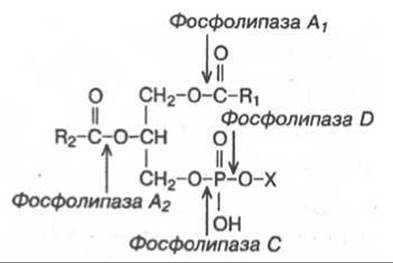
Fig. 11.7. Hydrolytic cleavage of specific phospholipid bonds by phospholipases.
in plant tissues. Recently, it has been detected in the soluble fraction of rat Brain, subsequently in brain and other organ microsomes, and most recently in rat Liver Cell/35.html">Mitochondria.
The status of phospholipase B remains unclear. It may represent a mixture of enzymes possessing The properties of both phospholipase A1 and A2. Alternatively, phospholipase B could be an enzyme specific for lysophospholipids (e.g., lysolecithin), functioning essentially as a lysophospholipase.
Last update: 06/08/2026
Editorial and Educational Adaptation: This material has been compiled based on the primary/original source text. The project team performed an editorial review, corrected technical inaccuracies, structured sections, and adapted the content for an educational format.
What was processed:
- elimination of formatting defects (OCR errors, structural breaks, corrupted characters);
- editorial organization of content;
- standardization of terminology in accordance with academic sources;
- verification of factual statements against the original source text.
All mentions of the author, publication year, and origin of the primary text have been preserved in accordance with the source.