Protein Chemistry - Part 1 - General Protein Chemistry - Ashmarin, I. P. 1968
Protein Electrochemistry. Protein-Water Interactions
Amino Acids as Dipoles. Ionization of Amino Acids
Amino Acids are amphoteric electrolytes containing both amino and carboxyl groups. Due to this property, they can form salts with both acids and bases. In aqueous solutions, they may exist either as neutral molecules, H2N—R—COOH, or as dipolar ions, H3N—R—COO-. Which of these two forms corresponds to reality remained unknown for a long time. Meanwhile, establishing the true Structure of Amino acids was of great importance both for understanding the mechanisms of their interaction with acids and alkalis and for determining the dissociation constants of their carboxyl and amino groups.
The hypothesis of the dipolar structure of amino acids was first proposed in 1916 by Adams and, slightly later, by Bjerrum. This assumption could not be tested directly by measuring the electrical conductivity of their solutions because, at neutral pH, amino acid molecules do not migrate in an electric field. Evidence for the dipolar structure of amino acids was obtained through studies of the Dielectric Constant of their solutions, The phenomenon of electrostriction, and the determination of ionization constants and heats of ionization.
It is well known that dissolving non-polar compounds in Water decreases its dielectric constant. When amino acids are dissolved, however, it increases, with this increase (the dielectric increment) reaching 23–35%. Such an increase can only be explained by the dipolar structure of amino acid molecules. This Conclusion is strongly supported by electrostriction—namely, the significant decrease in the partial molal volume (see § 5) of amino acids compared to the volume of an uncharged isomeric molecule. The volume reduction reaches about 13 cm3/mol when the amino group is in the α-position relative to the carboxyl, and 15 cm3/mol when it is in the β-position. The phenomenon of electrostriction is caused by the orientation and tight packing of water molecules around the ionic groups of Amino Acids and is accompanied by a decrease in the heat capacity and compressibility of zwitterionic solutions.
Substantial confirmation of the dipolar structure of amino acids came from determining the heats of ionization of their carboxyl and amino groups. Recall that the heat of ionization is defined as the number of calories per mole absorbed during an ionization reaction under constant Temperature and pressure. Corresponding measurements revealed that the heat of ionization of amino acids in acidic solutions averaged about 0.5 kcal/mol, and in alkaline solutions, about 11–12 kcal/mol. These values are very close to the heats of ionization of aliphatic carboxylic acids and amines (averaging 1 kcal/mol and 12 kcal/mol, respectively) and indicate that acid reacts with the carboxyl groups of amino acids, while alkali reacts with their basic groups.
Thus, hydrogen ions react not with the H2N group converting it into the  group, but with the COO- group. Conversely, hydroxyl ions react not with the carboxyl group, but with the
  group.
Class="center">
As a result, amino acids exist as cations in an acidic environment and as anions in an alkaline environment.
The fact that solid amino acids also likely exist in the dipolar form is evidenced by their high density and high melting points. Both of these properties point to strong electrostatic attraction between the oppositely charged ionized groups of adjacent molecules, making them significantly harder to separate than adjacent neutral molecules.
The new Concept of the dipolar structure of amino acids made it possible to correctly calculate the dissociation constants of their acidic and basic groups. Calculations based on older equations yielded values that differed significantly from the dissociation constants of aliphatic carboxylic acids and amines. For instance, the dissociation constant for the acidic groups was calculated to be ~10-9 and for the amino group ~10-11, whereas for acetic acid it is 1.8 × 10⁻⁵ and for ethylamine 1.2 × 10⁻¹³. These discrepancies are resolved by adopting the dipolar structure for amino acids.
Before proceeding to the dissociation of the acidic and basic groups of amino acids, we must briefly review Brønsted's theory of acids and bases and METABOLISM/2.html">THE CONCEPT OF the dissociation constant. According to Brønsted, an acid is any substance capable of donating a proton, and a base is any substance capable of accepting one. From this perspective, The ionization of a simple acid and its dissociation constant can be expressed as follows:
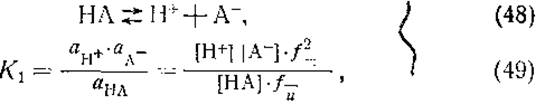
where HA is the acid, A- is the base, K1 is the acid dissociation constant, a are activities,  are the activity coefficients of the ions, and
  is the activity coefficient of the undissociated acid. In the case of dilute solutions, activity coefficients are close to unity, and the activities of the acid, base, and hydrogen ions are replaced by their molar concentrations. Taking the logarithm of both sides of equation (49), we obtain

where pH = −lg [H+] and pK1 = −lgK1.
At thermodynamic equilibrium, the concentrations of both forms of a weak acid will be equal—that is, the concentration of the proton donor HA will equal the concentration of the proton acceptor A-. Under these conditions, the acid dissociation constant will equal the hydrogen ion concentration, which serves as a measure of acid dissociation, and the pK1 value will correspondingly equal the pH of the solution:

In other words, the acid dissociation constant indicates the proton concentration at which The ratio of the concentrations of both forms of the acid is equal to one; that is, pK1 equals the pH at which 50% of the acid is in the dissociated form and 50% in the undissociated form.
When viewing amino acids through the lens of Brønsted's theory, the COOH and H3N groups should be considered acids, while the COO- and H2N groups should be considered bases. Accordingly, the ionization of the carboxyl and amino groups and their dissociation constants (K1 and K2) can be expressed by the following equations:

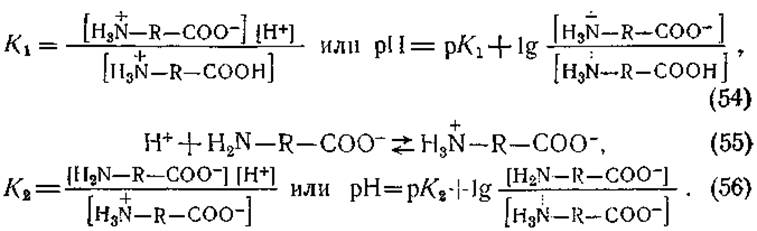
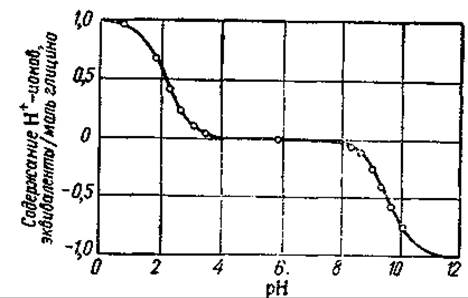
Fig. 42. Dissociation curve of Glycine (after Meister, 1961).
Based on the foregoing, we can conclude that the dissociation constants K1 or K2 (expressed as pK1 or pK2 values) are numerically equal to the hydrogen ion concentration (pH values) at which the ratio


equals one, i. e.
50% of The amino acid exists as zwitterions, and 50% as cations or anions. For the bulk of amino acids, The values of K1 and K2 calculated from equations (53) — (56) were found to be approximately 10-2—10-3 and 10-9—10-10, respectively (pK1 is approximately 2—3 and pK2 is 9—10). The higher values of K1 compared to the ionization constant of acetic acid (1.8∙10-5) are due to the presence of the NH3 group, which enhances the ionization of the carboxyl group. The exact values of these constants, as well as the dissociation constants of side groups (pK3), are given in Table 6. The values of pK1 and pK2 can be determined using electrometric titration. The titration curve of glycine with Hydrochloric acid and sodium hydroxide is shown in Fig. 42. It can be seen that at the point corresponding to pH 2.34, one molecule of the acid releases 0.5 equivalent of hydrogen ions. Consequently, at this point, we have 50% of the amino acid as a zwitterion and 50% as a cation, and pK1 for glycine is 2.34. At the point corresponding to pH 9.6, the amino acid takes up 0.5 equivalent of H+ ions; here, 50% of the amino acid is in the anionic form (NH2—R—COO-) and 50% is in the zwitterionic form, i. e., pK2 = 9.6. Thus, the pK values will equal the pH value on the titration curve that corresponds to 0.5 equivalent of acid or alkali bound by one amino acid molecule.
Table 6 Dissociation constants and isoelectric point values of Amino Acids Commonly Found in Proteins

The dissociation curves of amino acids whose molecules contain more than two dissociating groups exhibit additional inflection points. For example, Histidine shows inflections not only at pH 1.82 (pK1) and pH 9.17 (pK2), but also at pH 6.0 (pK3, imidazole group).
The isoelectric point (pI) of an amino acid is defined as the pH value at which the molecule is electrically neutral and does not migrate in an electric field. The isoelectric point for Monoaminomonocarboxylic Acids can be found by dividing the sum of pK1 and pK2 by 2. If the degree of ionization of the carboxyl and amino groups were equal, the isoelectric point of monoaminomonocarboxylic amino acids would lie in a neutral medium. However, since the ionization of the carboxyl group is higher than that of the amino group, these acids are weakly acidic substances with an isoelectric point around pH 6.0. For dicarboxylic acids and diamino acids, the isoelectric points lie in acidic and alkaline media, respectively; exact pI values for individual amino acids are given in Table 6.
Last update: 06/08/2026
Editorial and Educational Adaptation: This material has been compiled based on the primary/original source text. The project team performed an editorial review, corrected technical inaccuracies, structured sections, and adapted the content for an educational format.
What was processed:
- elimination of formatting defects (OCR errors, structural breaks, corrupted characters);
- editorial organization of content;
- standardization of terminology in accordance with academic sources;
- verification of factual statements against the original source text.
All mentions of the author, publication year, and origin of the primary text have been preserved in accordance with the source.