Protein Chemistry - Part 1 - General Protein Chemistry - Ashmarin I. P. 1968
Introduction
Definition of the concept "protein". Distinctive features of the composition, structure, and properties of proteins
The composition, Structure, and Functions of Proteins are so complex that even at the current level of biochemistry, a precise Definition of the term "protein" presents certain difficulties. These difficulties, along with the rationale for a correct definition, will become clear through a consistent examination of the principal Features of protein composition, structure, and functions.
The most characteristic feature of the Elemental Composition of proteins is the presence of a relatively constant proportion of nitrogen. In most cases, its content ranges from 15—18% (averaging 16%) of the dry weight. The relative constancy of this parameter makes it useful for quantitative protein determinations (The amount of nitrogen found upon analysis is usually multiplied by a factor of 6.25). However, A number of proteins exhibit very significant deviations from the average nitrogen content. For example, in protamines—the proteins found in fish sperm—the nitrogen content reaches 30%.
The typical fluctuation limits for other essential protein elements are 51—55% for carbon, 21—23% for oxygen, 6—7% for hydrogen, and 0.3—2.5% for sulfur, although there are occasional exceptions (for instance, in certain Histones—Cell Nucleus proteins). Overall, the elemental composition, when considered independently of other characteristic features, does not allow for a reliable distinction between proteins and a number of other nitrogen-containing compounds of biological origin.
Amino Acids are obligatory components of proteins, specifically those belonging to the L-series rather than the D-series. However, proteins cannot be defined simply as compounds of amino acids, as this would not distinguish them from Polypeptides and certain Other Compounds that also contain amino acids. A characteristic feature is the primary type of bond between amino acids in a protein: the peptide bond. Yet, even this characteristic does not allow proteins to be distinguished from Peptides.
A crucial characteristic of proteins is their relatively high molecular weight—ranging from 4–5 thousand to many millions. Below are data on the Molecular Weight of certain proteins:
Class="center">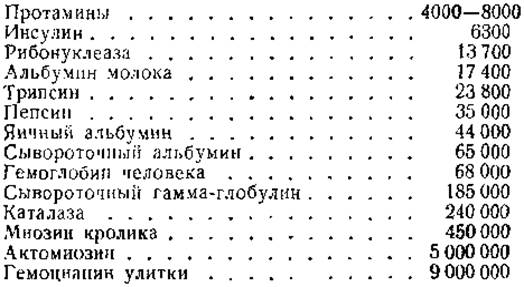
This factor largely distinguishes them from natural polypeptides, which rarely have a molecular weight exceeding 1,000. It is true that the polypeptide Glucagon, isolated from the Pancreas, has a molecular weight of around 4,000, and certain polypeptides of extremely simple composition (such as polymers of D-glutamic acid) found in Bacteria like Bacillus megaterium and hay bacillus have a molecular weight around 50,000. On the other hand, the molecular weight of some artificially synthesized polypeptides reaches hundreds of thousands, although they cannot be classified as proteins.* Thus, a high molecular weight is a very important and characteristic feature, but it remains insufficient to strictly differentiate proteins from natural and artificial polypeptides.
* It should also be noted that a number of authors consider it incorrect to classify certain relatively simply structured Fibrillar Proteins (e.g., from Connective Tissue) as true proteins, suggesting they be segregated into a transitional group of intermediate complexity known as proteinoids.
Most known proteins consist of more than one polypeptide chain. However, this criterion is clearly unsuitable as a distinguishing feature, since many typical proteins are known to consist of a single polypeptide chain (Myoglobin, Ribonuclease, Trypsin, etc.).
One of the unique Properties of Proteins is their capacity for Denaturation—the loss of certain characteristic physicochemical and biological properties under mild conditions that do not disrupt The system of peptide bonds. It should be noted, however, that numerous proteins exhibit a very high resistance to denaturation, such as the proteins of thermophilic bacteria, trypsin, Chymotrypsin, and many others. It appears more accurate to view denaturation as a manifestation of a more general property of proteins. Specifically, all proteins are characterized by the ability—not only during denaturation, but also when native proteins perform their functions within a living Organism—to undergo substantial changes in their physicochemical and biological properties without a simultaneous change in composition and without the Cleavage of peptide bonds within the molecule. Examples include the superprecipitation of Actomyosin under METABOLISM/18.html">The Influence of ATP, sharp changes in enzyme activity driven by minor environmental shifts, and many others. This general property of proteins must undoubtedly be recognized as their characteristic distinction.
Particular emphasis should be placed on a vital functional characteristic of a significant portion of proteins: they serve as the primary, if not the sole, catalysts for all Chemical Reactions in the living organism.
Special attention is also frequently drawn to the fact that proteins are, on average, the quantitatively predominant components of living organisms (Table 1). For example, in human Tissues, proteins account for about 45% of the dry tissue weight. However, one can cite numerous organisms and tissues in which the protein fraction is relatively very small (1–4%), though this, of course, does not warrant the Conclusion that proteins play a minor role in these objects.
Finally, the definition of a "protein" sometimes relies on one of its highly characteristic specific properties—The ability to be precipitated by 10% trichloroacetic acid.
Generally speaking, a great many precipitation reactions for proteins are known, along with other more or less characteristic specific physicochemical and chemical reactions. The fact that, among a multitude of such reactions, attention settles solely on precipitability by 10% trichloroacetic acid is due, firstly, to the applicability of this trait to all known proteins and, secondly, to the extremely wide adoption of this simple reaction in laboratory practice.
Table 1 Protein content in various Organs and tissues of animals and plants
|
Organ or tissue |
In % of dry tissue weight |
In % of fresh tissue weight |
|
73* |
18-25 |
|
|
57* |
18-19 |
|
|
72* |
16-17 |
|
|
82* |
14-15 |
|
|
60* |
16- 18 |
|
|
45* |
7-9 |
|
|
84* |
17- 18 |
|
|
Whole cow's milk |
24 |
3-4 |
|
Chicken eggs |
35 |
12 |
|
Defatted chicken eggs |
77 |
— |
|
Pea seeds |
25 |
6-7 |
|
Soybeans |
37 |
— |
|
Cereal seeds |
||
|
wheat |
— |
12-14 |
|
rye |
8-10 |
|
|
rice |
— |
7—9 |
|
Potato (tubers) |
— |
2-3 |
|
Spinach |
— |
2-4 |
|
Baker's/Food Yeasts |
47 |
— |
* Average data for tissues of various mammals.
Summarizing all of the above and selecting only the most necessary and sufficient criteria, we can formulate the following definition.
Proteins are macromolecular compounds that include a polypeptide (or polypeptides) as an obligatory component and consist of amino acids linked together by peptide bonds; a most characteristic feature of proteins is their ability to undergo substantial changes in physicochemical and biological properties without a simultaneous alteration in composition and without Cleavage of the peptide bonds within the molecule.
Last update: 06/08/2026
Editorial and Educational Adaptation: This material has been compiled based on the primary/original source text. The project team performed an editorial review, corrected technical inaccuracies, structured sections, and adapted the content for an educational format.
What was processed:
- elimination of formatting defects (OCR errors, structural breaks, corrupted characters);
- editorial organization of content;
- standardization of terminology in accordance with academic sources;
- verification of factual statements against the original source text.
All mentions of the author, publication year, and origin of the primary text have been preserved in accordance with the source.