INVERTEBRATE ZOOLOGY IN THREE VOLUMES - BOOK 3 - H. Y. Shcherbak - 1997
PHYLUM MOLLUSCA
CLASS BIVALVIA
SUPERORDER AUTOBRANCHIA
This superorder comprises the majority of bivalves. They inhabit all seas and oceans, as well as freshwater bodies, and occur at various depths, ranging from the intertidal zone to the deepest oceanic trenches.
Autobranchia are characterized by shells with a hinge whose Teeth radiate from the umbo; alternative positioning or complete reduction occurs only secondarily. Their gills are enlarged, featuring greatly elongated filaments (lamellae); each filament extends ventrally from the stationary axis of the ctenidium (descending limb) and then, following a bend, runs dorsally (ascending limb, see Fig. 33). A large typhlosole projects from the intestine into The Stomach cavity. The digestive gland (Liver) opens into the stomach through numerous apertures. The FOOT is wedge-shaped and lacks a flat sole; in juveniles, it always bears a byssus, which is sometimes secondarily reduced.
Unlike protobranchs, which collect food particles from the substrate surface using appendages of the labial palps, the bulk of lamellibranchs feed by filtering Water and straining food particles from it. Their gills are modified into a filter-screen equipped with ciliated water-current epithelium.
This group of bivalves is extremely diverse in size, shell shape, and lifestyle, including crawling, swimming, jumping, and attached forms.
The superorder Autobranchia encompasses seven to nine orders (according to various authors) and more than 120 families. Below are the most important ones.
Order Unionida. This order comprises large freshwater Mollusks. They are characterized by a well-developed nacreous (mother-of-pearl) shell layer, a robust hatchet-shaped foot, and an external shell ligament. The mantle margins are unmerged, and the siphons are very short. Hinge teeth are mostly divided into two groups: tubercle-like central teeth located near the umbo, and lamellar lateral teeth extending along the postero-dorsal margin of the shell. Sometimes hinge teeth are entirely absent, as in the swan mussel (Anodonta).
Unionids brood their eggs within the gill cavities of maternal specimens. These cavities function as incubators where the eggs develop into larvae known as glochidia (see Fig. 39). A glochidium possesses a bivalved shell with a single adductor Muscle. The ventral margin of each valve bears a sharp hook, and a larval byssus gland is situated in the median region of the body. The mollusk expels the glochidia through the excurrent siphon into the water
whenever a fish swims by. The larva attaches to the gills or fins of the fish using an adhesive byssal thread and the marginal teeth of the shell. Penetrating the fish's Tissues, the glochidium becomes encysted and leads a parasitic lifestyle for some time; after one to two months, the fully formed juvenile mollusk leaves the fish and transitions to an independent benthic life. Fish serve as vectors for unionid dispersal, enabling them to colonize the upper reaches of rivers.
Among unionids, the freshwater pearl mussel family (Margaritiferidae), distributed across Eurasia and North America, is widely known. These particular mollusks are capable of producing pearls, which have long been prized as gems. In northern Europe, the European freshwater pearl mussel (Margaritifera margaritifera), with a shell length of up to 12 cm, is well documented (Fig. 41). Because these mollusks inhabit only pristine, fast-flowing rivers, they have been nearly eradicated due to sewage pollution in European waterways. They are absent from the rivers of Ukraine, and in Russia, they survive only in the rivers of the Kola Peninsula, where their populations remain extremely sparse.
Class="center">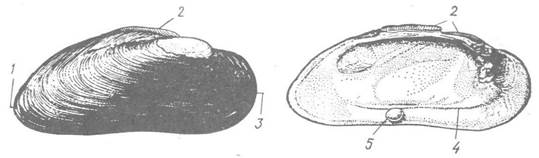
Fig. 41. Order Unionida: European freshwater pearl mussel (Margaritifera
margaritifera) with a pearl: 1 — posterior end of the shell; 2 — external ligament; 3 — anterior end of the shell; 4 — pallial
line; 5 — pearl
In the rivers of Ukraine, the most widespread representatives belong to the family Unionidae, which includes species of the genera Anodonta (swan mussels, see Fig. 25), Unio (river mussels), and Crassiana. The shells of Anodonta are typically thin-walled, with a thin nacreous layer. The most common species in Ukraine is the swan mussel (A. cygnea), reaching up to 20 cm in length, which occurs predominantly in slow-flowing rivers with silty-sandy bottoms. River mussels (Unio) feature a thick shell with a well-developed nacreous layer. The thick-shelled river mussel (Crassiana crassa) possesses a particularly robust shell, which has historically been utilized for crafting mother-of-pearl ornaments and buttons.
Order Mytilida. These are exclusively marine bivalves, predominantly attached to the substrate by a byssus. Most species exhibit a reduction or even complete loss of one of the adductor Muscles.
This order includes economically important commercial mollusks: edible oysters and mussels (suborder Mytilenina), as well as true pearl oysters (suborder Pteriina), which produce valuable pearls.
Oysters (families Ostreidae and Crassostreidae) possess an uneven, ribbed shell with dissimilar Valves: the left (lower) valve is more convex and deeper, with a more prominent umbo. The mollusk cements its left valve to the substrate, conforming to its relief and mirroring its irregularities. There is a single adductor muscle located in the center of the valve. The mantle is open and does not form siphons; water enters via the anterior margin of the shell and exits through the ventral and posterior margins. Adults lack a foot, although it is present in juveniles (Fig. 42). The shell length is typically 8–12 cm, though the Pacific oyster (Crassostrea gigas) can reach up to 38 cm.
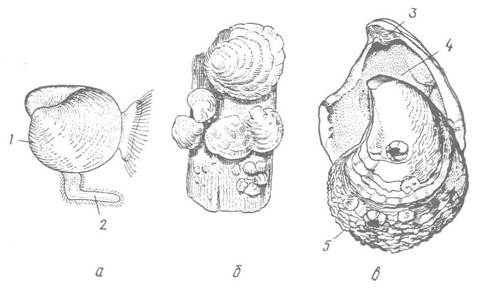
Fig. 42. Order Mytilida: Black Sea oyster (Ostrea taurica):
a — crawling larva; b — juvenile oysters attached by their valves to the substrate; c — shell of an adult mollusk; 1 — shell; 2 — foot; 3 — ligament; 4 — lower (left) valve cemented to the substrate; 5 — upper (right) valve encrusted with barnacles
Approximately 50 species of oysters are known, almost all of which are warm-water inhabitants. They live primarily on rocky substrates at depths ranging from 1 to 50–70 m, either solitarily or in dense aggregations, forming coastal beds and reefs where population density is so high that individual specimens fuse together to form extensive clusters.
Oysters are considered a delicious delicacy and have long been harvested in large quantities. One of the main commercial species, Ostrea edulis, inhabits the coastal waters of Europe, including the Mediterranean and Black Seas.
Some scientists believe that the Black Sea oyster is a distinct species, O. taurica.
Since ancient times, humans have also used mussels (family Mytilidae) for food. They possess a smooth shell with the umbo strongly shifted toward the tapered anterior margin, and a well-developed byssal gland. The posterior adductor muscle is significantly larger than the anterior one. The shell length can reach up to 10 cm. They inhabit the littoral zone and depths down to 80 m, forming dense settlements.
The best-known and most widespread species is the edible mussel (Mytilus edulis, see Fig. 38), which lives along the Atlantic coast of Europe, off the shores of Iceland, southern Greenland, North America, in the Barents, White, Baltic, and Far Eastern seas. A closely related species, the Black Sea mussel (M. galloprovincialis), inhabits the Black Sea.
Representatives of the suborder Pteriina have only a single adductor muscle, a foot with a well-developed byssal gland, and a robust nacreous (mother-of-pearl) layer. These mollusks are capable of producing quite large pearls. The finest and most valuable pearls are produced by species of the genera Pinctada and Pteria. These are the ones referred to as true pearl oysters. They feature a large, mostly rounded shell with a straight hinge margin extended posteriorly into an ear-like process.
The largest of the pearl oysters, Pinctada margaritifera (Fig. 43, a), reaches up to 30 cm in shell diameter and a mass of 10 kg, although such large specimens are rarely encountered. This species lives in the Pacific and Indian Oceans, forming dense settlements known as pearl banks.
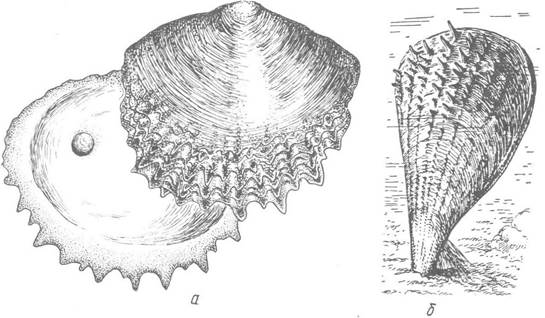
Fig. 43. Order Mytilida:
a — pearl oyster Pinctada margaritifera; b — Pinna sp.
The primary marine pearl fisheries are concentrated in the Persian Gulf, off the island of Sri Lanka, in the Red Sea, off the coast of Australia, Japan, along the coasts of Venezuela, Panama, Mexico, and in several other locations.
Closely related to pearl oysters are the pen shells (family Pinnidae), which possess a large, wedge-shaped shell up to 30 cm long, lacking hinge teeth, with radial Ribs and curved scales (Fig. 43, b). Pen shells inhabit shallow depths in the Mediterranean Sea, the Atlantic, and Indian Oceans; they burrow into the substrate with their narrowed anterior end, anchoring themselves with the byssus, while their posterior end protrudes above the bottom surface.
Order Pectinida. Among this order, the best known are scallops (families Pectinidae and Propeamussiidae), distributed in almost all seas and oceans across various depths, including the deepest trenches. They are particularly abundant and diverse in the coastal shallows of the subtropical and temperate Zones of the World Ocean.
Scallops have a rounded shell with a straight hinge margin that projects at the front and back into extensions called auricles or ears (Fig. 44, a). The upper (left) valve is flatter, while the lower (right) one is more convex. The shell surface bears radial or concentric ribs, often equipped with spines or scales. In shallow-water scallops (Pecten, Chlamys, etc.), the shell is typically large and thick-walled; in deep-water species (Amussium, Propeamussium, Delectopecten), the valves are fragile and translucent.
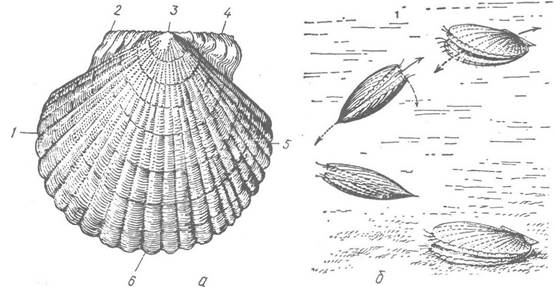
Fig. 44. Order Pectinida: Yesso scallop (Patinopecten yessoensis):
a — external view of the right valve; b — successive movements of a scallop; 1 — posterior margin of the shell; 2 — posterior auricle;
3 — umbo; 4 — anterior auricle; 5, 6 — anterior and ventral margins of the shell
The foot in scallops is weakly developed, rudimentary, and appears as a finger-like outgrowth. Juveniles attach to the substrate by a byssus, whereas adults lose this ability, though exceptions are known. Scallops are the most mobile of all bivalve mollusks. They are capable of swimming and jumping by periodically clapping their valves and expelling water from beneath them (Fig. 44, b). This is facilitated by the specialized Structure OF THE single adductor muscle and the mantle, the edges of which hang down from beneath the shell. The mantle edge is fringed with numerous tentacles (tactile Organs) and eyes, which help orient the animal during swimming.
In the Barents, White, and Far Eastern seas, off the coast of Scandinavia, and along the Atlantic coast of North America at depths down to 100 m, the Iceland scallop (Chlamys islandicus) lives—a fairly large species with a shell diameter of 8 cm. Its meat is very palatable, making it an object of commercial fishery. In the Far Eastern seas, there is also the Yesso scallop (Patinopecten yessoensis). In the Black Sea, only a single species occurs—the Black Sea scallop (Flexopecten ponticus), which features a brightly colored shell 5 cm in diameter with shades of yellow, orange, pink, and red.
Order Lucinida. This is a highly diverse and species-rich group comprising about 30 families; its representatives inhabit both marine and freshwater bodies.
Among marine forms, the best known are members of the family Astartidae, which are widespread in the seas of the Northern Hemisphere and constitute a common component of benthic biocenoses there, such as Astarte crenata and the northern astarte (A. borealis).
This same order includes freshwater mollusks of the families Pisidiidae and Sphaeriidae. These are small mollusks (with the smallest species reaching up to 2 mm); the largest among them are species of the genus Sphaerium, for example, the river pea clam (S. rivicola, Fig. 45), which reaches 2.5 cm. Pea clams are ovoviviparous: their eggs develop in brood chambers located on the inner demibranches; fully formed juveniles emerge from the chambers.
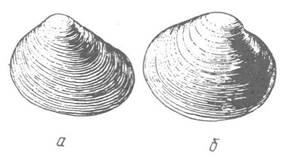
Fig. 45. Order Lucinida:
a — pea clam (Pisidium amnicum); b — river pea clam (Sphaerium rivicola)
Pill clams are widespread in freshwaters across all continents except Antarctica. When water bodies dry up, they can survive without water for up to six months by burrowing into the silt.
Some species of pea clams (Pisidium) have mastered a biotope unusual for bivalves: they inhabit waterlogged soils, where the negligible amount of moisture trapped between soil particles is sufficient for their Respiration and feeding.
Among the small (up to 5 cm) yet highly attractive marine lucinids, special mention should be made of members of the family Donacidae, which feature an elongated, rounded-triangular shell with an umbo shifted toward the posterior end. They are characterized by vibrant color rays radiating from the umbo to the ventral margin, as well as distinct spots on the inner surface of the shell. Because of this, species of the genus Donax are often referred to as sea butterflies. These mollusks are adept at burrowing into the sediment and even moving through it using a large foot.
Order Venerida. This is the largest order of bivalves, comprising about 40 families. Its representatives inhabit both marine and freshwater environments.
The most famous and popular family is Tridacnidae, which includes the largest bivalve mollusks. Among them, giant clams (genus Tridacna) are the best known. The giant clam (T. gigas) reaches nearly 1.5 m in length and weighs up to 250 kg, with the shell accounting for the bulk of its mass.
Giant clams are inhabitants of tropical shallows. They are found in the Indian and Pacific Oceans within coral reef zones, resting motionlessly on the substrate with their dorsal side down and ventral side facing upward (Fig. 46). The foot, which secretes the byssus, is located on the dorsal side, and the byssus emerges from the shell near its umbo. The siphons are shifted accordingly: the inhalant (dorsal) siphon has moved to the anteroventral region, while the exhalant siphon points upward and lies in the middle of the ventral margin. The mantle margins are fused along their entire length except at the points where the siphons and byssus emerge. Within the thickened mantle edge lives a multitude of single-celled flagellates known as zooxanthellae (Symbiodinium microadriaticum, order Dinoflagellida). Tridacnas possess A number of adaptations to optimize conditions for their symbionts. Along the mantle edges of T. crocea and T. elongata, so-called hyaline organs are found. These are flask-shaped structures about 1 mm in size, filled with transparent Cells, surrounded by clusters of zooxanthellae. It is believed that these hyaline organs concentrate incident light falling on the mantle and scatter it into the adjacent tissues, thereby enhancing photosynthetic conditions for the Algae. Furthermore, the mantle margins of giant clams are brightly colored. This abundant pigmentation is also thought to have an adaptive function: protecting the symbionts' chlorophyll from excessive solar radiation during daylight hours. By contracting and expanding the pigment Cells of the mantle, the mollusks can effectively regulate the level of solar radiation reaching the symbionts. Giant clams obtain products of Photosynthesis (glucose, glucose-phosphate, Lipids) from their symbionts, whereas the symbionts consume the host's nitrogenous waste products (ammonia, ammonium salts), Amino Acids, and carbon dioxide.
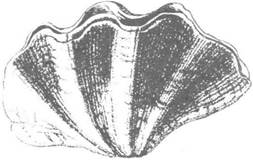
Fig. 46. Order Venerida: tridacna (Tridacna crocea) — the body is oriented as it is positioned in the substrate (ventral side up)
The family of cockles (Cardiidae) is a massive group of shallow-water forms inhabiting predominantly warm seas. Their shells, featuring radial ribs, resemble a Heart (Fig. 47, a). In the Black Sea, Lamarck's cockle (Cerastoderma lamarckii) and several other species are widespread.
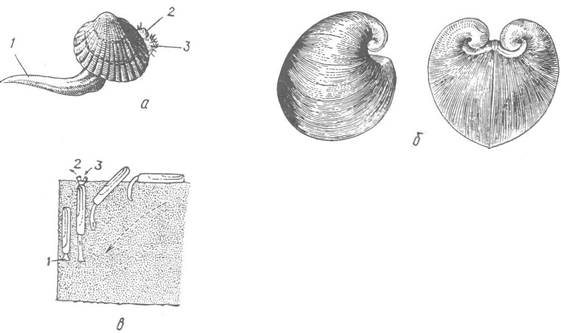
Fig. 47. Order Venerida:
a — edible cockle (Cerastoderma edule); b — heart cockle (Glossus humanus); c — razor clam (Solen Vagina), stages of burrowing into the sediment; 1 — foot; 2 — exhalant siphon; 3 — inhalant siphon
The family Glossidae deserves attention. In the Mediterranean Sea and the Atlantic Ocean lives a mollusk known as The Heart cockle (Glossus humanus). Its thin-walled shell, up to 5 cm in length, features convex, strongly spiraled umbones (Fig. 47, b).
The large family Veneridae is widespread in temperate and tropical seas on sandy shallow bottoms. Venerid shells are very attractive, coming in various Sizes and Shapes. Many of them are commercially harvested. In the Black Sea, several species of venerids inhabit the coastal waters. One of the most common species is the Warty venus (Chamelea gallina).
Common in the Black Sea is a representative of the razor clam family (Solenidae) — the common razor clam (Solen vagina), which possesses an elongated, nearly rectangular shell up to 12 cm long (Fig. 47, c). They live at depths of up to 10 m and are capable of burrowing rapidly into the sediment while protruding a pair of siphons, as well as performing jet-propelled leaps using a stream of water expelled from the siphons.
In freshwaters, sessile mollusks of the family Dreissenidae are extremely common. The most widespread species in European water bodies is the zebra mussel (Dreissena polymorpha), whose triangular shell reaches 4–5 cm in length and features a striped pattern (Fig. 48). This species also invades the limans of the Black Sea and the brackish areas of the Sea of Azov. In southern Ukraine, the quagga mussel (D. bugensis) is also found and is currently actively expanding its range. The zebra mussel attaches itself to substrates via a byssus, forming massive clusters and encrusting rocks, pilings, various hydraulic structures, as well as water intakes, turbine supply pipes, and protective screens. This results in substantial maintenance and cleaning costs for these facilities.
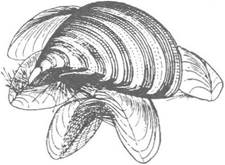
Fig. 48. Order Venerida: a cluster of freshwater zebra mussels (Dreissena polymorpha) bound together by byssal threads
The order Venerida also includes two families whose members have adapted to life in burrows they excavate themselves in rocks, limestone, and wood. Representatives of the family Pholadidae bore into hard substrates using their shells. The pholad shell lacks a ligament, which significantly increases the mutual mobility of the valves. A specialized arrangement of the adductor muscles causes the shell valves to rock alternately at their anterior and posterior ends. Driven by these valve movements—armed with ribbed ridges, spines, and tubercles—the substrate is bored. The common piddock (Pholas dactylus) is widespread in the Black Sea.
Members of the family Teredinidae have adapted to boring into wood. This family comprises two genera, Bankia and Teredo, which possess elongated, worm-like bodies, earning them the common name "shipworms." At the anterior end of the body lies a very small shell (1/30 to 1/40 of the total body length) armed with sharp ridges (Fig. 49). As the shell valves move apart, the sharp teeth on the valve ridges scrape away the wood layer.
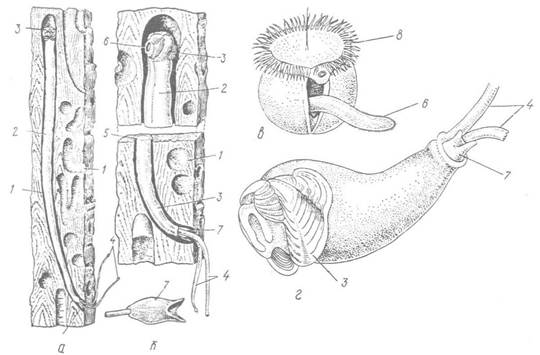
Fig. 49. Order Venerida: the shipworm Teredo:
a, b — adult mollusk in its excavated burrows; c — veliger larva; d — Juvenile Stage; 1 — burrows bored by Teredo; 2 — body of the mollusk; 3 — shell; 4 — siphons; 5 — calcareous lining of the burrows; 6 — foot; 7 — pallet; 8 — velum
At the posterior end of the body are two slender siphons and a pair of calcareous plates known as pallets, which protect the mollusk by sealing the entrance to the burrow. The inner walls of the burrow are lined by the mollusk with a thin layer of calcareous deposits. Shipworms use wood not only as a shelter but also as food. Fine wood particles are digested intracellularly by liver amebocytes. In addition to wood, planktonic organisms drawn in through the inhalant siphon serve as food.
Woodborers damage timber structures. They pose a particularly severe threat to wooden pier structures and wooden vessels. Three species of woodborers are known in the Black Sea: Teredo navalis, T. pedicellatus, and T. utriculus; the first two species have also invaded the Sea of Azov.
Last update: 13/08/2026
Editorial and Educational Adaptation: This material has been compiled based on the primary/original source text. The project team performed an editorial review, corrected technical inaccuracies, structured sections, and adapted the content for an educational format.
What was processed:
- elimination of formatting defects (OCR errors, structural breaks, corrupted characters);
- editorial organization of content;
- standardization of terminology in accordance with academic sources;
- verification of factual statements against the original source text.
All mentions of the author, publication year, and origin of the primary text have been preserved in accordance with the source.