INVERTEBRATE ZOOLOGY IN THREE VOLUMES - BOOK 3 - H.I. Shcherbak - 1997
PHYLUM MOLLUSCA (MOLLUSCS)
CLASS BIVALVIA (BIVALVES)
SUPERORDER PROTOBRANCHIA
Protobranchs are exclusively marine forms distributed throughout the World Ocean. They are absent from enclosed seas with low salinity, such as the Azov, Aral, and Caspian seas. They inhabit virtually all depths—from the littoral zone to deep-sea trenches (deeper than 8 km)—and constitute one of the dominant mollusc groups at great depths.
This superorder unites Molluscs that exhibit primitive structural features. The shell hinge consists of uniform pointed Teeth arranged perpendicularly to the hinge margin; in some species, the teeth are reduced. The gills are bipectinate ctenidia. The Stomach of protobranchs is relatively simple in Structure, with one to three hepatic ducts; the intestinal typhlosole does not protrude into its cavity (see p. 43). The FOOT has a broad, flat crawling sole. When retracted into the shell, the sole folds longitudinally along the midline. The Kidneys and Gonads open into the mantle cavity via a single pore. The labial palps are mostly well developed and consist of a pair of leaflets and a long tentacle-like appendage used by the mollusc to collect detritus. These molluscs never form a byssus and do not attach to the substrate. By feeding habit, they are detritivores.
Class="center">
The superorder Protobranchia comprises two orders: Solemyida and Nuculida, the latter being the most species-rich, predominantly distributed in the seas of the Northern Hemisphere. Representatives of the family Nuculidae are very common here, such as nut-shells (Nucula). In these molluscs, the hinge consists of numerous sharp teeth resembling the teeth of a comb. The slender nut-shell (Leionucula tenuis, Fig. 40) inhabits the coastal zone of the northern seas of Europe.
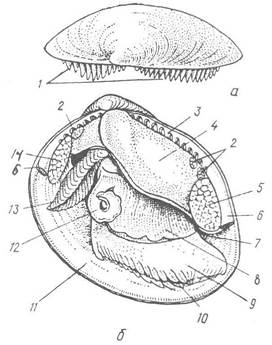
Fig. 40. Superorder Protobranchia: Anatomy of the slender nut-shell (Leionucula tenuis):
a — right valve from the dorsal side; b — LATERAL VIEW OF the body, with the right valve and mantle fold removed; 1 — pectinate hinge teeth; 2 — pedal Muscles; 3 — outgrowths of the mantle margin between the teeth; 4 — visceral mass; 5 — anterior adductor Muscle; 6 — region of the right mantle leaflet; 7 — Mouth; 8 — labial palp; 9 — foot; 10 — pedal sole; 11 — left mantle leaflet; 12 — labial palp appendage; 13 — right ctenidium; 14 — posterior adductor muscle
Representatives of the family Nuculanidae are also widespread in northern seas, with species of the genera Yoldia, Portlandia, and Nuculana being particularly numerous; the latter form dense populations and thus play a significant role in benthic biocenoses.
The considerably smaller order Solemyida includes species that live buried deep within muddy sediments without direct contact with open Water—a very rare occurrence among molluscs. For example, Solemya borealis, whose shell length reaches 5 cm, possesses large gills and a reduced intestine; these molluscs remain insufficiently studied.
Last update: 13/08/2026
Editorial and Educational Adaptation: This material has been compiled based on the primary/original source text. The project team performed an editorial review, corrected technical inaccuracies, structured sections, and adapted the content for an educational format.
What was processed:
- elimination of formatting defects (OCR errors, structural breaks, corrupted characters);
- editorial organization of content;
- standardization of terminology in accordance with academic sources;
- verification of factual statements against the original source text.
All mentions of the author, publication year, and origin of the primary text have been preserved in accordance with the source.