INVERTEBRATE ZOOLOGY IN THREE VOLUMES - VOLUME 3 - H.I. Shcherbak - 1997
PHYLUM MOLLUSCA (MOLLUSCS)
CLASS BIVALVIA (BIVALVES)
SUPERORDER SEPTIBRANCHIA
Septibranchs are marine, predominantly deep-Water Mollusks. They inhabit only waters with full oceanic salinity and are therefore absent from the Black Sea. This superorder comprises four orders and several families.
In septibranchs, the gills are small, reduced, or modified into a muscular septum that extends along the shell, dividing the mantle cavity into upper and lower chambers. The gill septum is perforated by several openings that connect these upper and lower Chambers of the mantle cavity. The shell features a reduced hinge. The Stomach is completely lined with a chitinoid cuticle that covers even the sorting area. The typhlosoles are poorly developed. The Liver consists of a small number of lobes and opens into the stomach via two orifices. The FOOT is wedge-shaped with a longitudinal groove, sometimes partially reduced. By mode of Nutrition, these animals are carnivorous.
The most diverse family in this superorder is the Cuspidariidae (order Cuspidariida), characterized by a posteriorly elongated, tube-like shell enclosing the siphons (Fig. 50). Their gills are reduced. Water exchange within the gill cavity is achieved through the alternating contraction and relaxation of the gill septum. A sharp contraction of the septum causes a sudden intake of water through the inhalant siphon—an "inhalation." The water is then forced through the openings from the lower chamber into the upper one, the pores close, and the water is expelled through the exhalant siphon—an "exhalation." These mollusks are predators; with rapid "inhalations," they draw small planktonic organisms into the mantle cavity. The chitinoid gastric lining and muscular stomach walls facilitate the crushing and grinding of prey, primarily small crustaceans. The inner surface of the mantle cavity, richly supplied with Blood Vessels, performs the respiratory function.
Class="center">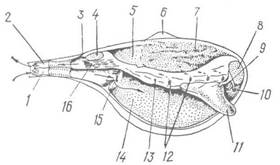
Fig. 50. Diagram of the Internal Structure of the septibranch mollusk Cuspidaria:
1 — inhalant siphon; 2 — exhalant siphon; 3 — anus; 4 — posterior adductor Muscle; 5 — upper (suprabranchial) chamber of the mantle cavity; 6 — umbo; 7 — liver; 8 — anterior adductor muscle; 9 — Mouth; 10 — labial palps; 11 — foot; 12 — Pores in the gill septum; 13 — gill septum; 14 — lower (subbranchial) chamber of the mantle cavity; 15 — membrane; 16 — siphon retractor muscle
Last update: 13/08/2026
Editorial and Educational Adaptation: This material has been compiled based on the primary/original source text. The project team performed an editorial review, corrected technical inaccuracies, structured sections, and adapted the content for an educational format.
What was processed:
- elimination of formatting defects (OCR errors, structural breaks, corrupted characters);
- editorial organization of content;
- standardization of terminology in accordance with academic sources;
- verification of factual statements against the original source text.
All mentions of the author, publication year, and origin of the primary text have been preserved in accordance with the source.