INVERTEBRATE ZOOLOGY IN THREE VOLUMES - VOLUME 2 - H.Y. Shcherbak - 1996
PHYLUM ARTHROPODA
SUBPHYLUM TRACHEATA
CLASS DIPLOPODA
Millipedes (Diplopoda) represent the most numerous Class of myriapods. Over 8,000 species have been described, though some estimates suggest there may be at least 50,000. Most of them inhabit the tropical and subtropical Regions of the Earth, populating the upper layers of humus-rich soil and decaying plant debris, including dead wood. Over 120 species have been found in Ukraine. One species, *Leptojulus semenkevitshi*, and one subspecies, *Polydesmus montanus ukrainicus*, are listed in the Red Data Book of Ukraine.
Their sizes range from a few millimeters (for instance, the very common species *Polyxenus lagurus* has a length of 2.1–5.2 mm) up to 28 cm in the tropical species *Graphidostreptus gigas*. The body of diplopods is typically elongated, and only rarely woodlouse-like or shortened.
The HEAD is usually rounded, occasionally tapering forward, and well sclerotized. The antennae are short, most commonly eight-segmented. The eyes are represented by clusters of simple ocelli, though they are sometimes absent. Behind the upper lip and a pair of serrated mandibles lies a single unpaired plate (the gnathochilarium), which varies in Structure among representatives of different genera (Fig. 105).

Fig. 105. Mouthparts of Diplopoda
The trunk in various species consists of a varying number of segments (from 11 to 170); moreover, as in centipedes, the number of segments in individuals of the same species can vary. For the most part, the trunk segments are cylindrical, but they may also be more or less flattened, as in other myriapods. The exoskeleton of each segment can form a complete ring (in Polydesmida) or an incomplete one composed of separate sclerites (in Julida and Polyzoniida).
Each trunk segment, with the exception of the first few anterior and sometimes posterior ones, bears two pairs of legs (hence the name of the class) and is called a diplosegment, as it results from the fusion of two adjacent segments (Fig. 106). The legs are six-segmented; in most millipedes they are quite delicate, but there are groups with long legs capable of moving rather swiftly.
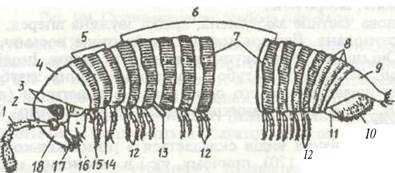
Fig. 106. Diplopoda (diagram of The structure of an julid millipede):
1 - antenna; 2 - cluster of simple ocelli; 3 - head; 4 - dorsal shield of the first "legless" segment; 5 - segments bearing one pair of legs; 6 - segments bearing two pairs of legs; 7 - openings of poison glands; 8 - young "legless" segments; 9 - telson; 10 - anal valve lobe; 11 - unpaired subanal plate; 12 - trunk appendages; 13 - gonopod; 14 - Location OF THE genital opening; 15 - modified appendages of the 11th segment; 16 - cheek; 17 - Mandible; 18 - upper lip
In front of the telson lies the zone of new segment formation. Here, there are always several incompletely formed segments without appendages. The body terminates in the telson, which may bear setae, spinneret-like styli (warts), etc.; as a rule, it features a pair of anal Valves and an unpaired subanal plate.
When disturbed, most millipedes roll into a ball, protecting their head and appendages with sturdy dorsal shields (the ventral side is invariably much less heavily sclerotized).
Unlike other terrestrial Arthropods, the integument in most diplopods is impregnated with calcium carbonate and is extremely tough. The coloration of diplopods from temperate latitudes is brownish-black, grayish, or occasionally pale reddish; tropical forms may be green, yellow, or red, sometimes featuring a characteristic pattern of spots and stripes. In most species, males are brighter than females.
The integument of millipedes is quite rich in unicellular and multicellular cutaneous glands, among which of particular interest are
defensive glands. They are located along the sides of the tergites and open externally via so-called defensive pores. They eject a secretion whose appearance and chemical properties vary greatly among species. For example, the secretion of *Spirobolus* is caustic and stains human Skin dark; *Polyzonium rosalbum* secretes a milky fluid with the scent and burning taste of camphor. The tropical *Fontaria* contains free hydrocyanic acid in its glands and smells of bitter almonds. In many diplopods, when disturbed, the poison is released as a droplet, while in some species it is forcibly squirted from the defensive pores to a distance of up to 75 cm in either direction, as, for example, in the Tahitian species *Rhinocricus salvii* and certain other diplopods.
The Digestive System, like that of other myriapods, appears as a straight tube; the excretory system, similar to that of centipedes, is represented by a pair of Malpighian tubules that extend as blind-ending channels along the entire intestine from their point of entry at the junction of the Midgut and Hindgut.
The Circulatory system is similar to that of centipedes, but the ventral vessel is absent. In the first four segments, The Heart chambers possess a single pair of ostia, while all other chambers possess two pairs.
The tracheal system begins with spiracles located at the Base of the legs on each segment (except for the first few anterior ones, which have two pairs of spiracles). Each spiracle leads into a sac-like dilation from which more or less branched tracheae extend, supplying oxygen to the Organs of the respective segment. Unlike in centipedes and insects, a single unified tracheal system is not formed in diplopods.
The Nervous system is typical of tracheates. A distinctive feature of its structure is the doubling of the ventral nerve cord ganglia in all segments starting from the 5th.
The Sense Organs are fairly well developed. Simple ocelli are clustered on the sides of the head in many diplopods, though blind species also exist. Numerous peg-like and awl-like sensory sensilla are located on the antennae and gnathochilarium, likely serving as chemical sense organs. In many diplopods, on the sides of the head between the antennae and ocelli, there are Tömösváry organs, which appear as horseshoe-shaped pits housing a ridge of sensory Cells at the bottom, or are concealed beneath the integument. Various opinions exist regarding the function of this organ—whether it serves for Hearing or Olfaction.
Tactile Functions are performed by sensory setae scattered over the antennae, trunk, and legs of the diplopods.
Diplopods are gonochoric. The female and male Gonads are unpaired and appear as elongated pouches; they extend into an unpaired channel (oviduct or vas deferens), which then bifurcates (Fig. 107) and opens via a pair of openings on the third trunk segment, unlike chilopods and insects, in which the genital openings are always located on the posterior segments.
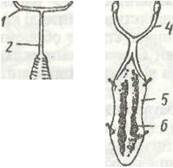
a 5
Fig. 107. Reproductive System of millipedes (Diplopoda):
a - male; b - female; 1 - paired section of the vas deferens; 2 - vas deferens; 3 - Testis; 4 - paired section of the oviduct; 5 — everted genital pouch; 6 - Ovary
Fertilization is spermatophoric, occurring through various Methods. Development proceeds via anamorphosis: a larva hatches from the egg with three leg-bearing segments and several legless ones (Fig. 108). During subsequent molts, legs appear on the previously legless segments, while new legless segments emerge anterior to the telson. This process continues throughout their entire life.

Fig. 108. Six-legged larva of a millipede:
1 - telson; 2 - head; 3 - antenna; 4 - leg buds; 5 — legs
Recently, in some diplopod species, notably the millipede Ommatojulus sabulosus, a phenomenon unique to the animal kingdom has been discovered: periodomorphosis, namely the ability of adult males, after a regular molt, to revert to a juvenile (larval) form. This results in The formation of " intercalary males." This extends the overall lifespan of such individuals by 1.5 to 2 times and is believed to help the population survive under unfavorable conditions.
Diplopods are primarily saprophages, although predators and species with a sucking proboscis are also found among them. They play a significant role as primary destructors of dead plant material in maintaining natural soil fertility. Some species are facultative phytophages and can damage the roots of cultivated plants, seed sprouts, and berries.
Despite having poison glands and a secretive lifestyle, diplopods are readily preyed upon by amphibians and birds, especially starlings.
Diplopods can be conditionally divided into two groups. One comprises very small animals with soft integuments, united in the single order Polyxenida, while the second includes the so-called millipedes (though they actually have considerably fewer legs; for instance, one of the largest diplopods—the Seychelles millipede, which has 75 trunk segments—has only 139 legs).
The second group is characterized by robust integuments rich in calcium carbonate. Millipedes are divided into at least a dozen orders; we will examine some of them.
Order Polyxenida. These are very small (2–4 mm) millipedes with a soft cuticle lacking calcium carbonate, bearing numerous bizarre outgrowths (Fig. 109).

Fig. 109. Bristle millipede: Polyxenus lagurus
Most commonly, they form uniform rows on the DORSAL SIDE OF the segments and bush-like branched rows on the sides. There is a tuft of long hairs at the end of the body, which gave them their name. The body of bristly millipedes is silvery in color. Defensive glands are absent.

Bristly millipedes typically live in large groups under bark, in decaying wood, in forest litter, and are frequently found in ant nests.
To date, only one species (Polyxenus lagurus) is known in Ukraine. Like some other myriapods, it is characterized by geographic parthenogenesis—a phenomenon where animals reproduce in the presence of males in some latitudes, and strictly parthenogenetically in others.
Order Glomerida. The body of glomerids (Fig. 110) is woodlouse-like; the integuments are shiny, bare, with a bright pattern or "encrusted" with calcified transverse Ribs bearing granules and rods. Body sizes are on the centimeter scale (up to 10 mm long and 5 mm wide).

Fig. 110. Pill millipede: Glomeris marginata
Glomerids are highly hygrophilous and therefore do not inhabit regions with dry climates. They have The ability to roll up into a tight sphere and remain in this state for hours or even days, protecting themselves against desiccation.
The most widespread species in Ukraine, Glomerula hexasticha, is a typical inhabitant of hornbeam forests.
Order Polydesmida. The body of polydesmidans is bead-like, with narrower constrictions between the body segments (adults typically have 19–20 segments) (Fig. 111). The tergites often feature distinct lateral wing-like expansions. Eyes are always absent.

Fig. 111. Polydesmidans: Strongylosoma stigmatosum
In Polissya and across most of the Forest-Steppe zone of Ukraine, the species Polydesmus complanatus is commonly found. These millipedes inhabit bark, decaying wood, and tree stumps. In greenhouses, the introduced species Oxidus gracilis has emerged as a dangerous pest of various vegetable and berry crops.
Order Julida. Members of this order are among the most thoroughly studied groups of diplopods. They live in the soil—both in surface layers and at greater depths—as well as in leaf litter, under bark, in tree stumps, and similar habitats.
The body of julidan millipedes is cylindrical, comprising A large number (at least 30) of trunk segments (Fig. 112). They move slowly across open surfaces via a wave-like contraction of the leg Muscles from front to rear. They also burrow effortlessly through fallen leaves and soil, delving deeper when the surface layers dry out.

Fig. 112. Julidans: Rhinocrinus sp.
Members of the family Blaniulidae possess slender bodies with weakly defined segmentation and distinct openings of the defensive (poison) glands. The eyes are rudimentary or entirely absent.
Blaniulids inhabit the soil of open landscapes. They predominantly congregate around decaying plant roots and occasionally feed on living roots, which can compromise the yields of field and garden crops. The most common species in Ukraine is Nopoiulus kochii, which lives in forests beneath tree bark.
Representatives of the family Julidae are shorter and thicker, and they possess eyes. They inhabit leaf litter and other decomposing organic matter, with some species living permanently in the soil or beneath the bark of stumps and rotting trees. Many species favor cultivated lands and greenhouses. The European species Archiboreoiulus pallidus, which is also widespread in Ukraine, is becoming a dangerous pest of vegetable crops in kitchen gardens and greenhouses, reaching densities of over 1,500 individuals per 1 m2.
In tropical regions of the world, large millipedes are used as food.
Last update: 13/08/2026
Editorial and Educational Adaptation: This material has been compiled based on the primary/original source text. The project team performed an editorial review, corrected technical inaccuracies, structured sections, and adapted the content for an educational format.
What was processed:
- elimination of formatting defects (OCR errors, structural breaks, corrupted characters);
- editorial organization of content;
- standardization of terminology in accordance with academic sources;
- verification of factual statements against the original source text.
All mentions of the author, publication year, and origin of the primary text have been preserved in accordance with the source.