INVERTEBRATE ZOOLOGY IN THREE VOLUMES - VOLUME 2 - G.Y. Shcherbak - 1996
PHYLUM ARTHROPODA
SUBPHYLUM TRACHEATA
CLASS PAUROPODA
Members of this Class are the least studied group of myriapods. Almost until the mid-19th century, they were completely unknown, although it has now been established that pauropods are widely distributed in both the Old and New Worlds. About 400 species have been described.
They inhabit the upper layers of forest soils, living under stones, in compost, and in decaying wood. Synanthropic species are also known. Pauropods can be called dwarf myriapods: the smallest species barely reach 1 mm in length, while the largest reach 1.9 mm.
Body shape varies among different species—they may be elongated or more shortened (Fig. 113).
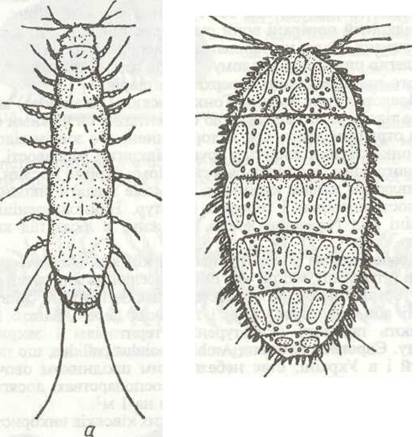
Fig. 113. Pauropoda:
a - Pauropus huxleyi; b - Eurypauropus ornatus
The HEAD is relatively small. Unlike other myriapods, the antennae of pauropods are branched. Eyes are absent. On the ventral side, There is a pair of strong, serrated mandibles and a single pair of maxillae. The trunk consists of 10–12 segments, of which the first or the subsequent two or three are devoid of appendages. The legs are widely spaced and clearly visible from above, though
in species with a short body and broad tergites, they may be inconspicuous. Along the sides of the body, There are five pairs of long sensory hairs.
In The Structure of the Digestive System, attention is drawn to the well-developed Muscles surrounding the anterior ectodermal region. This suggests that pauropods feed by suction. Specifically, it is known that the species Pauropus lanceolatus and Allopauropus gracilis suck out the hyphae of mold Fungi. In addition, saprophages and predators are found among pauropods.
Excretory Organs are represented by a pair of Malpighian tubules. The Circulatory system is absent. The Respiratory system has a simple structure: a pair of short tracheal tubes extends from spiracles located at the Base of the legs.
The Gonads of the female and male differ in structure: the Ovary resembles an elongated sac opening via a pore on the third segment, whereas the Testis consists of four elongated sacs whose ducts merge into a single duct that then bifurcates and opens through two pores on the same third segment.
Pauropods lay spherical, glossy eggs, from which a larva hatches after two weeks, possessing only three pairs of legs and a pair of lateral hairs. Three large shields are present on the dorsal side. The larvae grow rather slowly, molting every 2–5 weeks. After each molt, the number of trunk segments increases (anamorphosis). Adult pauropods do not molt.
A typical representative of pauropods is Pauropus sylvaticus, a species widely distributed in Europe.
Last update: 13/08/2026
Editorial and Educational Adaptation: This material has been compiled based on the primary/original source text. The project team performed an editorial review, corrected technical inaccuracies, structured sections, and adapted the content for an educational format.
What was processed:
- elimination of formatting defects (OCR errors, structural breaks, corrupted characters);
- editorial organization of content;
- standardization of terminology in accordance with academic sources;
- verification of factual statements against the original source text.
All mentions of the author, publication year, and origin of the primary text have been preserved in accordance with the source.