Molecular Biology: Protein Structure and Functions - Stepanov V.M. 2005
Protein Isolation
Hydrophobic Interaction Chromatography of Proteins
As is well known, The surface of a protein globule is rich in hydrophilic Amino Acids, yet it also contains a significant number of hydrophobic residues (accounting for up to half of their total content), which frequently form clusters or “patches.” Such hydrophobic areas, developed to a greater or lesser degree, constitute a characteristic structural feature of every protein, forming The basis of hydrophobic interaction chromatography. The corresponding sorbents are synthesized by incorporating hydrophobic groups into a hydrophilic matrix, such as cross-linked agarose (Sepharose). Octyl- and phenyl-Sepharose, in particular, are constructed according to this principle:
Class="center">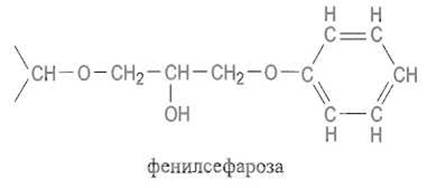
When a protein solution is passed through phenyl-Sepharose, the hydrophobic regions on the protein surface interact with the phenyl groups, displacing the Water molecules surrounding these structures. The number and strength of these contacts vary significantly among different Proteins. Their binding strength is enhanced by sorbing proteins from concentrated salt solutions, such as ammonium sulfate. A gradual decrease in the salt concentration of the solution flowing through the phenyl-Sepharose Column results in the sequential desorption of the proteins (Fig. 3.3).

Fig. 3.3. Isolation of human fibroblast interferon by hydrophobic interaction chromatography on phenyl-Sepharose CL-4B.
1 — protein content in the eluate; 2 — concentration gradient of Ethylene glycol used for desorption; 3 — interferon activity; the breakthrough peak containing proteins that do not bind to the sorbent, as well as the purified interferon peak, are clearly visible
Sorbents prepared by attaching hydrophobic alkyl radicals of varying lengths to macroporous silica gel operate on a similar principle. Being rigid, they are particularly well-suited for high-pressure Applications in High-Performance Liquid Chromatography (HPLC). Those containing long C18 hydrocarbon chains are poorly suited for protein Separation due to excessively strong and often irreversible binding, but they can be successfully used for peptide chromatography. Better results in Protein chromatography are achieved using sorbents with shorter C4–C8 hydrocarbon chains.
Hydrophobic chromatography is frequently combined with other separation mechanisms. For example, attaching diamines of varying lengths to Cyanogen bromide-activated Sepharose yields sorbents that contain hydrophobic hydrocarbon chains alongside two cationic groups. Combining The properties of a hydrophobic sorbent and an anion exchanger in a single chromatographic material significantly expands its capabilities.
The chromatographic Procedure on a hydrophobic sorbent described above is by no means the only possible approach. High salt concentrations in the solution are not strictly required for protein sorption, and elution can be achieved by adding organic Solvents or shifting the pH. In certain cases, where protein binding relies on a combination of hydrophobic and ionic interactions, salt solutions prove effective for elution. It is also worth noting that features of hydrophobic chromatography are frequently encountered in other protein separation techniques, most notably in Affinity Chromatography.
Last update: 13/08/2026
Editorial and Educational Adaptation: This material has been compiled based on the primary/original source text. The project team performed an editorial review, corrected technical inaccuracies, structured sections, and adapted the content for an educational format.
What was processed:
- elimination of formatting defects (OCR errors, structural breaks, corrupted characters);
- editorial organization of content;
- standardization of terminology in accordance with academic sources;
- verification of factual statements against the original source text.
All mentions of the author, publication year, and origin of the primary text have been preserved in accordance with the source.