Molecular Biology: Protein Structure and Function - Stepanov V.M. 2005
Protein Isolation
Affinity (Biospecific) Protein Chromatography
As noted earlier, Protein Separation Methods based on differences in their physicochemical properties cannot be highly specific. From this perspective, preparative methods rooted in the functional differences of Proteins are much more promising. For many proteins, including Enzymes, inhibitors, transport proteins, IMMUNOGLOBULINS, regulatory proteins, toxins, and receptors, the paramount functional feature is their ability to selectively bind specific ligands—substrates, Coenzymes, allosteric effectors, Antigens, and the like.
Such binding is inherently highly specific, a property that sharply distinguishes a given protein from a multitude of others. Affinity, or biospecific, chromatography relies precisely on this functionally driven ability of proteins to reversibly bind corresponding ligands.
To synthesize an affinity sorbent, a Ligand matching the Specificity of the target protein (such as a substrate or its analogue in enzyme chromatography) is attached to an inert matrix in a way that minimally disrupts the structural elements directly involved in protein interaction. Sometimes the ligand is reacted directly with functional groups on the matrix surface, but more often they are linked via an intermediate spacer (such as an arm or tether) to distance the ligand from the matrix and reduce steric hindrance for its approach to the protein.
Specific requirements are imposed on each structural element of the affinity sorbent. The matrix must be inert and create no steric hindrance for the protein. Most commonly, the matrix consists of macroporous gels formed by cross-linked hydrophilic polymers—such as agarose derivatives like Sepharose—synthetic polymers, or inorganic carriers like macroporous silica gel or Glass. Ligand attachment to Sepharose (directly or via a spacer) is typically carried out by activation with Cyanogen bromide. Cyanogen bromide (a potent poison!) reacts in an alkaline medium with the hydroxyl groups of Sepharose to yield a highly reactive cyanate ester:
Class="center">
The latter then reacts with the amino groups of ligand L or the spacer to form an isourea derivative, which is a strong base and carries a positive charge over the standard pH range:

Thus, attaching the ligand to cyanogen bromide-activated Sepharose simultaneously generates A number of cationic groups on the matrix equivalent to the ligand content. Consequently, alongside biospecific protein-ligand binding, such a sorbent may exhibit anion-exchanger properties, which must be taken into account during its use.
Other methods for attaching ligands to the matrix are also known; however, each case requires accounting for Changes in the carrier's properties resulting from the reaction with the ligand, as well as the varying Stability of the formed bond, which can occasionally cause gradual ligand "leakage." For example, isourea can convert into a guanidine derivative in the presence of significant concentrations of primary amines or ammonia, leading to ligand Cleavage.
The requirements for the ligand are more complex. First and foremost, it must interact sufficiently strongly with the protein. For instance, it is generally accepted that for the preparation of sorbents intended for enzyme isolation, inhibitors or substrate analogues used as ligands should have an inhibition constant (substrate constant)—i.e., the enzyme-ligand dissociation constant—of no worse than 10-4 M. It is also important to consider that attaching the ligand to the matrix impairs (i.e., increases) the inhibition constant by at least an order of magnitude.
When selecting ligands for the Affinity Chromatography of enzymes, the substrate Structure must often be modified to prevent its conversion into a product by the enzyme—such as the cleavage of a peptide ligand in the case of proteinase chromatography. Clearly, a sorbent containing a true substrate as a ligand would be transformed upon the very first contact with the enzyme and prove useless.
When passing a solution containing a complex mixture of proteins, other Biopolymers, low-molecular-weight compounds, salts, pigments, and the like through a biospecific sorbent constructed According to the scheme described above, the ligand forms a complex exclusively with the protein that possesses a binding site complementary to the ligand structure. As a result, only this protein is retained by the affinity Column, while all Other components of the mixture pass through without hindrance.
After washing the column to remove non-specifically retained impurities, the protein is eluted by altering the COMPOSITION OF THE solution flowing through the column to weaken the protein-ligand interaction. To achieve this, the pH is adjusted, and inorganic salts or organic Solvents are added to the eluent. All these factors disrupt the ligand-binding pocket and suppress specific types of Protein-ligand interactions, such as ionic bonds and hydrophobic contacts, thereby driving desorption. In certain cases, affinity elution with a solution of the ligand or its analogue is employed. This technique, based on competition for protein binding between the matrix-bound and free ligands in solution, is highly specific and efficient, albeit expensive.
As an example, let us consider the application of the cyclic peptide antibiotic gramicidin S (see Chapter 2) as a ligand in the affinity chromatography of Proteolytic Enzymes. It contains a number of hydrophobic Amino Acids matching the specificity of many proteinases, alongside two Ornithine residues whose δ-amino groups allow the cyclic peptide to be easily attached to cyanogen bromide-activated Sepharose or other matrices:
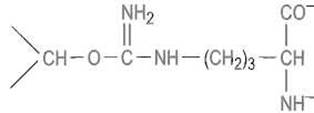
ornithine residue whose amino group is attached to cyanogen bromide-activated Sepharose
Gramicidin S binds proteinases of various classes; however, it is resistant to their action and does not undergo Hydrolysis, presumably due to the presence of D-phenylalanine and Proline residues in its structure, as well as the unique conformation of the cyclic peptide. Consequently, gramicidin S serves as a natural analogue of proteinase substrates and is well suited as a broad-specificity ligand. For instance, when a complex mixture of substances from the culture fluid of a Bacillus subtilis bacterial strain is passed through a gramicidin S-Sepharose column, the sorbent binds solely the metalloproteinase, allowing it to be completely freed of impurities and isolated as a virtually pure protein.
Even more efficient are sorbents containing ligands that interact not only with the binding site but also with the catalytic center of the enzyme. For example, benzylsuccinic acid derivatives have proven to be excellent ligands for isolating Carboxypeptidases—enzymes that cleave amino acids from the carboxy-terminal end of a peptide chain. At first glance, the structural similarity between the ligand and carboxypeptidase substrates appears minor, but it turns out that the HOOC—CH2 group can act as a distinctive analogue of the peptide bond:

As a result, the β-carboxyl group of benzylsuccinic acid interacts with the catalytic center of the enzyme, while the side benzyl group and the α-carboxyl interact with Components of the substrate-binding site. The resulting complex—typically formed by attaching the ligand to the matrix via an amino group introduced into the para-position of the benzene ring—binds the enzyme very tightly.
A specialized variant of affinity chromatography is widely used, based on the Application of Synthetic anthraquinone Dyes, such as Cibacron Blue, as ligands:

The planar structure formed by three condensed aromatic rings of substituted anthraquinone, with a substituted aniline and a triazine ring attached at position 1, is capable of selectively interacting with a wide range of proteins. The ligand presumably binds within clefts that frequently occur on protein surfaces, particularly within the active centers of enzymes. It has been suggested that anthraquinones, together with their attached aniline and triazine rings, form a structure sterically similar to natural ligands—such as coenzymes like NAD—and mimic the latter's mode of protein binding. Consequently, sorbents containing Cibacron Blue and certain other anthraquinone dyes are particularly recommended for the Affinity Chromatography of Proteins containing NAD or other nucleotide-derived compounds.
It is not necessary for the nucleotide or structurally similar compound to resemble a substrate—it may instead mimic an effector that regulates enzyme activity. For example, chromatography of aspartate carbamoyltransferase on anthraquinone dyes yields excellent results, with the NUCLEOTIDES acting as allosteric effectors.
However, the range of proteins bound by these sorbents is much broader and includes, for instance, serum albumin. Albumin readily binds various ligands, including certain Pharmaceuticals and Tryptophan, which can (with major caveats) be viewed as structurally reminiscent of condensed anthraquinone rings. The structure of the substituted anthraquinone ligand matters significantly; thus, by utilizing different dyes, it is possible to generate a series of sorbents with varying affinities for different proteins.
Last update: 13/08/2026
Editorial and Educational Adaptation: This material has been compiled based on the primary/original source text. The project team performed an editorial review, corrected technical inaccuracies, structured sections, and adapted the content for an educational format.
What was processed:
- elimination of formatting defects (OCR errors, structural breaks, corrupted characters);
- editorial organization of content;
- standardization of terminology in accordance with academic sources;
- verification of factual statements against the original source text.
All mentions of the author, publication year, and origin of the primary text have been preserved in accordance with the source.