Molecular Biology: Protein Structure and Function - Stepanov V.M. 2005
Protein Isolation
Ion-Exchange Chromatography of Proteins
Ion-exchange Chromatography, which relies on differences in the ratio and distribution of charged groups on the protein surface, is among the most widely used Methods. Synthetic polystyrene-based ion-exchange resins, which are very popular in the analytical chemistry of Amino Acids and Peptides, are virtually never used in Protein Chromatography. This is due, firstly, to the high degree of cross-linking, which makes such Materials practically impermeable to Proteins, and secondly, to the often irreversible sorption of proteins onto the hydrophobic polystyrene surface.
For these reasons, protein Separation utilizes ion exchangers in which the matrix (“support”) is distinctly hydrophilic. Particularly widespread are ion exchangers produced by attaching ionogenic groups to Cellulose or cross-linked dextrans (Sephadexes).
To prepare cation exchangers, the carboxyl group is most frequently used as the ionogenic group; its pKa, which varies slightly depending on the microenvironment, is close to 4 (carboxymethyl (CM) derivatives of cellulose or Sephadex, containing (CH - O - CH2COOH) groups).
The carboxyl groups of such ionites are negatively charged at pH 5 and above and, consequently, are capable of binding proteins that carry a positive charge under these conditions. Protein binding is enhanced if clusters (“bunches”) of cationic groups occur on their surface. Other things being equal, proteins of higher molecular weight bind more effectively to the cation exchanger, which is explained by the cooperativity of multi-point interactions between extensive surface areas of such proteins and the anionic groups of the ion exchanger.
Desorption of proteins bound to a cation exchanger is usually achieved by increasing the Ionic strength of the eluting solution, whereupon the interacting charged groups of the protein and the ionite become surrounded by oppositely charged salt ions. As a result, at a certain salt concentration characteristic of each protein, the Electrostatic Interactions between the protein and the ionite are disrupted, and the protein is eluted from the Column. A gradual increase in the ionic strength of the solution, employing a linear or more complex salt concentration gradient, causes the desorption of first the most weakly held molecules, then the more tightly bound proteins, and so forth. In preparative experiments, stepwise elution is frequently used, in which the salt concentration is increased in jumps. This accelerates the separation and allows the protein to be collected in a small volume; however, it easily leads to The formation of multiple false peaks by the same protein.
When washing the ionite column with a salt solution of appropriate concentration, the protein is desorbed, sometimes forming a rather long “tail,” which may be a consequence of the uneven distribution of ionic groups within the sorbent. Areas with a higher concentration of these groups, or clusters of such groups, hold the protein more tenaciously, thereby causing a delay in elution and the formation of a “tail.” In such a situation, a stepwise increase in the ionic strength of the eluting solution drastically improves desorption conditions; consequently, the portion of the protein that would normally form a “tail” is desorbed abruptly, producing a false peak.
In view of this, the protein composition of each fraction should be determined by an independent method, such as Polyacrylamide gel Electrophoresis, or questionable peaks should be subjected to rechromatography under the same conditions. Failure to observe such precautions frequently leads to the erroneous detection of “multiple forms” of proteins.
In principle, a pH gradient can also be used to desorb proteins from cation exchangers. For example, lowering the pH to 3–4 leads to the protonation of the carboxylate ions of carboxymethylcellulose or similar ionites and the gradual desorption of the proteins bound to them. One can also aim to reach the isoelectric point of the sorbed protein, which would likewise induce its desorption. However, this approach is rarely employed, not only due to the risk of Protein Denaturation at lowered pH, but also because of complications associated with the sorption of some eluting solution ions by the ionite and the resulting indeterminacy of local pH changes. For similar reasons, it is not recommended to use solutions containing several different cations or a mixture of anions in protein ion-exchange chromatography.
In addition to the carboxyl cation exchangers discussed above, cation exchangers containing sulfo groups (—SO-3), such as sulfopropyl Sephadex, are also utilized. Unlike carboxyl groups, sulfo groups retain a negative charge at virtually all pH values used in protein chromatography.
The ionogenic groups of phosphocellulose are weaker than those of sulfopropyl Sephadex, but stronger than carboxyl groups. It has been found that this ion exchanger can be employed as a biospecific sorbent in the isolation of certain phosphorus-metabolizing Enzymes. Among anion exchangers, diethylaminoethyl (DEAE)-cellulose and its analogs with other matrices have become the most widespread:
Class="center">
diethylaminoethyl group attached to a cellulose or other polysaccharide matrix
The basicity of the diethylaminoethyl group in sorbents of this type is somewhat lower than usual due to METABOLISM/18.html">The Influence of surrounding hydroxyl groups, such that its pKa is 9.5. DEAE-cellulose is effective as an anion exchanger up to pH 8.5–9.0. Anion exchangers containing quaternary ammonium groups—such as QAE-Sephadex or QAE-Sepharose—retain a positive charge even at higher pH values.
Protein Chromatography on DEAE-cellulose and similar anion exchangers, much like chromatography on cation exchangers, is governed by multi-point binding of negatively charged protein groups (primarily carboxyls) with the cationic groups of the ion exchanger. As with cation chromatography, protein desorption is achieved by increasing the ionic strength of the eluting solution, which can be performed stepwise or using a salt concentration gradient. In this case as well, pH gradients and solutions containing different anions are not recommended. For instance, during the desorption of proteins with sodium chloride from DEAE-cellulose equilibrated with an acetate buffer, apart from the shielding of oppositely charged groups of the sorbent and protein, acetate ions held by the anion exchanger are displaced by chloride ions. If elution is carried out in weakly acidic solutions, the desorbed acetate ions, by binding protons, will cause an alkaline shift in pH, which leads to local changes in elution conditions and makes the process difficult to control.
Recently, ion exchangers based on hydrophilic organic polymers produced in the form of beads of strictly uniform diameter (10 μm) with a large working surface have been increasingly used in protein chromatography. The standardization of the granules of such ionites reduces the broadening of chromatographic peaks caused by differences in the diffusion time of protein molecules within the sorbent—a factor that limits the efficiency of conventional ion exchangers with nonuniform granules. Carriers of this type are rigid, which makes it very high flow rates of solutions through the column possible at pressures around 20 atm*. The combined effect of these factors dramatically increases the efficiency and speed of protein chromatography on such sorbents, a technique known as fast protein liquid chromatography (commonly abbreviated as FPLC). The sorbents used include Mono-Q, a strong anion exchanger with quaternary ammonium groups; Mono-S, a strong cation exchanger containing sulfo groups; or Mono-P, a cation exchanger with phosphate groups (Fig. 3.2).
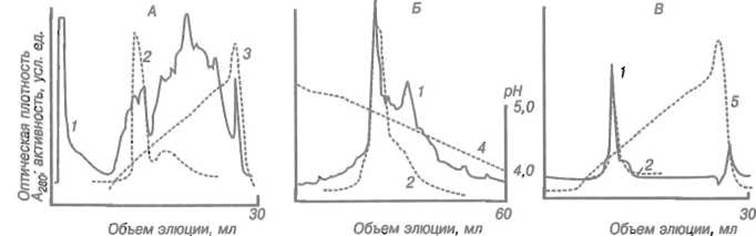
Fig. 3.2. Purification of alkaline phosphatase by ion-exchange chromatography.
I — optical density at 280 nm, reflecting total protein content; 2 — alkaline phosphatase activity;
A — separation of the crude preparation on the Mono-Q anion exchanger at pH 8 in a 0–0.35 M NaCl concentration gradient (3); B — chromatofocusing on Mono-P of alkaline phosphatase purified in the previous step using a pH gradient (4); C — chromatography of the fraction isolated on Mono-P using the Mono-Q anion exchanger in a NaCl concentration gradient (5)
Unfortunately, it has not yet been possible to develop a sufficiently efficient method for the Preparative Electrophoresis of proteins in gels, although their analytical separation by polyacrylamide gel electrophoresis yields very good results and remains a leading method in The Study of protein mixtures and individual proteins.
* 1 atm = 0.1 MPa.
Last update: 13/08/2026
Editorial and Educational Adaptation: This material has been compiled based on the primary/original source text. The project team performed an editorial review, corrected technical inaccuracies, structured sections, and adapted the content for an educational format.
What was processed:
- elimination of formatting defects (OCR errors, structural breaks, corrupted characters);
- editorial organization of content;
- standardization of terminology in accordance with academic sources;
- verification of factual statements against the original source text.
All mentions of the author, publication year, and origin of the primary text have been preserved in accordance with the source.