MICROBIOLOGY - M.H. Serhiichuk - 2008
Chapter 3. BACTERIAL GROWTH AND REPRODUCTION
PATTERNS OF MICROBIAL POPULATION DEVELOPMENT IN A BATCH SYSTEM
The GROWTH AND REPRODUCTION of microorganisms were studied by J. Monod (1942). According to Monod, the Reproduction of a bacterial population proceeds as follows: when Bacteria are inoculated into a fresh nutrient medium, they initially adapt to the new conditions and do not reproduce for a certain period (lag phase); this is followed by a phase of rapid reproduction where The Cell count increases logarithmically with cultivation time (log phase); gradually, nutrients in the medium are depleted, and the bacterial population enters the stationary phase; finally, the death and cell lysis phase occurs (Fig. 3.8).
Class="center">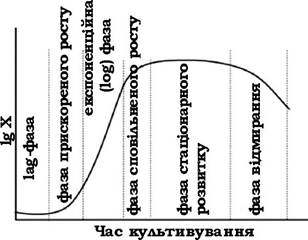
Fig. 3.8. Idealized growth curve of a bacterial population in a batch cultivation system
A population (from French population) is an assemblage of bacteria of the same species (pure culture) or different species (mixed cultures) developing within a limited space. Bacterial populations constantly undergo growth, reproduction, and death. When observing The Development of a bacterial population, primary attention is paid to the cell count (or biomass) per unit volume and cell viability. Direct and Indirect Methods are used for this purpose. Direct methods count the total number of Cells in a population or determine their total mass in a given volume of nutrient medium. Cell counts are performed using counting chambers under a Microscope, electronic counters, or by counting cells on membrane filters, etc. To determine solely the Number of viable cells, the bacterial suspension is plated onto solid nutrient media, followed by counting the resulting colonies. It is assumed that each colony originates from a single cell.
Upon entering a new environment, microorganisms must adapt to its conditions (lag phase, or delay phase). Due to the sudden change in conditions, microbial enzyme systems remain inhibited for some time. The duration of this phase depends on external conditions, as well as bacterial age and species Specificity. When the source of energy and carbon in the new medium differs from that of the previous cultivation, adaptation may require the synthesis of new Enzymes not previously needed. The synthesis of these new Enzymes can be induced by new substrates in the medium. Changes in the composition of a bacterial cell during the lag phase primarily affect the RNA content, which increases 8-12 fold. Such an increase in RNA indicates its involvement in enzyme synthesis.
Over time, microbial cells begin to synthesize the enzymes required to assimilate Components of the existing medium, the average cell volume increases, and the bacterial population gains The ability to reproduce. The accelerated growth phase then begins (see Fig. 3.8).
Young cells exhibit a higher affinity for basic Dyes, staining more intensely than older cells. This led to the hypothesis that the isoelectric point of their protoplasm is shifted toward lower pH values. Oxygen consumption, heat production, and the release of CO2 and ammonia indicate that METABOLISM is more intensive in young cells. While young cells adapt to a new nutrient medium better than older ones, they are less resistant to external factors (phenol, heat, cooling, salts, etc.).
Following intensive reproduction, the microbial culture enters the exponential phase, also known as the logarithmic growth phase. It is characterized by a constant maximum rate of Cell Division, which depends on the microorganism species and environmental conditions. During this period, the microbial population increases exponentially in geometric progression (Fig. 3.9).

Fig. 3.9. Schematic of bacterial cell reproduction
Cell size and protein content in many bacteria remain constant throughout the exponential phase, and growth processes are balanced—biomass doubling is accompanied by doubling of protein, RNA, DNA, and other constituents. Under such conditions, culture growth can be monitored by measuring any of these parameters.
The stationary phase begins when the cell count ceases to increase. The growth rate depends on the Substrate Concentration in the medium.
The transition from the exponential phase to the stationary phase occurs gradually. Growth rate may decline not only due to nutrient depletion, but also due to increasing bacterial population density, changes in O2 partial pressure, or the accumulation of metabolic products. All these factors trigger the shift to the stationary phase. Equilibrium is reached when the number of cells (biomass) neither increases nor decreases, because The rate of cell death equals the rate of Cell Formation through reproduction.
Over time, the number of dead cells begins to outnumber the newly formed ones, and the microbial population growth curve turns downward. The death phase ensues, accompanied by the lysis of microbial cells. The number of viable cells may decline exponentially. Sometimes cells undergo lysis due to their own enzymes (autolysis). This state of the bacterial population is caused by shifting PHYSICOCHEMICAL PROPERTIES OF the nutrient medium and other adverse factors.
Microbial culture development is typically characterized by several quantitative parameters used in practice. These include: population size, growth rate, generation time, and the yield coefficient (economic coefficient).
Population size is determined by its cell count or total biomass; thus, microbial population size can be expressed as the number of cells (or their mass) per unit volume of culture liquid. Characteristically, a microbial population combines a very small mass of individual cells with a massive total quantity per unit volume.
Gross growth rate represents the increase in biomass per unit of time:

However, this is an absolute value that reflects only changes in total biomass under specific given conditions and cannot be used to compare operations of different scales or evaluate the efficiency of a given microorganism. A more realistic representation is provided by the specific growth rate, defined as The ratio of the gross growth rate to the initial biomass:

After integrating equation (2)

and after conversion to a common logarithm

where X and X0 are the cell counts (or any cell component) at time t and t0, respectively.
Knowing X0 and determining X, one can calculate μ of the microbial population using equation (4). For instance, if at time t the population reached 104 cells, and after 4 hours (at time t0) it had 108 cells, then

Equation (3) shows that μ (t - t0) represents the exponent of the natural logarithm, as this expression is derived from taking the logarithm of the equation

where e is the Base of the natural logarithm.
Based on equation (6), the biomass concentration can be determined for any growth phase:

The amount of biomass accumulated in the stationary phase is referred to as the yield (Fig. 3.10). It depends on The Nature and amount of nutrients utilized, as well as the cultivation conditions.
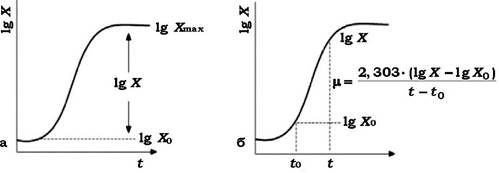
Fig. 3.10. Growth parameters:
a - cell yield, b - growth rate
Generation time is the time required for a population of cells (or cell components) to double. This parameter can be determined from equation (3). Assuming that t - t0 = g, then X = 2 X0. Under these conditions, equation (3) takes the form
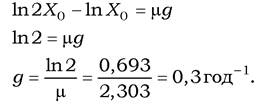
The reproduction rate (division rate coefficient) represents the number of divisions per unit time:

The duration of each generation can be expressed as

The quantitative metrics associated solely with culture growth are insufficient to fully characterize a microbiological process. It is also necessary to account for environmental changes resulting from cellular activity, specifically the depletion of nutrients and the accumulation of metabolic byproducts.
A definite relationship exists between the specific growth rate and the substrate assimilation rate

where μ max is the maximum specific growth rate of the culture (growth constant), which is the limit approached by the growth rate as the concentration of the assimilated substrate increases; S is the concentration of the assimilated substrate; and K is the saturation constant, defined as the nutrient substrate concentration at which the growth rate reaches half of its maximum value, i.e.

One of the key Factors Determining the culture growth rate is the accumulation of metabolic products. There is a direct relationship between The production of metabolites and the specific growth rate of a culture:

where μ0 is the specific growth rate of the culture in a given medium in the complete absence of metabolic products; P is the actual concentration of metabolites; Kр is a constant equal to the concentration of metabolic products at which the growth rate drops by half, i.e., when 
An important metric for microbial culture development is the yield coefficient (economic coefficient), defined as the ratio of biomass increment (yield, X) to the amount of substrate consumed (S), representing the biomass yield per unit of substrate:

When the yield (in grams) is referenced to the number of moles of assimilated substrate, this economic coefficient is referred to as the molar growth yield and is designated as Ym. For instance, YATP is the energy yield coefficient expressed in grams of cellular mass produced per mole of ATP consumed.
The microbial population growth curve shown in Fig. 3.8 is idealized. In complex media, bacterial cells often utilize substrates in a sequential manner. The presence of certain substrates can trigger the repression of enzymes involved in the metabolism of other nutrients. In this case, enzymes catalyzing the metabolism of specific compounds do not become active until the concentration of the substrates repressing their synthesis decreases due to cellular assimilation. The regulation of bacterial physiology leads to alterations in the growth curve, resulting in one or more transient stationary phases. This cellular response to medium changes is known as diauxie. A classic example of diauxie is the growth of Escherichia coli on a medium containing both glucose and lactose (Fig. 3.11). Initially, the culture grows by utilizing glucose. Once this substrate is depleted, the slope of the growth curve changes abruptly, and cell numbers may temporarily decline. This is followed by a new lag phase during which the enzyme system required to assimilate lactose is induced, allowing biomass accumulation to resume.
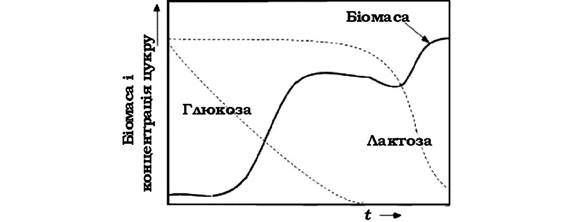
Fig. 3.11. Idealized diauxic growth of bacteria in a batch culture system containing two substrates (glucose and lactose)
Batch cultivation presents certain challenges associated with continuous changes in culture Morphology and physiology, nutrient concentrations, and Metabolic waste products. The interplay of these factors alters the growth rate of the microbial population, ultimately bringing the cultivation process to an end.
Last update: 13/08/2026
Editorial and Educational Adaptation: This material has been compiled based on the primary/original source text. The project team performed an editorial review, corrected technical inaccuracies, structured sections, and adapted the content for an educational format.
What was processed:
- elimination of formatting defects (OCR errors, structural breaks, corrupted characters);
- editorial organization of content;
- standardization of terminology in accordance with academic sources;
- verification of factual statements against the original source text.
All mentions of the author, publication year, and origin of the primary text have been preserved in accordance with the source.