MICROBIOLOGY - M.H. Serhiichuk - 2008
Chapter 3. BACTERIAL GROWTH AND REPRODUCTION
Continuous Cultivation
The aforementioned changes inherent in batch cultivation can be avoided by employing continuous cultivation. In this method, a sterile, nutrient-rich medium is continuously fed into a bioreactor (fermenter) at set intervals, while the culture liquid (consisting of the medium, microbial Cells, and metabolic byproducts) is simultaneously withdrawn at a controlled rate. This enables the culture to remain in the exponential growth phase for extended periods under a constant Substrate Concentration and stable environmental conditions.
Continuous cultivation is characterized by the continuous supply of fresh nutrients at a rate equal to the removal of the culture fluid. Provided the culture is thoroughly mixed, samples drawn from any part of the fermenter will exhibit identical biomass and substrate concentrations.
Theoretically, Bacteria undergoing continuous cultivation grow exponentially while maintaining a constant culture volume over time. This principle forms The basis of continuous cultivation systems such as chemostats and turbidostats.
A chemostat (see Fig. 3.12) features a culture vessel (fermenter) into which the nutrient medium is fed at a constant rate from a dedicated reservoir. Aeration and continuous agitation within the vessel ensure optimal oxygenation and the uniform distribution of incoming nutrients. As the nutrient solution enters the vessel, an equivalent volume of culture fluid is discharged, typically regulated by a dual-pump system (one for feeding fresh medium and another for harvesting the culture liquid).
Class="center">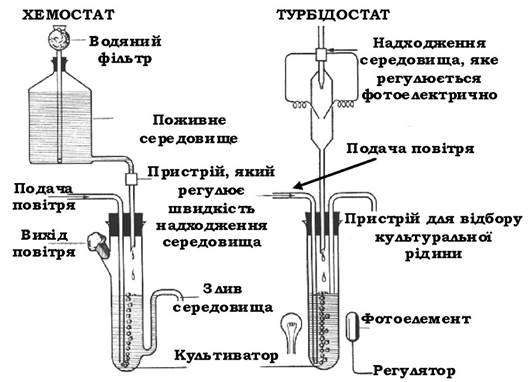
Fig. 3.12. Continuous cultivation in a chemostat and turbidostat
The dual pump, alongside the medium level and condition control system, maintains virtually constant conditions for culture development.
Bacterial growth in a chemostat is governed by the substrate concentration. System stability relies on this growth rate limitation imposed by a single essential nutrient (such as a nitrogen, sulfur, or phosphorus source, or a hydrogen donor).
Continuous cultivation is invariably preceded by batch cultivation, during which biomass accumulates due to excess substrate. Continuous operation should be initiated precisely when the batch culture reaches the exponential phase. This minimizes fluctuations caused by medium input and prevents washout associated with a lag phase.
Culture growth within the fermenter follows an exponential law. The rate of biomass accumulation is defined by the equation:  , meaning that
the density of the bacterial suspension increases exponentially: 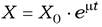 .
.
The rate of change in bacterial suspension density is determined as 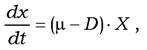
where D is the dilution rate of the culture, h-1:  , with F representing the medium flow rate (mL/min) and V denoting the culture volume.
When μ = D, Cell loss due to washout and biomass production counterbalance one another; thus, the net change is zero, and the bacterial suspension density X remains constant. Under these conditions, the culture exists in a state of "dynamic equilibrium," where the exponential increase in cell numbers is offset by an equivalent exponential decrease.
The stability of dynamic equilibrium in a chemostat relies on growth rate limitation by substrate availability. The chemostat Functions as a self-regulating, user-friendly system. Once the medium flow rate remains constant over an extended period, the operation of the chemostat is regulated automatically.
A turbidostat (see Fig. 3.12) represents the simplest form of continuous culture systems. Its operation is based on maintaining a constant bacterial suspension density or turbidity. Unlike the chemostat, the biomass concentration in a turbidostat is predetermined by the operator, while the dilution rate—and consequently the substrate concentration—is adjusted to sustain the desired biomass level. Consequently, since substrate limitation is unnecessary, the nutrient is supplied in excess. Therefore, the system operates most stably when the specific growth rate of the culture approaches its maximum, μmax. Biomass density is monitored by a photocell connected to a Relay that controls medium delivery. Once the biomass density reaches the target threshold, the relay triggers the influx of a fresh portion of nutrient medium, lowering The Cell concentration to the set point and automatically halting the medium supply.
The term "turbidostat" applies to any method wherein cell density is held constant. It encompasses techniques based on metabolic shifts measured via a "pH-stat" or "CO2-stat". Because key metabolic activities (such as oxygen uptake, CO2 output, pH fluctuations, etc.) correlate with cell growth rates and ultimately with the specific growth rate of the culture, they can serve as indicator variables for regulating medium flow.
Last update: 13/08/2026
Editorial and Educational Adaptation: This material has been compiled based on the primary/original source text. The project team performed an editorial review, corrected technical inaccuracies, structured sections, and adapted the content for an educational format.
What was processed:
- elimination of formatting defects (OCR errors, structural breaks, corrupted characters);
- editorial organization of content;
- standardization of terminology in accordance with academic sources;
- verification of factual statements against the original source text.
All mentions of the author, publication year, and origin of the primary text have been preserved in accordance with the source.