GENERAL MICROBIOLOGY - T.P. Pyrog - 2004
6. MICROBIAL GROWTH
6.4. GROWTH PHYSIOLOGY
6.4.5. Bacterial growth in batch culture
When inoculated into a nutrient medium, Bacteria grow until the concentration of a vital component drops to a minimum or becomes entirely depleted, after which growth ceases. If no nutrients are added to the medium and no metabolic products are removed throughout this period, a so-called batch culture (a Cell population in a restricted living space) is obtained.
The curve describing the relationship between the logarithm of the Number of viable Cells and the cultivation time is called the growth curve (Fig. 6.7). This curve is S-shaped (sigmoidal), and several growth phases can be distinguished on it: the initial (lag) phase, the exponential (logarithmic) phase, the stationary phase, and the death phase. In some manuals, the growth curve features not four, but six phases (see Fig. 6.7): the lag phase, the exponential (logarithmic) phase, the deceleration phase, the stationary phase, the death phase, and the survival phase.
Lag phase. This phase begins at the moment bacteria are inoculated into fresh nutrient medium. During this period, cells adapt to the given cultivation conditions. The duration of the lag phase depends on the history and age of the inoculum, as well as on how favorable the medium and cultivation conditions (pH, Temperature, dissolved oxygen concentration) are for growth. For example, if the carbon and Energy Sources in the new medium differ from those in the medium used to produce the inoculum, adaptation to the new conditions requires the synthesis of new Enzymes that were previously unnecessary and therefore not synthesized. The production of these new enzymes is induced by the new substrate.
Class="center">
Fig. 6.7. Bacterial population growth curve. Growth phases:
I — lag phase; II — exponential phase; III — deceleration phase; IV — stationary phase; V — death phase; VI — survival phase
An example of the substrate's effect on enzyme synthesis is diauxie. This is The phenomenon of sequential utilization of two substrates, or biphasic growth (Fig. 6.8). In a mixture of glucose and sorbitol, bacteria consume glucose first. Enzymes for sorbitol METABOLISM are synthesized only after the glucose is completely depleted.
Quantitative Changes in the COMPOSITION OF THE bacterial cell during the lag phase involve RNA: its content increases 8-12 fold. This indicates the involvement of RNA and Ribosomes in the synthesis of enzyme Proteins.
Exponential phase. This phase is characterized by the maximum rate of Cell Division. In this phase, growth processes proceed in a balanced manner (i.e., the doubling of biomass is accompanied by the doubling of The amount of protein, DNA, RNA, etc.). It can be said that a culture in the exponential phase consists of "standard" cells. However, it should be kept in mind that even in the exponential phase, batch culture cells undergo changes because the environment is constantly changing: Substrate Concentration decreases, cell suspension density increases, and metabolic products accumulate. Because the division rate is relatively constant during this phase, it is the most convenient for determining division and growth rates. The Influence of Environmental factors and nutrient medium composition on Microbial growth is determined by observing biomass indicators or cell counts specifically during exponential growth.
Deceleration phase. The onset of this phase is caused by qualitative changes in the nutrient medium (nutrient consumption, accumulation of metabolic products, oxygen deficiency, pH changes). The Cell responds to this by altering the synthesis rates of RNA, proteins, Polysaccharides, and other components.
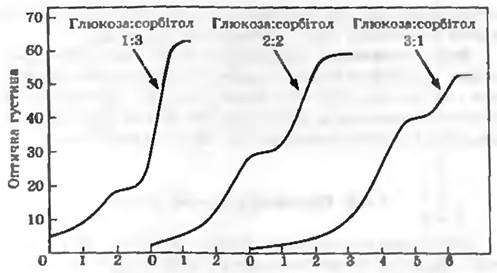
Fig. 6.8. Biphasic growth (diauxie) of Escherichia coli in a medium with glucose and sorbitol at various ratios
Stationary phase. This phase begins when the cell number stops increasing, meaning it is characterized by a balance between newly formed and dying cells. The stationary phase exhibits maximum biomass and maximum Total Cell Count. The amount of biomass in the stationary phase is also referred to as yield. However, in scientific literature, the terms "biomass yield" or "crop yield" are rarely used. Instead, The concepts of "biomass level," "biomass concentration," or simply "biomass" are predominantly employed.
Death phase. This phase is characterized by a decrease in the number of viable cells and an increase in population heterogeneity. Sometimes cells undergo lysis under the action of their own enzymes (autolysis). This phase has been studied significantly less than the preceding ones.
Survival phase. This phase is characterized by the persistence of isolated viable cells amidst the death of the majority of the population. If such cells are transferred to fresh nutrient medium, they begin to grow and divide actively. These surviving cells are characterized by a low rate of metabolic processes.
Last update: 13/08/2026
Editorial and Educational Adaptation: This material has been compiled based on the primary/original source text. The project team performed an editorial review, corrected technical inaccuracies, structured sections, and adapted the content for an educational format.
What was processed:
- elimination of formatting defects (OCR errors, structural breaks, corrupted characters);
- editorial organization of content;
- standardization of terminology in accordance with academic sources;
- verification of factual statements against the original source text.
All mentions of the author, publication year, and origin of the primary text have been preserved in accordance with the source.