GENERAL MICROBIOLOGY - T.P. Pirog - 2004
6. MICROBIAL GROWTH
6.4. GROWTH PHYSIOLOGY
6.4.4. Exponential Growth
Bacteria reproduce by binary fission, which is why their population increases in a geometric progression: 20 → 21 → 22 → 23 →... 2n. If a growing batch culture contains Nn Cells per unit volume, then after n divisions, The Cell count will become Nn · 2n. Taking Logarithms, we obtain:
Class="center">
from which the number of cell divisions is:

THE NUMBER OF CELL DIVISIONS per hour (division rate constant V) is determined by the formula

The time required for a single division cycle (generation time g) is determined by the formula

Example. If the cell count in a suspension increases from 10a to 10® over 10 hours, the division rate constant is:

where lg 2 = 0.3010.
The generation time in minutes is:

Graphical representation of exponential growth. If we plot the number of cells in an exponentially growing population on the ordinate axis and the growth duration on the abscissa axis (both quantities on an arithmetic scale), we obtain an exponential growth curve (Fig. 6.6). However, this method of graphical representation is unsuitable for A large number of cell divisions because, depending on the chosen scale, it allows us to account for either only the early or only the late divisions. Therefore, a semi-logarithmic scale is used, where the logarithm of the cell count is plotted on the ordinate axis. With this type of graph construction, bacterial exponential growth is described by a straight line. The slope of the line characterizes the division rate: the steeper the slope, the higher the rate. Since exponential growth exhibits a linear relationship between the duration of growth and the logarithm of the cell count, such growth is also referred to as logarithmic growth. However, in recent scientific literature, preference is given to the term "exponential growth", while the term "logarithmic growth" is used very rarely and is considered obsolete.
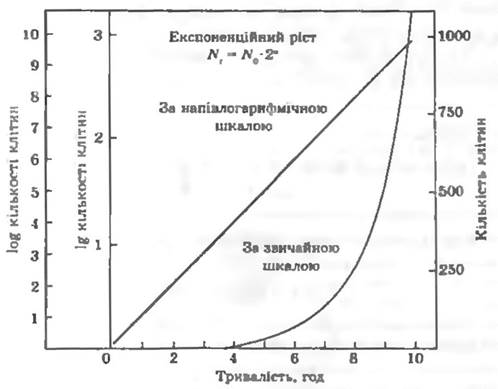
Fig. 6.6. Exponential growth of unicellular organisms: cell count as a function of cultivation time
If the generation time is determined from the cell count using the method described above, we obtain an average value. However, a bacterial population always contains some proportion of defective cells incapable of division; consequently, for actively dividing cells, the true generation time will be slightly shorter than the calculated one. For this reason, when studying growth kinetics, individual cells are disregarded, and the bacterial population is treated as an autocatalytically reproducing system, basing calculations on the bacterial mass density (biomass). The rate of change of this bacterial mass density at any given moment is proportional to the density itself, meaning the change follows first-order reaction kinetics.
In the exponential growth phase, the specific growth rate constant is determined by the formula
.
where X is biomass and t is time
Integrating this equation, we obtain:

where X and X0 are the final and initial biomass, respectively.
For the doubling of cellular biomass 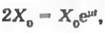 from which the doubling time td is:

Only for "standard cells" (under conditions where biomass growth is proportional to the increase in cell concentration):
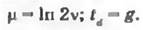
The distinction between The concepts of "cell number" and "cell mass" is summarized in Table 6.6.
Table 6.6.
Differences between the concepts of "cell number" and "cell mass"
Parameters |
Cell number |
Cell mass |
Per unit volume |
Bacterial concentration (number of cells per 1 mL) |
Bacterial density (biomass), mg of dry weight per 1 mL |
Number of doublings per unit time |
Division rate constant v, h-1 |
Growth rate constant μ, h-1 |
Doubling time (time interval required for doubling) |
Generation time g, h |
Doubling time td, h |
Last update: 13/08/2026
Editorial and Educational Adaptation: This material has been compiled based on the primary/original source text. The project team performed an editorial review, corrected technical inaccuracies, structured sections, and adapted the content for an educational format.
What was processed:
- elimination of formatting defects (OCR errors, structural breaks, corrupted characters);
- editorial organization of content;
- standardization of terminology in accordance with academic sources;
- verification of factual statements against the original source text.
All mentions of the author, publication year, and origin of the primary text have been preserved in accordance with the source.