General Microbiology - Schlegel, H. 1987
Electron transport under anaerobic conditions
Methane formation via carbonate reduction
Methane is produced during the anaerobic decomposition of organic matter. Its reserves are substantial; rough estimates indicate that 1–1.5% of the carbon entering the atmosphere as CO2 via the Mineralization of organic matter initially enters as methane and is subsequently converted by hydroxyl radicals (OH) first into CO and then into CO2. Ecosystems that generate methane include vast areas of tundra and wetlands (hence methane's alternative name, marsh gas), rice paddies, sediments at the bottom of ponds and lakes, lagoons, salt marshes and estuaries, sewage Treatment plant sludge, and lastly, the rumen of more than 109 ruminants. Under anaerobic conditions, organic matter is first fermented through a series of intermediate steps into acetate, CO2, and H2. These metabolic products of Primary and secondary decomposers are then utilized by methanogenic Bacteria.
Taxonomic position of methanogenic bacteria. Based on their Morphology, these bacteria can be categorized into rod-shaped (Methanobacterium), coccoid (Methanococcus), sarcina-like (Methanosarcina), and spirillum-like (Methanospirillum) forms (Table 9.2). Methanogenic bacteria constitute a distinct group of microorganisms. They differ from other bacteria not only in their type of METABOLISM, but also in certain features concerning the composition of their Cell structures. They lack a typical peptidoglycan backbone; Methanococcus possesses merely a protein wall, Methanospirillum features a polypeptide sheath, and The Cell wall of Methanosarcina barkeri is composed of a polysaccharide containing uronic acids, neutral sugars, and aminosugars. Penicillin does not inhibit the growth of methanogenic bacteria.
Class="center">Table 9.2. Selected methanogenic bacteria
|
Substrates (hydrogen Donors) |
Autotrophic growth |
|
|
Мethanobacterium thermoautotrophicum |
H2 |
+ |
|
Methanobrevibacter (Methanobacterium) arboriphilicum |
Н2 |
+ |
|
Methanobrevibacter (Methanobacterium) ruminarttium |
Н2 or formate |
- |
|
Methanobacterium formicicum |
Н2 or formate |
+ |
|
Methanomicrobium (Methanobacterium) mobile |
Н2 or formate |
- |
|
Methanococcus vannielii |
Н2 or formate |
n.d.1 |
|
Methanococcus (Methanosarcina) mazei |
Н2, methanol, acetate |
+ |
|
Methanosarcina barkeri |
Н2, methanol, acetate, mono-, di-, and trimethylamine |
|
|
Methanospirilium hungatii |
Н2 or formate |
n.d. |
|
Methanothrix soehngenii |
Acetate |
— |
1 n.d. — not determined.
The cytoplasmic membrane contains Lipids composed of glycerol esters and isoprenoid Hydrocarbons (Section 3.13). The Ribosomes are similar in size to those of eubacteria (70S); however, the base sequences in Ribosomal RNAs, particularly in 16S rRNA, differ significantly from those of eubacteria. Regarding the 16S rRNA sequence, methanogenic bacteria differ much more strongly from, e.g., E. coli than cyanobacteria do. Furthermore, the Translation mechanism is insensitive to Antibiotics that inhibit Protein Synthesis in eubacteria. Based on these and several other distinguishing features, methanogenic bacteria are classified as archaebacteria (Section 3.13).
Physiology. Methanogenic bacteria are strict anaerobes; atmospheric oxygen is lethal to them. They lack both catalase and superoxide dismutase. Precisely because of these bacteria's high sensitivity to oxygen, our knowledge of their physiology, biochemistry, and ecology remains relatively sparse. Only after The Development of specialized techniques (such as the Hungate technique) did it become possible to culture and isolate methanogenic bacteria in the absence of oxygen.
Most species isolated in pure culture thus far are capable of utilizing H2 as a hydrogen donor, while some also utilize formate, methanol, acetate, or methylamine. In A number of anaerobic ecosystems, acetate serves as the primary substrate for methane production. Thus, the range of substrates is very narrow.
Methanogenic bacteria constitute the final link in the anaerobic food chain (p. 266), which begins with Polysaccharides (Cellulose, starch), Proteins, and fats. This chain also involves: 1) bacteria that ferment cellulose into succinate, propionate, butyrate, lactate, acetate, alcohols, CO2, and H2; 2) acetogenic bacteria that ferment these primary Fermentation products into acetate, formate, CO2, and H2 (which in turn serve as substrates for methanogenic bacteria).
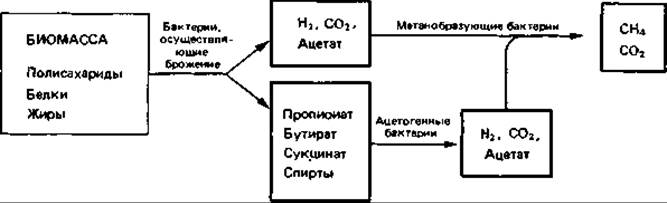

Fig. 9.6. Interspecies hydrogen transfer is illustrated here using Components of the Methanobacterium omelianskii culture. For 30 years, it was considered a pure culture, and only in 1967 was it separated into strain MoH (methanobacterium oxidizing hydrogen) and the accompanying strain S.
Methanogenic bacteria evidently exist in close interaction with hydrogen-producing bacteria (Fig. 9.6). In the microenvironments of such bacteria, free gaseous hydrogen is virtually non-existent. Hydrogen produced by bacteria and dissolved in the medium is immediately consumed by methanogenic species. It is well established that a high partial pressure of H2 inhibits the metabolism and growth of many hydrogen-producing bacteria. This means that not only do methanogenic bacteria depend on H2 producers, but the latter likewise depend on H2-scavenging methanogens. Thus, a mutualistic symbiotic association is established.
Methanogenic bacteria are capable of activating hydrogen and carrying out its Oxidation coupled with the reduction of CO2. Since cellular material in a number of species can be synthesized from CO2 as the sole carbon source, this mode of life can be regarded as chemoautotrophic. To obtain energy, CO2 is used as a hydrogen acceptor, leading to The formation of methane:

Thus, by analogy with Other types of Respiration, methanogenesis can be termed carbonate respiration. Consequently, methanogenic species are characterized as anaerobic, autotrophic, hydrogen-oxidizing bacteria:

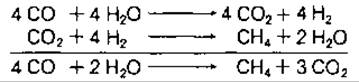
Certain methanogenic bacteria can also convert carbon monoxide into methane, with CO2 and H2 being formed as intermediates:
Biochemistry of methane formation and energy generation. The biochemical conversion of H2 and CO2 into methane, or of acetate into methane and CO2, involves a number of Coenzymes and prosthetic groups that have hitherto been found exclusively in methanogenic bacteria: the deazaflavin derivative F420, methanopterin, methanofuran, the nickel-tetrapyrrole factor F430, and coenzyme M (mercaptoethanesulfonate). Their structures are shown in Fig. 9.7. The most probable pathways for methane formation from

Fig. 9.7. Coenzymes and prosthetic groups found in methanogenic bacteria. A — coenzyme M; B — methyl-coenzyme M; C — F420, a deazaflavin derivative; D — methanopterin; E — methanofuran; F — factor F430 after dissociation from methyl-CoM methylreductase. Reactive groups of compounds D and E are not indicated. Rc, Rd, and Rc denote various multi-component side chains.
acetate and from CO2 + H2 are illustrated in the accompanying schemes:

Little is yet known about the Enzymes involved in individual reactions. The question of ATP regeneration also remains finally unresolved. From a thermodynamic standpoint, only the final reaction leading to methane formation can be coupled with ATP synthesis. Experiments on Methanosarcina barkeri—a bacterium also capable of carrying out the reaction CH3OH + H2 → CH4 + H2O—yielded the following results. The addition of both substrates to the bacterial suspension resulted in proton efflux, ATP generation, and Methane synthesis. Via methyltransferase, methanol can be directly converted into methyl-coenzyme M, the reduction of which yields methane:

The repairing enzyme, methyl-CoM methylreductase, is a multienzyme complex containing, inter alia, protein factors F420, F430, and Hydrogenase. The reaction is presumably always accompanied by the efflux of protons from The Cell, and the resulting proton motive force provides the energy for ATP regeneration. These findings lead to the Conclusion that methanogenic bacteria generally synthesize ATP not via substrate-level phosphorylation, but rather via Oxidative Phosphorylation under anaerobic conditions ("Anaerobic respiration").
Biochemistry of CO2 assimilation. Autotrophic CO2 fixation in methanogenic bacteria [just like in hydrogen-utilizing sulfate-reducing (Chap. 9.2) and acetogenic (Chap. 9.5) anaerobes] occurs without the involvement of the ribulose bisphosphate cycle reactions. The pathway of cell material synthesis from CO2 proceeds via the synthesis of acetyl-CoA and Pyruvate. The steps of this pathway have been elucidated using radioactive compounds, as well as through studies of enzymes from Methanobacterium thermoautotrophicum. The mechanisms of these transformations are currently under intensive investigation.

CO2 is reduced to methanol (in a bound form). A second CO2 molecule is reduced to CO by means of CO dehydrogenase. Reducing equivalents are generated by the activation of H2 via hydrogenases and are transferred by enzymes reacting with factor F420 or NADP. Carbonylation of methyl-X leads to the Formation of Acetyl-X, and the reductive carboxylation of acetyl-CoA by means of pyruvate synthase yields pyruvate, from which cell components are synthesized via known pathways.
Practical significance of methanogenic bacteria. Digesters, in which the anaerobic breakdown of municipal wastewater organics takes place, are standard equipment in municipal Water treatment facilities. In industrialized countries, sludge Digestion serves primarily for the stabilization of primary sludge, as well as waste-activated sludge generated during aerobic wastewater treatment. The methane released during sludge digestion is partly utilized by certain microorganisms and partly used as a fuel. In agriculture, biogas digesters and manure pits are employed to ferment animal excrement together with cellulose-containing waste to produce methane. The biogas production method, with methane as its main component, offers two major advantages: first, the nitrogen contained in the excrement is preserved, along with the valuable fertilizer properties inherent to sulfide-containing sludge; second, biogas is generated (consisting mainly of methane), which can be used as an energy source both in agricultural production and in households.
Last update: 13/08/2026
Editorial and Educational Adaptation: This material has been compiled based on the primary/original source text. The project team performed an editorial review, corrected technical inaccuracies, structured sections, and adapted the content for an educational format.
What was processed:
- elimination of formatting defects (OCR errors, structural breaks, corrupted characters);
- editorial organization of content;
- standardization of terminology in accordance with academic sources;
- verification of factual statements against the original source text.
All mentions of the author, publication year, and origin of the primary text have been preserved in accordance with the source.