BIOTECHNOLOGY - V. H. Gerasymenko - 2006
Part II. Specialized Biotechnologies
Chapter 22. BIOTECHNOLOGIES FOR WASTE MANAGEMENT AND BIOCONVERSION IN THE AGRO-INDUSTRIAL COMPLEX
22.3. NON-TRADITIONAL METHODS. BIOTECHNOLOGY FOR BIOGAS PRODUCTION VIA ANAEROBIC WASTE DIGESTION
22.3.1. Biomethanogenesis and Its Stages
Biomethanogenesis is The process of converting biomass Organic compounds into biogas involving methanogenic anaerobic microorganisms. The coefficient of biomass energy transformation into
methane energy in this process reaches 80%. This is a long-known process discovered back in 1776 by Volta, who established the presence of methane in marsh gas.
The biomethanogenesis process involves methanogenic microorganisms, with 30 to 50 species identified. This symbiotic community, thanks to its ability to alter Fermentation pathways, Functions as a self-regulating system that maintains optimal pH values, redox potential, and thermodynamic equilibrium within the Reactor.
The formation of the methane tank microflora occurs due to microorganisms introduced with the substrate (manure biomass, wastewater, etc.). Alongside obligate anaerobes, facultative anaerobes may also be present in the methane tank. The total bacterial count in the substrate ranges from 1 to 15 mg/ml.
The natural population of microorganisms carrying out the methanogenesis process includes various anaerobes that break down Cellulose, ferment simple sugars, split Proteins, Peptides, and Amino Acids, and degrade Lipids. Consequently, biomass of diverse origins can serve as a raw material for biogas production.
Biomethanogenesis is a multi-stage process in which Biopolymers are converted into acetate, formate, methanol, methylamine, Carbon Monoxide and dioxide, ammonia, hydrogen sulfide, and hydrogen. It proceeds in three successive stages, each carried out by a specific group of microorganisms.
Stage 1: Hydrolysis. This stage involves Gram-negative non-spore-forming microorganisms exhibiting amylolytic, cellulolytic, proteolytic, lipolytic, and Other types of activity. Using hydrolase Enzymes synthesized by these microorganisms, biopolymeric compounds (CARBOHYDRATES, proteins, lipids, Nucleic Acids) are broken down into low-molecular-weight organic substances (mono- and Oligosaccharides, Amino Acids and peptides, glycerol and carboxylic acids, purine and pyrimidine bases). The COMPOSITION OF THE microflora dominating this stage depends on the microflora present in the substrate entering the methane tank, as well as on The chemical composition of the substrate.
Small amounts of carbon dioxide and hydrogen are also formed at this stage.
Stage 2: Acidogenesis. At this stage, various organic acids (butyric, propionic) and their salts are formed from the low-molecular-weight organic substances obtained in The First stage through the action of acid-forming microorganisms. These are subsequently oxidized to acetate and carbon dioxide. Hydrogen, ammonia, and hydrogen sulfide are also produced during this stage.
Acid-forming Bacteria are facultative anaerobic heterotrophs and function best in the pH range of 4.0 to 6.5. The main product of this stage is acetate.
For example, 1 mol of substrate (glucose) yields 4 mol of hydrogen and 2 mol of acetate:
Class="center">
The conversion of low-molecular-weight organic substances proceeds as follows:
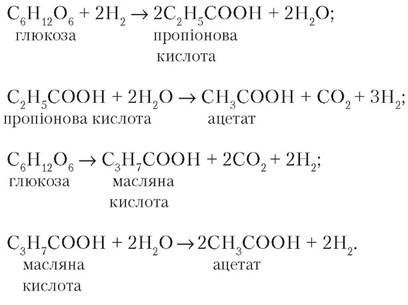
At this stage, about 76% of organic substances are converted into organic acids (52% of which into acetate) and 24% into hydrogen.
Actual methane fermentation takes place in the Third Stage.
Stage 3: Methanogenesis. At this stage, involving enzymes from methanogenic spore-forming and non-spore-forming microorganisms, organic substances are ultimately converted into methane and carbon dioxide. Methane is also formed at this stage from previously obtained carbon dioxide and hydrogen. Thus, 72% of methane is produced from acetate, and 28% from Н2 and СО2.
The methanogenic microorganisms of this stage are obligate (strict) anaerobes. They exhibit maximum activity within a narrower pH range of 7.0 to 7.8. Methanogens belong to the most ancient living organisms—archaebacteria. They differ from other prokaryotes in having a small genome—about 1/3 of the E. coli genome. In Cell shape, methanogens are cocci or rods of various sizes and motility, and some can even form filamentous Cells.
The vital activity of methanogenic microorganisms is based on their ability to reduce carbon dioxide According to the following reaction:

From a biochemical standpoint, methane fermentation is essentially Anaerobic Respiration, in which electrons from organic compounds are transferred to carbon dioxide, reducing it to methane.
Methanogens synthesize methane via the following reactions:
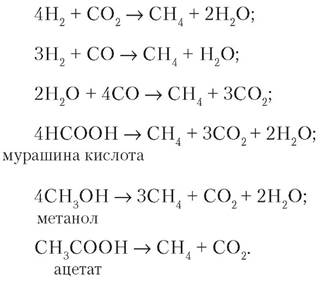
The primary substrate for methanogens is acetate:

Certain methanogens utilize formate as a substrate, converting it into methane:

The core process of biomethanogenesis can be represented by the following reactions:
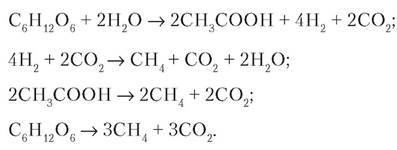
The ratio of intermediate to final products in methane fermentation depends on the Chemical composition of the biomass, fermentation conditions, and the prevailing microflora.
Not all organic feedstocks need to go through all three phases of fermentation. Many types of waste, such as animal manure, contain significant amounts of partially broken-down matter ready to undergo the successive Phases of the fermentation process. At the same time, certain organic compounds (such as Lignin) and all Inorganic Components are non-biodegradable through fermentation.
The reactions occurring during the Digestion of organic matter are exothermic. This process releases approximately 1.5 MJ of heat per 1 kg of dry matter of the fermented biomass, which corresponds to 25 kJ/mol of C6H10O5 (cellulose). As a rule, this thermal energy is insufficient to maintain the required Temperature of the fermenting biomass.
In practice, fermentation is rarely carried to completion because this would excessively prolong the process. Typically, about 60% of the initial product is digested.
Last update: 11/08/2026
Editorial and Educational Adaptation: This material has been compiled based on the primary/original source text. The project team performed an editorial review, corrected technical inaccuracies, structured sections, and adapted the content for an educational format.
What was processed:
- elimination of formatting defects (OCR errors, structural breaks, corrupted characters);
- editorial organization of content;
- standardization of terminology in accordance with academic sources;
- verification of factual statements against the original source text.
All mentions of the author, publication year, and origin of the primary text have been preserved in accordance with the source.