Human Anatomy - H. I. Koliadenko 2009
Main periods and stages of human development in ontogenesis
Postnatal development of the organism
The human Organism goes through three developmental stages: evolutionary, stable, and involutionary. From birth to 18–21 years of age, the body undergoes the evolutionary stage.
Following birth, an infant's growth rate decreases compared to the prenatal period, but The Development of Organs and systems undergoes radical qualitative changes. This is primarily because the external environment, unlike the primary intrauterine environment, is dynamic and exerts a strong influence on the newborn's organism. From this moment, adaptation to the surrounding environment begins and continues throughout a person's life. While hereditary mechanisms drive the embryo and fetus's adaptation to the mother's internal environment during gestation, acquired mechanisms join them after birth, resulting in highly complex transformations within the body.
The evolutionary stage is characterized by the predominance of Cell proliferation over cell destruction. During this phase, human body mass increases 20–25 fold compared to that of a newborn. In the postnatal period, physical development indicators (height, body mass, dimensions of individual body parts, and proportions) vary across different intervals of the evolutionary stage. Specifically, accelerated growth is observed during early childhood (1–3 years), at ages 5–7, and during Puberty (12–15 years). Conversely, between these intervals, accelerated development (differentiation) of Tissues, organs, and the entire organism takes place. Cyclicity is one of the fundamental patterns of the evolutionary stage.
The stable stage of ontogenesis is characterized by a balance between Cell Formation and destruction processes, as well as the preservation of body mass, dimensions, and individual parts. The cessation of somatic growth indicates the onset of maturity. During this period, body mass increases mainly due to adipose tissue, although it can also increase through Muscle mass gain during athletic training.
The involutionary stage of ontogenesis is characterized by the predominance of destructive processes over formative ones, leading to a decrease in body mass and dimensions. Aging occurs during this phase. Old age is not a disease, but it typically develops and progresses against the backdrop of various pathologies. According to V.V. Frolkis's molecular hypothesis, organismal aging results primarily from changes within the genetic apparatus. During aging, protein self-renewal processes decline, leading initially to quantitative and later qualitative changes in Protein METABOLISM. Degeneration of Nerve Cells in the Central Nervous system plays a particularly crucial role in the aging process.
Sclerotic changes in The Cardiovascular system exacerbate this process by impairing cerebral Circulation.
Morphological and physiological changes occurring in the body across various Stages of the postnatal period are governed by the fundamental laws of GROWTH AND DEVELOPMENT. Organismal growth and development are not primarily driven by external influences; rather, they are governed by endogenous mechanisms encoded in the hereditary program.
Gradualness and irreversibility represent key patterns of growth and development. Human Development proceeds through a sequence of successive stages. Furthermore, both growth and development are characterized by unidirectionality. Once a specific stage of growth and development has occurred, it can never be repeated.
Processes of growth, development, and aging occur relatively simultaneously across different organs and systems, yet their progression may vary in intensity (heterochronicity). The synchronicity of organismal growth and development is particularly disrupted during the evolutionary and involutionary stages. Disharmony in children's development sometimes manifests in cases of acceleration.
Below is the WHO age periodization adopted at the International Seminar on Gerontology Problems (Kyiv, 1973):
1. The neonatal period, during which the newborn's organism adapts to new environmental conditions, lasting about one month.
2. The period of breastfeeding (artificial in some cases), lasting 12–15 months.
3. The period of neutral childhood (secondary sex characteristics are weakly expressed), lasting from 1 to 7 years. This period is subdivided into early childhood (1–3 years) and preschool age (3–7 years).
All deciduous Teeth erupt, permanent teeth begin to emerge, and secondary ossification centers appear in the Skeleton.
4. The fourth period, marked by the eruption of permanent teeth and the ossification of epiphyses, is typically divided into early (7–10 years) and middle (11–14 years) school age. During middle school age, the Gonads begin to develop and function, and secondary sex characteristics emerge: boys' voices change, and girls' Mammary Glands develop.
5. Puberty (adolescence) in females generally spans from 12–13 to 16–17 years of age, and in males from 13–14 to 17–18 years. This period includes senior school age (15–18 years).
Early, middle, and senior school ages are defined as adolescence. Skeletal ossification is completed by the end of adolescence. The main feature of this period, also referred to as the period of bisexual childhood, is the full development of reproductive organs and secondary sex characteristics.
6. Adolescence is followed by the period of adult organism development. This phase of human life is typically divided into several stages: young adults (up to 44 years), middle-aged adults (45–59 years), elderly adults (60–74 years), and senile adults (75 years and older). Finally, individuals aged 90 and older are considered centenarians.
Class="center">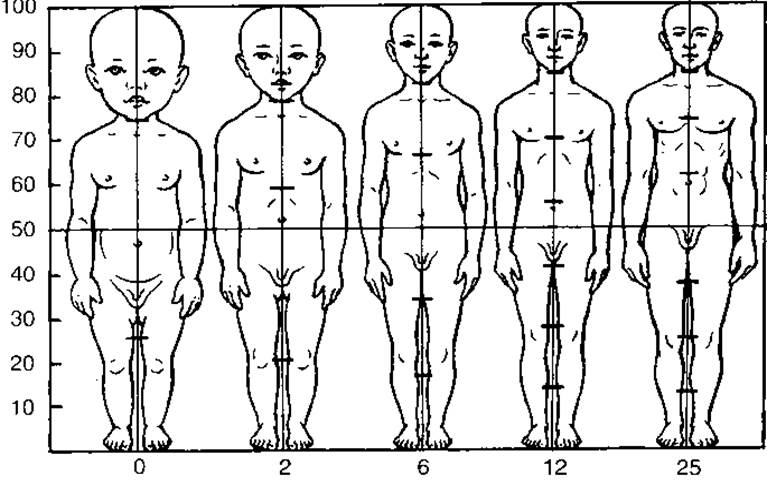
Fig. 13. Changes in body proportions with age
Each period of ontogenesis is characterized by specific Anatomical and physiological features that teachers must take into account when educating and upbringing students.
Morphological criteria of biological age are of great significance for evaluating each period. A child's biological age is determined by the degree of approximation of their organs and systems to the so-called definitive state characteristic of an adult (Fig. 13).
Last update: 08/08/2026
Editorial and Educational Adaptation: This material has been compiled based on the primary/original source text. The project team performed an editorial review, corrected technical inaccuracies, structured sections, and adapted the content for an educational format.
What was processed:
- elimination of formatting defects (OCR errors, structural breaks, corrupted characters);
- editorial organization of content;
- standardization of terminology in accordance with academic sources;
- verification of factual statements against the original source text.
All mentions of the author, publication year, and origin of the primary text have been preserved in accordance with the source.