MEDICAL BIOLOGY, HUMAN ANATOMY, PHYSIOLOGY AND PATHOLOGY - Y.I. Fedoniuk 2010
BIOLOGY
CHAPTER 1. BIOLOGICAL FOUNDATIONS OF HUMAN VITAL ACTIVITY
1.4. ONTOGENETIC LEVEL OF LIFE ORGANIZATION
1.4.2. Fundamentals of Human Genetics
Stages of Genetics Development
Genetics as a science emerged from practical needs (in agriculture and medicine). The earliest concepts of genetics date back to antiquity. Even then, people applied the principles of heredity and Variability to improve desirable traits in animals and plants, without understanding the underlying nature of these phenomena. The fundamental laws of trait inheritance were first discovered by G. Mendel (1865).
Class="center">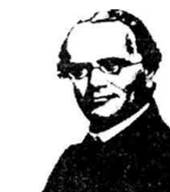
Gregor Johann Mendel (1822-1884)
G. Mendel was born in the village of Heinzendorf (Austrian Empire). In 1843, he entered the Augustinian Abbey in Brno (now the Czech Republic), where he was ordained as a priest. He spent two years studying mathematics at the University of Vienna. Upon his return, working alone in a small garden plot (35x7 m) of the monastery over an 8-year period, he conducted Hybridization experiments with various varieties of garden pea (Pisum sativum). Mendel established that traits are determined by discrete hereditary factors, which the Danish geneticist W. Johannsen later named genes (1909). When crossed, these factors combine within the zygote without fusing or blending like two liquids of different colors—as inheritance was previously imagined (the hypothesis of blending inheritance). Instead, retaining their individual integrity, they are redistributed among the offspring according to specific
statistical patterns. Thus, heredity is particulate (discrete) in nature.
G. Mendel reported the results of his experiments in 1865 at a meeting of the Society for Natural Research in Brno, and in 1866 he published the paper "Experiments on Plant Hybrids" in the society's proceedings. The paper was far ahead of the biological science of its time and went unnoticed by his contemporaries. Recognition came 35 years later, in 1900, when three scientists independently—using different subjects and in different countries (H. de Vries in Holland, C. Correns in Germany, and E. Tschermak in Austria)—rediscovered the laws of inheritance that G. Mendel had established in garden peas. The year 1900 marks the official birth of genetics. Three Main stages in its development are traditionally distinguished.
The First stage of genetics development (1900–1910). This period established Mendel's doctrine of heredity (Mendelism): THE PRINCIPLE OF discreteness in the transmission of hereditary traits, the hybridological method for studying heredity, and the universality of Mendel's Laws for sexually reproducing organisms. The Dutch botanist H. de Vries discovered Mutations in the evening primrose (Oenothera lamarckiana) and formulated the mutation theory (1901). This initial stage is associated with The Study of heredity at the organismal level.
The Second Stage of genetics development (1911–1953). The American geneticist T. Morgan and his school, through Experiments on the fruit fly (Drosophila melanogaster), substantiated the chromosomal theory of inheritance. N.I. Vavilov formulated the law of homologous series in hereditary variation (1920). G.A. Nadson and G.S. Filippov in 1925 were the first to induce artificial mutations in Yeast Fungi using radium rays, while the American geneticist H. Muller achieved the same in Drosophila using X-rays (1927). These discoveries laid the foundation for radiation genetics. S.S. Chetverikov (1926) established that natural populations of Drosophila are saturated with recessive mutations in a heterozygous state, thus laying the groundwork for Population Genetics. A.S. Serebrovsky and co-workers (1929) discovered The phenomenon of stepwise allelomorphism in Drosophila and formulated the step-Gene theory, according to which a gene is divisible and has a complex Structure. American geneticists O. Avery, C. MacLeod, and M. McCarty demonstrated through transformation experiments in pneumococci that the genetic material is DNA rather than protein, as previously believed (1944). This second period in the History of Genetics is characterized by the study of heredity at THE CELLULAR LEVEL and the subsequent development of cytogenetics.
The Third Stage (from 1953 onward). Of decisive importance during this period were the Discovery of the three-dimensional double-helix STRUCTURE OF THE DNA molecule (the English biologist J. Watson and the American physicist F. Crick, 1953), the deciphering of METABOLISM/28.html">The Genetic Code (M. Nirenberg et al., 1960s), the artificial Chemical synthesis of a gene (H. Khorana, 1969), and the discovery of the enzyme Reverse Transcriptase, which catalyzes reverse Transcription—the synthesis of DNA on an mRNA template (H. Temin and D. Baltimore, 1970). In 1972, American geneticists P. Berg, H. Boyer, and S. Cohen created the first recombinant DNA molecule *in vitro*. This marked the birth of a new science: Introduction/32.html">Genetic Engineering, opening up possibilities for Gene Therapy and Gene Surgery. The third stage of genetics development is characterized by the study of heredity at THE MOLECULAR LEVEL and the rapid rise of Molecular Genetics. Molecular genetics owes much of its success to the USE OF MICROORGANISMS as model organisms. These new subjects offered immense population sizes, extremely rapid reproduction rates, a simple genetic apparatus (a single DNA molecule), and mutant forms that were easily cloned.
THE CONTRIBUTION OF Ukrainian scientists to the Selection/4.html">Development of Genetics.
S.M. Gershenzon (1906–1998) discovered the ability of exogenous DNA to induce mutations (1939) and developed THE CONCEPT OF the crucial evolutionary role of adaptive genetic polymorphism. Contrary to the prevailing view regarding the genetic inertness of the heterochromatic region of the Drosophila X chromosome, he determined the number and localization of genes within this region and clarified its role in sex chromosome conjugation. He was the first to obtain experimental data demonstrating the possibility of the reverse transfer of Genetic information from RNA to DNA (1961), which was later proven in Oncogenic Viruses by H. Temin and D. Baltimore (1970). The results of these and other studies placed S.M. Gershenzon among world-renowned geneticists. He made a major contribution to training scientific personnel in genetics while serving at the departments of genetics at Moscow and Kyiv universities. For many years, students studied genetics from S.M. Gershenzon's textbook *Fundamentals of Modern Genetics*, which was published in two editions and awarded the State Prize of Ukraine.
G.D. Berdyshev (born 1930) is renowned for his research in ontogenetics, gerontology, and juvenology (his own term designating the science of prolonging youth). He formulated the Synthetic Theory of human ontogenesis, which is based on the principle of genetic determination across all stages of ontogenesis, including the Aging phase. From 1984 to 1987, he served as an expert in molecular biology and genetics for the World Health Organization (WHO). He is the author of textbooks on medical genetics, General Genetics, and molecular genetics, which have educated more than one generation of students in Ukraine.
Last update: 08/08/2026
Editorial and Educational Adaptation: This material has been compiled based on the primary/original source text. The project team performed an editorial review, corrected technical inaccuracies, structured sections, and adapted the content for an educational format.
What was processed:
- elimination of formatting defects (OCR errors, structural breaks, corrupted characters);
- editorial organization of content;
- standardization of terminology in accordance with academic sources;
- verification of factual statements against the original source text.
All mentions of the author, publication year, and origin of the primary text have been preserved in accordance with the source.