MEDICAL BIOLOGY, HUMAN ANATOMY, PHYSIOLOGY AND PATHOLOGY - Ya.I. Fedonyuk 2010
ANATOMY, PHYSIOLOGY, PATHOLOGY
SECTION 3. ANATOMICAL AND PHYSIOLOGICAL ASPECTS OF BODY FUNCTION SELF-REGULATION
GENERAL ISSUES OF THE ANATOMY AND PHYSIOLOGY OF SENSORY SYSTEMS
THE SKIN (ORGAN OF TOUCH, TEMPERATURE, AND PAIN SENSATION)
1. GENERAL CHARACTERISTICS OF THE SKIN
The Skin (cutis, derma) forms the General Integument of the body, protecting it from environmental influences. It is a vital organ that performs A number of Functions: thermoregulation, excretion of secretions (sweat, sebum) along with harmful substances, Respiration (gas exchange), acting as a depot for energy reserves (subcutaneous adipose tissue), and the perception of environmental stimuli (pressure, Touch, Temperature, etc.).
The surface area of the skin in an adult is about 1.5-2 m2.
Human skin consists of two layers (Fig. 3.56):
1. Epidermis (epidermis) - the superficial layer, composed of keratinized stratified squamous epithelium.
2. Dermis proper - the deep layer - dermis (corium, dermis), composed of Fibrous Connective Tissue with a small number of elastic and smooth Muscle fibers.
Class="center">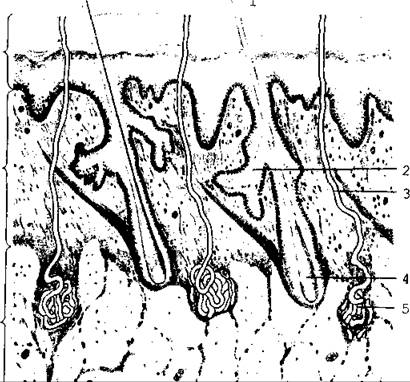
Fig. 3.56. Structure OF THE Skin: I - epidermis; II - dermis (dermis proper); III - subcutaneous base. 1 - Hair; 2 - sebaceous gland;
3 - excretory duct of the sweat gland; 4 - hair ROOT; 5 - sweat gland.
The dermis proper has two layers: an upper dense layer and a lower layer.
The upper dense layer (papillary layer) projects into the epidermis and forms papillae, inside of which run Blood and Lymphatic capillaries and nerve endings.
The papillae on the skin surface form a distinct relief pattern of ridges and grooves. The openings of the Sweat Glands open onto the ridges. On the palms and soles, the ridges and grooves form a complex pattern unique to each individual. This is used in criminology and forensic medicine for personal identification if fingerprints have been previously taken (i.e., dactyloscopy has been performed).
The lower layer transitions into the subcutaneous layer (hypodermis), which is represented by loose Connective tissue with fat Cells. Adipose tissue is involved in thermoregulation. In areas subject to heavy pressure (the sole when standing, the buttocks when sitting), the subcutaneous fat layer is well developed, acting as an elastic cushion.
Skin color depends on The amount of pigment (melanin) located in the Deep Layer of the epidermis.
Last update: 08/08/2026
Editorial and Educational Adaptation: This material has been compiled based on the primary/original source text. The project team performed an editorial review, corrected technical inaccuracies, structured sections, and adapted the content for an educational format.
What was processed:
- elimination of formatting defects (OCR errors, structural breaks, corrupted characters);
- editorial organization of content;
- standardization of terminology in accordance with academic sources;
- verification of factual statements against the original source text.
All mentions of the author, publication year, and origin of the primary text have been preserved in accordance with the source.