MEDICAL BIOLOGY, HUMAN ANATOMY, PHYSIOLOGY AND PATHOLOGY - Ya.I. Fedoniuk 2010
ANATOMY, PHYSIOLOGY, PATHOLOGY
CHAPTER 2. MUSCULOSKELETAL SYSTEM (THE MECHANICS OF MOVEMENT)
MUSCLES AND FASCIAE OF BODY REGIONS
MUSCLES AND FASCIAE OF THE TRUNK
1. MUSCLES AND FASCIAE OF THE BACK
The Muscles of the back are divided into superficial and deep groups.
SUPERFICIAL MUSCLES OF the back (Fig. 2.81):
Class="center">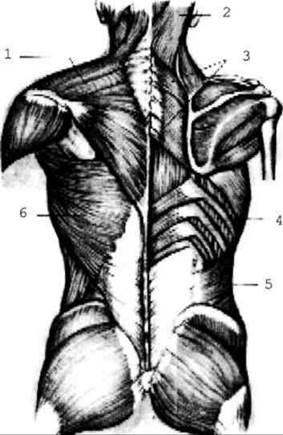
Fig. 2.81. Superficial muscles of the back
1. The trapezius Muscle originates from the Occipital bone, the nuchal ligament, and the spinous processes of all thoracic vertebrae. It inserts into the lateral third of the clavicle, the acromion, and the spine of the scapula. Function: the upper fibers elevate the scapula, the lower fibers depress it, and the middle fibers retract the scapula toward THE Vertebral Column. Contraction of the entire muscle draws the scapula toward the midline, while fixed scapulae facilitate extension of the HEAD.
2. The latissimus dorsi muscle originates from the spinous processes of the lower six thoracic and all lumbar vertebrae, the thoracolumbar fascia, and the iliac crest. It inserts into the crest of the lesser tubercle of the humerus. Function: extends, adducts, and medially rotates the arm at the shoulder joint.
3. The rhomboid muscles (Major and minor) lie beneath the trapezius. They originate from the spinous processes of the two lower cervical and four upper thoracic vertebrae and insert into the medial border of the scapula. Function: elevates the scapula and retracts it toward the midline. When both muscles (left and right) contract simultaneously, the scapulae move closer together.
4. The levator scapulae muscle originates from the transverse processes of the upper four cervical vertebrae and inserts, along with the latissimus dorsi, into the superior angle of the scapula. Function: elevates the scapula.
5. The serratus posterior superior lies beneath the rhomboid muscles. It originates from the spinous processes of the two lower cervical and two upper thoracic vertebrae and inserts into Ribs II-V. Function: elevates the ribs.
6. The serratus posterior inferior is located beneath the latissimus dorsi. It originates from the spinous processes of the two lower thoracic and two upper lumbar vertebrae and inserts into the four lower ribs. Function: depresses the ribs.
Deep Muscles of the back (Fig. 2.82).
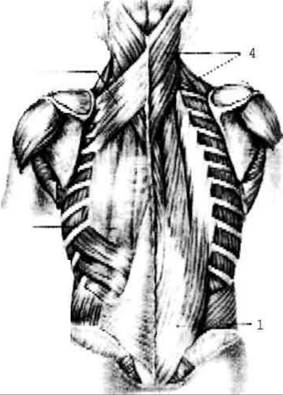
Fig. 2.82. Deep muscles of the back
The deep back muscles form the lateral and medial tracts, which lie on either side of the spine and extend from the occipital bone to the sacrum. The lateral tract is more superficial, forming the erector spinae muscle. The muscles of the medial tract (transversospinales) lie deeper and consist of groups of short muscular bundles that span across 5-6, 3-4, or 1 vertebra.
In the posterior neck region, superficial to these tracts, lie the splenius capitis and splenius cervicis muscles.
Upon contraction, all these muscles develop significant force, maintaining the vertical alignment of the spine, which serves as the support for the head, ribs, and upper and lower limbs.
Fascia of the back
The superficial fascia covers the trapezius and latissimus dorsi muscles. The thoracolumbar fascia separates the superficial back muscles from the deep ones, forming a sheath for the erector spinae muscle.
Last update: 08/08/2026
Editorial and Educational Adaptation: This material has been compiled based on the primary/original source text. The project team performed an editorial review, corrected technical inaccuracies, structured sections, and adapted the content for an educational format.
What was processed:
- elimination of formatting defects (OCR errors, structural breaks, corrupted characters);
- editorial organization of content;
- standardization of terminology in accordance with academic sources;
- verification of factual statements against the original source text.
All mentions of the author, publication year, and origin of the primary text have been preserved in accordance with the source.