HUMAN MEDICAL BIOLOGY, ANATOMY, PHYSIOLOGY, AND PATHOLOGY - Ya.I. Fedoniuk 2010
BIOLOGY
CHAPTER 2. BIOGEOCENOTIC LEVEL OF ORGANIZATION OF LIFE AND HUMAN PLACE IN IT
2.6. ORGANISMS POISONOUS TO HUMANS
Poisonous Animals
Class="center">
Primary venomous (poisonous) animals are those that produce venom in specialized glands or whose metabolic products are toxic. As a rule, toxicity in primary venomous animals is a species-specific trait present in all individuals of a given species. Secondary venomous animals do not produce venom themselves, but are capable of accumulating exogenous toxins. For example, Mollusks and fish accumulate toxins produced by blue-green Algae, while insects accumulate toxins from the plants they feed on. These animals exhibit their toxicity only when consumed as food. Actively venomous animals are primary venomous species equipped with a specialized apparatus for venom production, whereas passively venomous animals lack such an apparatus. Armed actively venomous animals possess a venom delivery device (e.g., snakes' fangs, insects' stingers, fish spines and thorns), while unarmed actively venomous animals lack this device (e.g., amphibian Skin glands, insect anal glands). The poisonous secretions of the latter exert their toxic effect upon contact with the victim's integument.
Despite the fact that venomous animals pose a danger to humans, they themselves require protection. The population of snakes is declining not only due to the habit of destroying them, but also As a result of intensive capture for venom extraction. The population of venomous insects is decreasing due to The Use of insecticides, which destroy not only harmful fauna, but also beneficial ones.
Poisonous animals are found across many phyla of the animal kingdom.
Phylum Coelenterata (Cnidaria). This phylum comprises about 9,000 species. Coelenterates lead an exclusively aquatic and mostly marine lifestyle. The most characteristic feature of the phylum is the presence of stinging Cells (nematocytes) that produce venom and serve as instruments for attack and defense. Each stinging Cell consists of a stinging capsule filled with fluid, inside of which lies a tightly coiled hollow thread. A sensitive trigger Hair, the cnidocil, is located on The Cell surface. Touching it causes irritation, resulting in the ejection of the thread, which straightens out like an arrow. The stings of these threads are venomous and can paralyze small animals. Jellyfish, particularly tropical ones, are dangerous to humans. The body of a jellyfish is shaped like an inverted bell or umbrella. The margin of the bell bears a variable number of tentacles, where stinging cells are especially abundant.
In the Sea of Japan, near the coasts of Primorsky Krai and Sakhalin, the stalked jellyfish (Gonionemus vertens), up to 17-25 mm in diameter, can be found. When touched, a person experiences atonia, Muscle tone drops, Respiratory Muscles are also affected, and death is possible. Among tropical jellyfish, the most dangerous is the sea wasp (Chironex fleckeri), up to 45 mm in diameter. Contact with its tentacles causes cramps, paralysis, and death in humans. In the Black and Azov Seas, the barrel jellyfish (Rhizostoma pulmo) is widespread, causing Burns that, however, quickly pass.
Prevention. Do not swim in jellyfish habitats during morning and evening hours. During mass blooms of jellyfish, swimming in these areas is strictly prohibited. Do not catch jellyfish with bare hands. When working in the Water, use wetsuits, masks, goggles, thick-soled shoes, and gloves.
Phylum Arthropoda. Among Arthropods, venomous representatives belong to the classes Arachnida and Insecta. Poisonous arachnids include scorpions and spiders.
Class Insecta (Insects). Venomous insects include Representatives of the orders Hymenoptera and Coleoptera.
Order Hymenoptera. Bees, wasps, and bumblebees are venomous. Among bees, the honeybee (Apis mellifera) is the most dangerous. Multiple stings, when a person is attacked by a swarm, pose a serious threat. However, cases are known where a single sting proved fatal due to an allergic reaction to the venom. When stinging a person, a bee drives a barbed stinger into the body and then tries to fly away. The stinger, along with the venom glands and the last ganglion of the abdominal nerve chain, is torn off and remains in The Human Body, while the venom continues to be released. The bee quickly dies thereafter. The main symptoms of envenomation are pain and Swelling. Swelling is particularly dangerous if it affects the oral mucosa and respiratory tract, which can lead to asphyxia. Patients may die from paralysis of the respiratory muscles. When massive doses of venom enter the body, damage to Internal Organs occurs, especially the Kidneys, which excrete the toxin. Bee venom—apitoxin—exhibits hemotropic and neurotropic effects. It increases vascular permeability, causes hemolysis of red Blood Cells, and possesses analgesic and anti-inflammatory properties. It is used as a component in various pharmaceutical preparations.
Order Coleoptera (Beetles). Venomous beetles include the family Meloidae (blister beetles) and the family Staphylinidae (Fig. 2.63). The hemolymph of these beetles is poisonous. Hemolymph can get onto human skin if the beetle is crushed, causing dermatitis. Getting hemolymph into the eyes is particularly hazardous. The active substance of blister beetle venom is cantharidin. Paralysis develops in experimental animals.
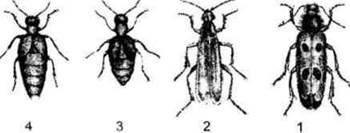
Fig. 2.63. Blister beetles:
1 - genus Mylabris; 2 - genus Epicauta; 3-4 - genus Meloe.
Last update: 08/08/2026
Editorial and Educational Adaptation: This material has been compiled based on the primary/original source text. The project team performed an editorial review, corrected technical inaccuracies, structured sections, and adapted the content for an educational format.
What was processed:
- elimination of formatting defects (OCR errors, structural breaks, corrupted characters);
- editorial organization of content;
- standardization of terminology in accordance with academic sources;
- verification of factual statements against the original source text.
All mentions of the author, publication year, and origin of the primary text have been preserved in accordance with the source.