MEDICAL BIOLOGY, HUMAN ANATOMY, PHYSIOLOGY, AND PATHOLOGY - Ya.I. Fedonyuk 2010
BIOLOGY
CHAPTER 2. BIOCOENOTIC LEVEL OF ORGANIZATION OF LIFE AND HUMAN'S PLACE IN IT
2.6. ORGANISMS POISONOUS TO HUMANS
Venomous Fish
Venomous fish are divided into actively and passively venomous species. Actively venomous fish inject venom primarily through punctures by fin rays (spines) or thorns located on the gill covers, tail, or at the Base of the dorsal fin.
In the Black Sea, the spiny dogfish, or spurdog (Squalus acanthias), is found locally known as the "nokotnitsa". It reaches a length of about 1 m and is a commercial species. Its spines are venomous, with venom glands located beneath them. The venom causes pain, hyperemia, and edema.
Stingrays (Fig. 2.64) also belong to venomous fish. They are typical bottom-dwellers widely distributed in temperate and warm seas. The common stingray inhabits the Black and Azov seas, reaching up to 1 m in length. It is a commercial species with a body ending in a long whip-like tail. In the middle section of the tail, on the dorsal side, There is a barbed spine (up to 30 cm long) with serrations on both sides. Venom accumulates in the grooves of the spine. When defending itself, the stingray delivers a powerful strike with this spine, which is capable of piercing clothing and footwear. Symptoms of poisoning include acute burning pain, hyperemia, followed by edema and spreading pain, weakness, loss of consciousness, convulsions, and respiratory disturbances. A puncture to the chest or abdomen can be fatal.
Class="center">
Fig. 2.64. Stingray.
Greater weever fish are common in the Baltic and Black seas. Their bodies are strongly laterally compressed, and the eyes are located on the dorsal surface of the HEAD, positioned very closely together. Their size ranges from 30 to 45 cm.
The rays of the first dorsal fin and the spines of the gill covers are venomous. The venom contains neurotoxins and hemotoxins. Punctures are not fatal, but they cause severe pain, edema, and Necrosis of the affected area. In severe cases, they may lead to paralysis as well as respiratory and hemodynamic disorders.
In scorpionfish and rockfish, the fin rays are venomous (Fig. 2.65).
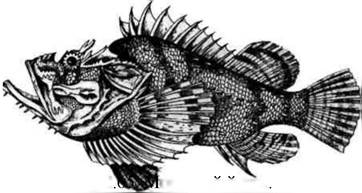
Fig. 2.65. Scorpionfish
Passively venomous fish do not produce venom themselves, but certain of their Organs are toxic. For example, in the pufferfish (tetrodon), found in the Pacific Ocean near the coast of Japan, the roe, Liver, and Blood are poisonous. The most dangerous pufferfish species is the globefish; its toxin (tetrodotoxin) causes death due to paralysis of the Respiratory Muscles.
In its MECHANISM OF ACTION, this toxin is similar to curare poison. Passively venomous fish also include the Central Asian marinka fish, whose meat is edible and delicious, while its reproductive organs and Peritoneum are toxic. Cases of severe mass poisoning are known.
Last update: 08/08/2026
Editorial and Educational Adaptation: This material has been compiled based on the primary/original source text. The project team performed an editorial review, corrected technical inaccuracies, structured sections, and adapted the content for an educational format.
What was processed:
- elimination of formatting defects (OCR errors, structural breaks, corrupted characters);
- editorial organization of content;
- standardization of terminology in accordance with academic sources;
- verification of factual statements against the original source text.
All mentions of the author, publication year, and origin of the primary text have been preserved in accordance with the source.