HUMAN MEDICAL BIOLOGY, ANATOMY, PHYSIOLOGY, AND PATHOLOGY - Y.I. Fedoniuk 2010
BIOLOGY
CHAPTER 1. BIOLOGICAL FOUNDATIONS OF HUMAN VITAL ACTIVITY
1.4. ONTOGENETIC LEVEL OF LIFE ORGANIZATION
1.4.2. Basics of human genetics
Cytogenetic Method
This is a method of Human Genetics based on the microscopic study of Human Chromosomes. The method is used for: 1) studying karyotypes; 2) diagnosing human Chromosomal Disorders; 3) constructing chromosome maps; 4) studying the Mutational Process in human populations; 5) resolving certain evolutionary issues.
The cytogenetic method includes: 1) studying the Human Karyotype and 2) determining sex Chromatin.
Study of the human karyotype (karyotyping). To study the human karyotype, mitotic (metaphase) chromosomes are examined, and less commonly, meiotic (prophase and metaphase) chromosomes. There are Direct and Indirect Methods for their study. In the direct method, fresh biopsy material is examined immediately after collection (Bone Marrow, tumors, embryonic Tissues, chorion, gonadal Cells), while in the indirect method, it is examined after preliminary cultivation on nutrient media. Currently, the human karyotype is most frequently studied using peripheral Blood leukocyte cultures. Metaphase plate preparations are thus obtained.
The primary method for identifying human chromosomes continues to be their systematization by cutting out each chromosome from a photomicrograph of a metaphase plate and mounting them on paper in accordance with the Denver Classification. The chromosomes are divided into 7 groups, within which pairs of homologous chromosomes are identified. This yields an idiogram (karyogram) of the chromosomes.
Determination of Sex chromatin. X- and Y-sex chromatin (c) are distinguished. X-sex chromatin (Barr body) is one of the two female X chromosomes that undergoes heterochromatinization during Cytology/cytology/16.html">Early stages of Embryogenesis and transitions into a genetically inactive state, thereby reducing Gene dosage. Most commonly, X chromatin is examined in the nuclei of oral mucosa epithelial cells, where it appears as a hemispherical clump of heterochromatin attached to the inner nuclear membrane. Sex chromatin is also detected in neutrophil leukocytes as a drumstick appendage protruding from The surface of one of the nuclear segments. The number of sex chromatin clumps (or drumsticks) is one less than the number of X chromosomes in somatic cells, which is expressed by the formula: a = n-1, where a is the number of X chromatin clumps and n is the number of X chromosomes. In a healthy female (XX), 60–70% of somatic cells contain one Barr body; in X chromosome trisomy (XXX), There are two Barr bodies; and in X chromosome monosomy (XO), Barr bodies are absent (Fig. 1.75). In most healthy males (XY), the somatic Cell nuclei do not contain any Barr bodies, although up to 8% may be observed in modern populations.
Class="center">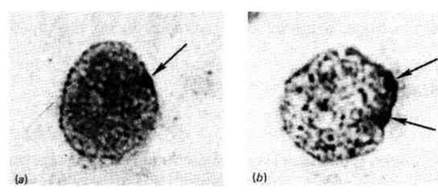
Fig. 1.75. X sex chromatin in the interphase Nucleus: a - a single sex chromatin body in a healthy female (46, XX); b - two sex chromatin bodies in a female with a 47, XXX karyotype (Triple-X syndrome).
Y chromatin (F-body) is the Y chromosome in the somatic cell nuclei of males. To detect Y chromatin, somatic cells are stained with fluorochromes and examined using a fluorescence Microscope. The Y chromosome differs from all other chromosomes by the intense green fluorescence of its long arm. A single fluorescent region is visible in the somatic Cell Nucleus of a healthy male, two are visible in Y polysomy (XYY), and so forth.
The METHOD FOR DETERMINING sex chromatin is applied in the following situations: 1) determining sex in cases of hermaphrodism; 2) prenatally determining the sex of a child (via amniocentesis); 3) diagnosing Hereditary diseases caused by sex chromosome imbalances; 4) identifying hereditary pathology in children with intellectual disabilities; 5) detecting hereditary pathology associated with Primary and secondary Amenorrhea in women; 6) investigating male and Female Infertility; 7) in forensic medical practice (bloodstain analysis can determine the sex of the individual to whom the blood belonged).
Significance: the determination of sex chromatin enables rapid preliminary Diagnostics of sex chromosome numbers without The Need for full, time-consuming karyotyping.
Last update: 08/08/2026
Editorial and Educational Adaptation: This material has been compiled based on the primary/original source text. The project team performed an editorial review, corrected technical inaccuracies, structured sections, and adapted the content for an educational format.
What was processed:
- elimination of formatting defects (OCR errors, structural breaks, corrupted characters);
- editorial organization of content;
- standardization of terminology in accordance with academic sources;
- verification of factual statements against the original source text.
All mentions of the author, publication year, and origin of the primary text have been preserved in accordance with the source.