Basics of Evolution - Korzh O.P. - 2006
Part II. MACROEVOLUTION
Chapter 12. Evolution of Ontogeny
12.4. Autonomization of Ontogeny
Individual development is always partially dependent on environmental factors. However, distinguishing between traits and processes that are influenced by EXTERNAL FACTORS AND those that are not is nearly impossible; according to I.I. Schmalhausen, ontogeny should be considered indivisible.
In the course of historical transformations, the relationship between the Organism and the environment has constantly changed, driven by environmental shifts and the Evolution of the organism itself. Specifically, There is a gradual reduction in the determinative influence of physical environmental factors; they lose their morphogenetic significance and recede to the level of conditions required for normal development. At the same time, Structure/19.html">The Importance of internal developmental factors steadily increases, manifesting as morphogenetic dependencies.
The enhancement of individual resistance in developmental processes against external influences makes ontogeny less vulnerable to destructive environmental impacts. The diminishing decisive role of physicochemical environmental conditions, which fosters greater stability in individual development, is referred to as the autonomization of ontogeny.
The Evolutionary Significance of this process lies in the fact that the organism gradually liberates itself from minor, short-term environmental influences, stabilizing the course of its development. If we examine
Examples, we can observe an extreme dependence of development on environmental conditions in lower invertebrates. This applies to both aquatic organisms (in the absence of Water, cysts, "winter eggs", etc., are formed) and terrestrial ones—for instance, in the intestinal threadworm (Strongyloides stercoralis), when certain nutrients are deficient, the rhabditiform larva transforms into a filariform larva and shifts to a parasitic lifestyle.
While a certain stabilization of ontogeny can be noted in insects, the dependence of their development rate on Temperature conditions is so pronounced that it has even been termed physiological time—ultimate development is only possible through a combination of time and a specific supra-threshold temperature (necessary for development). True reduction in the dependence of development on environmental influences is observed only in higher animals, most vividly in birds (where a duck's egg incubated by a hen still hatches a duckling) and mammals (intrauterine development). One of the most important consequences of autonomization can be considered the organism's ability to maintain Homeostasis.
Thus, at the lower rungs of the evolutionary ladder, the Ontogenetic development of organisms exhibits maximal dependence on physical environmental factors. As deviations from the adaptive norm were eliminated, internal mechanisms evolved that counteract adverse temporary impacts of various factors (driven by appropriate regulations) and facilitate The Use of regular phenomena to execute vital Functions (forming necessary adaptations).
During evolution, regulatory mechanisms of individual development undergo modification and refinement. This is accomplished on The basis of positive and feedback loops. According to I.I. Schmalhausen, the entire essence of individual development consists in transforming hereditary information into a system of life connections between the organism and the environment. Feedback information is received through phenotypic traits, allowing this Organization to be monitored by ecosystem factors. In the evolution of the organism as a whole, the stabilizing form of Selection plays a decisive role in its resilience. Through the elimination of all random phenotypic disruptions from the biological arena, more reliable Mechanisms for the transmission, transformation, and realization of hereditary information are formed. Along with The Development of the regulatory system, the lower and upper Limits of the normal morphogenetic reaction of organisms are established.
Thus, we arrive at The problem of the canalization of ontogeny—The process of increasing regulation in the individual development of organisms. If we represent the development of an organism from an egg to an adult state as a trajectory (creod), we can see that it is influenced by an extraordinarily large number of diverse factors. Such influences, both internal and external, can cause significant deviations from the generalized creod and even lead to a transition to another one. For instance, poor-quality or insufficient Nutrition can lead to reduced sizes in insect larvae and pupae, from which only males eventually emerge.
This concerns not only final size, developmental rate, and fecundity, but also the fact that in some species, multiple phenotypic developmental variants truly arise from the exact same genotype (Fig. 12.10). For example, in social insects, the same egg can give rise to either a fertile caste or a worker individual with a specific functional specialization. In the simplest case (primitive eusocial insects), caste polymorphism only operates at the adult (imago) phase: the sterility of workers is temporary and determined solely by the presence of a stronger female acting as the queen. Under such circumstances, a shift in power within the nest becomes possible, accompanied by increased aggressiveness and other behaviors.
Such a process of ontogenetic stabilization is the result of canalizing selection—a stabilizing form of natural selection acting on ontogeny. This process can be traced in the development of caste determination in termites. Pheromones from the royal couple counteract the appearance of replacements—new kings and queens—and promote the transformation of larvae into soldiers. The latter secrete their own pheromones, which prevent The Emergence of surplus soldiers and direct larval development down the worker pathway. In this way, the required ratio of individuals belonging to different castes is maintained. In primitive forms, the transition of individuals into different castes can occur at late Stages of Ontogeny. However, in higher termites, significant ontogenetic stabilization is present: as early as the second larval instar, larvae are definitively differentiated into future castes and develop along a single possible pathway (Fig. 12.11).
Class="center">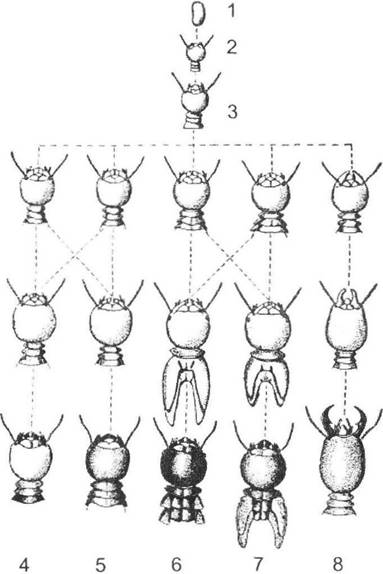
Fig. 12.10. Pathways of individual development in the African termite (after S. Skaife, cited in V.E. Kipyatkov, 1991):
1-3 - identical developmental stages: ontogenetic caste differentiation begins only from the third larval instar; 4 - worker caste; 5 - ergatoid (wingless) reproductives; 6 - adultoid (true) reproductive; 7 — nymphoid (underdeveloped wings) reproductive; 8 - soldier (certain transitions between castes are possible even in the fourth instar (intersections))
A clear example of the autonomization of ontogeny is the evolution of developmental mechanisms in certain Organ Systems of vertebrates. In primitive forms (such as the axolotl), the development of pulmonary alveoli and secondary renal tubules occurs only under the Influence of the corresponding function, without which this development is impossible. Later, even in other amphibian species, the development of these structures begins during the pre-functional period. In the toad, initial lung fragmentation occurs while still in the larval stage under METABOLISM/18.html">The Influence of thyroid hormone.
In reptiles and mammals, typical self-differentiation of pulmonary structures takes place during the Embryonic period, whereas lung functioning begins only after birth and is accompanied by subsequent tissue formation. Exceptions include monotremes and marsupial mammals, in which lung alveoli begin to develop solely under the influence of the breathing process itself. Similarly, the pronephros in birds is thought to act as an inducer for The formation of the adult trunk Kidney (likely its most important function in ontogeny).
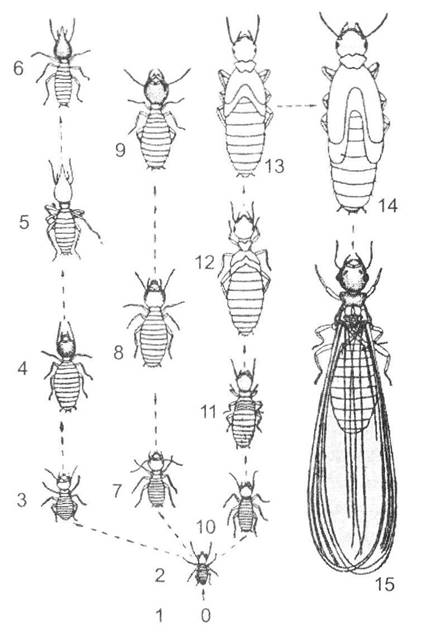
Fig. 12.11. Developmental pathways of different castes in the termite (after J. Batelli, cited in V.E. Kipyatkov, 1991):
1 - egg; 2 - first-instar larva; 3-6 - soldier development; 7-9 - worker development; 10-15 - alate reproductive development
Thus, we observe a gradual transition from the morphogenetic significance of an organ's function first to endocrine influences (or internal factors) and, finally, to the process of self-differentiation, i.e., autonomous development. This evolutionary pattern—where factors that drove the formation of new adaptations are replaced by more reliable, internal ones—implies the stabilization of morphogenesis and ontogeny as a whole. Ultimately, stabilizing (canalizing) selection leads to a more or less complete autonomization of ontogeny. The development of regulatory systems and the progressive autonomization of organismal development are accompanied by a substantial reorganization of their ontogeny. According to I.I. Schmalhausen, the Increasing complexity of The system of morphogenetic correlations, which gradually acquire a regulatory character, is of exceptional importance here. Maximum evolutionary plasticity also ensures the highest Rates of evolution in higher animals, which are characterized by great individual adaptability and autonomous development paired with a highly sophisticated regulatory system.
Last update: 07/08/2026
Editorial and Educational Adaptation: This material has been compiled based on the primary/original source text. The project team performed an editorial review, corrected technical inaccuracies, structured sections, and adapted the content for an educational format.
What was processed:
- elimination of formatting defects (OCR errors, structural breaks, corrupted characters);
- editorial organization of content;
- standardization of terminology in accordance with academic sources;
- verification of factual statements against the original source text.
All mentions of the author, publication year, and origin of the primary text have been preserved in accordance with the source.