Basics of Evolution - Korzh O.P. - 2006
Part II. MACROEVOLUTION
Chapter 12. Evolution of Ontogeny
12.5. Relationship Between Ontogeny and Phylogeny
According to F. Müller, offspring acquire a new state by deviating from the parental form in two ways: either by altering the course of development itself or by extending it. In the second case, descendants go through the entire development of their ancestors, As a result of which the historical development of a species is reflected in its individual development. The historical records preserved in ontogeny are gradually erased because development increasingly takes the form of a direct pathway—from the egg to the final animal form. These changes can be significantly amplified by the Struggle for Existence waged by free-living larvae. The rate of evolutionary transformation in organisms may vary to some extent, and in such cases, only those traits that were repeatedly reproduced in the Ontogenetic development of ancestral forms during periods of relative evolutionary stasis of the respective species will be well preserved. The early history of a species is preserved in ontogeny more completely the less the lifestyle of young individuals deviates from that of adults, the fewer the shifts of individual stages from later to earlier life periods, and the fewer independent novelties that occur.
Facts reflecting the repetition of phylogeny in ontogeny are divided into three main groups:
1) the reproduction in Ontogeny of the general pathway of historical development from simple to complex. This may consist in the fact that development in ontogeny, as in phylogeny as a whole, begins with a single Cell and culminates in a complexly differentiated multicellular Organism;
2) the repetition in ontogeny of the General Structural Features of adult ancestors;
3) the repetition in ontogeny of descendants of certain Features of the individual development of ancestors.
According to E. Haeckel's biogenetic law, ontogeny is a brief and rapid repetition (recapitulation) of phylogeny, driven by the physiological Functions of heredity and adaptation. Confirmation of this law is found in the fact that embryos of higher animals pass through stages in their development that are characteristic of ancestral forms. At the same time, by no means all stages are present; in particular, the embryo almost never acquires the appearance of adult ancestral forms, but merely resembles their embryos. Among the shortcomings of this law is its unidirectional nature: it traces only the dependence of ontogeny on phylogeny, and so forth.
Karl Ernst von Baer formulated the law of embryonic resemblance, which long served as the theoretical foundation for embryological research. In this law, Karl von Baer established two important phenomena of the embryonic development of organisms:
1) the Characteristic Features of adult animals are laid down in the embryo in a specific sequence, one after another;
2) The sequence of formation of features (Organs) in ontogeny corresponds to the hierarchy of systematic categories in order of decreasing generality, that is, the phylogenetic age of these features (the most general features are laid down first, followed only later by specialized ones). In other words, the features of large taxonomic groups are laid down earlier than those of smaller, phylogenetically younger ones (Fig. 12.12).
Class="center">
Fig. 12.12. Illustration of von Baer's law (after S. Gilbert, 1993)
A.N. Severtsov proposed The Theory of phylembryogenesis—evolutionary changes in ontogeny that lead to subsequent alterations in the phylogenetic development of a given group. The scientist identified three pathways of such ontogenetic transformation that can induce corresponding phylogenetic changes: anabiosis (anaboly), deviation, and archallaxis.
Anaboly refers to evolutionary changes in an organism's development at late stages (sometimes viewed as a kind of superstructure). According to A.N. Severtsov, A large number of organs in adult organisms develop precisely by adding certain stages to the final Phases of the respective organ's morphogenesis. These processes are often accompanied by a certain prolongation of ontogeny, since the organ initially develops normally, and only
after its formation does additional transformation take place. The final stages of ancestral morphogenesis become fixed in the descendants' ontogeny, allowing us to observe the repetition of adult ancestral traits. This type of organ evolution is considered quite widespread, with the most striking Examples being The Development of jaws in garfish (Fig. 12.13), and the fins in gurnards and anglerfish.
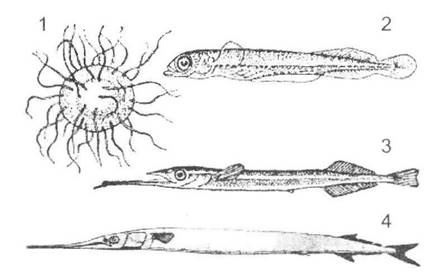
Fig. 12.13. Developmental Stages of the garfish (Belone sp.) (after various authors): 1 - roe; 2, 3 - fry; 4 - adult fish
Deviation can be regarded as The process of transformation of certain organs during the middle stages of their formation. As a rule, the organ is initially laid down in the traditional manner, but during intermediate stages, its development deviates from the ancestral forms. An example is the specific development of scales in sharks and reptiles (the initial anlage is formed identically, but significant changes occur later—scales become ossified in fish and keratinized in reptiles).
Archallaxis is considered the process of altering an organ's development at early stages or during its initial formation (anlage). Changes in the organ primordia themselves are almost always accompanied by alterations in their entire morphogenesis (Fig. 12.14). With this type of evolution, the duration of development does not increase, and no recapitulations are observed in the subsequent ontogeny of descendants. Archallaxis predominantly gives rise to novel, previously non-existent traits or functional connections between organs. This process is also considered quite widespread: The formation of an elongated body in snakes (the number of vertebrae increases from 80 to 250–300, mainly at the expense of trunk vertebrae, while the number of caudal vertebrae remains almost unchanged), the reduction to just three digits in the modern horse (two of which are transformed into splint bones), changes in tooth count, and so on.
According to A.N. Severtsov's evidence, the repetition of ancestral forms in ontogeny is possible only in the case of anaboly; in other modes of ontogenetic transformation, a return to the ancestral state is impossible. The researcher proposed distinguishing between positive and negative anaboly, deviation, and archallaxis (altogether proposing 12 modes of phylembryogenesis), which did not gain universal recognition.
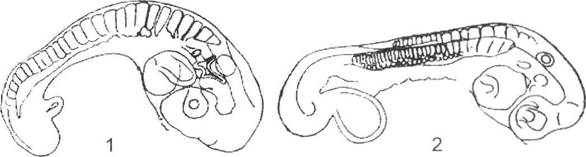
Fig. 12.14. Example of archallaxis (after A.N. Severtsov, 1945):
1 - gecko embryo with 28 trunk somites; 2 - grass snake embryo with 34 trunk somites
To date, a significant number of scientists not only reject the theory of phylembryogenesis but outright dismiss the biogenetic law due to numerous inconsistencies in the development of certain taxonomic groups (the sheer number of exceptions strips the law of its validity). At the same time, they acknowledge the undeniable connection between ontogeny and phylogeny, often focusing exclusively on mutation phenomena and their subsequent impact on ontogenetic development and, consequently, the phylogenetic changes within corresponding groups (concepts of teratological modifications—such as the formation of hopeful monsters, paedomorphosis, hormonal shifts, ontomutations, macromutations, etc.).
It is worth noting that Charles Darwin and Fritz Müller demonstrated long ago that evolutionary changes in ontogeny can occur at any developmental stage, leading to greater or lesser deviations from the ancestral pattern of development.
These arise as a result of The Emergence of novel traits or the displacement of existing structures in space or time. Notably, earlier developmental changes do not necessarily cause more pronounced deviations in the subsequent development of a group.
Food for Thought
The phenomenon of ontogeny is so multifaceted and diverse that such A brief Overview cannot possibly cover all of its crucial aspects. Despite the absence of a universally accepted theory of ontogeny, one must agree that individual development is among the most unique biological phenomena, serving as the foundational basis for many other processes, including evolution. This diversity of viewpoints once again emphasizes The Need for further research while serving as a warning against the dogmatic emulation of any scientific authorities.
Last update: 07/08/2026
Editorial and Educational Adaptation: This material has been compiled based on the primary/original source text. The project team performed an editorial review, corrected technical inaccuracies, structured sections, and adapted the content for an educational format.
What was processed:
- elimination of formatting defects (OCR errors, structural breaks, corrupted characters);
- editorial organization of content;
- standardization of terminology in accordance with academic sources;
- verification of factual statements against the original source text.
All mentions of the author, publication year, and origin of the primary text have been preserved in accordance with the source.