Basics of Evolution - Korzh O.P. - 2006
Part II. MACROEVOLUTION
Chapter 12. Evolution of Ontogeny
12.2. Integrity and Stability of Ontogeny
Structure/149.html">The problem of ontogenetic integrity can be considered one of the most pressing issues in the entire biology of individual development. According to I.I. Schmalhausen's views, the growth process cannot be imagined in isolation from development, nor can a developing Organism be isolated from its developmental environment. Therefore, no formal equations can fully capture biological patterns that result from extraordinarily complex interactions.
Despite the significant attention scientists have paid to this problem, The concepts of integrity proposed so far remain merely fragmentary. Molecular biology is potentially capable of explaining certain processes occurring during ontogeny, but there are aspects of development that are not directly controlled by The Genome. In particular, it is not always possible to predict an organism's phenotype based on its genotype or the genotype of its parents: the mechanisms governing the interaction between an individual's genotype and environmental conditions remain uncertain. It is likely that even the thoroughly studied microprocesses of ontogenetic events do not provide an integrated understanding of the entire course of development of a given organism.
Today, several lines of evidence confirm the objective presence of holistic control over the execution of ontogeny. Development at the level of the whole organism or its major parts (organ primordia) proceeds in an orderly fashion, whereas the microprocesses comprising it lack such strict orderliness and allow for "errors." In other words, a macro-order is formed within the organism in the absence of micro-order (neither the number of Cells in specific primordia, nor their arrangement, nor their growth rates are entirely immutable or definitively determined). At the same time, even organisms belonging to the same taxonomic type that are quite distant genetically resemble each other in the most vital features of their development, which rely on a common body plan. Moreover, even Mutations affecting The Development of certain morphological structures are unable to alter the general body plan of the respective organism.
According to modern concepts, differentiated cells of an adult organism do not fundamentally differ in their genetic Complement from the genetic material contained in the zygote.
Nevertheless, cellular diversity and functional specialization arise through The process of differentiation, which triggers the expression of a specific subset of genes such that different cells synthesize different Proteins. However, even in differentiated cells, unused genes are preserved in a form that allows for their expression under certain conditions (such as the regeneration of lost body parts). In special cases, differentiation is accompanied by the loss of a portion of the genetic material, which should be considered not the cause, but the consequence of the differentiation process.
Today, the existence of genes capable of switching the developmental pathways of certain cells, thereby steering them toward one of several possible variants, has been proven. The operation of such "regulatory genes" is itself governed by intercellular interactions within the organism during development. The ability to form identical holistic structures from different embryonic material or through participation in different intermediate processes also points to the existence of holistic control over the organism's development.
Overall, the Structural and functional integrity of an individual relies on the interconnection and interaction of ontogenetic differentiations. All their stages are interrelated; each subsequent stage builds upon the preceding one and makes the future one possible—thus they complement each other.
Correlations and coordinations, concepts actively developed by I.I. Schmalhausen, acquire great significance in ontogeny. According to his views, correlations are the interdependent development of certain parts of an organism, where changes in one organ are accompanied by corresponding changes in another. Genomic correlations are primary in organismal development and are based on the phenomena of linkage and pleiotropic Gene action (for example, the flower color of peas (Fig. 12.5) also determines pod color, etc.).
Class="center">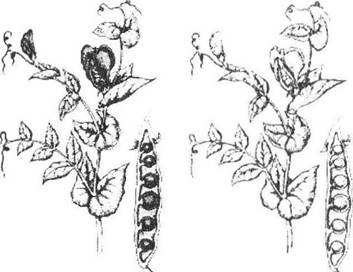
Fig. 12.5. The phenomenon of pleiotropy in G. Mendel's experiments (after F. Ayala, J. Kiger, 1988).
The gene determining flower color affects the color of the seeds and leaf axils.
Morphogenetic correlations are established during the development of certain Organs through their interaction—changes in a specific part depend not only on the processes taking place within it, but also on processes occurring in adjacent regions. It is precisely in this case that development acquires a regulatory character—The Fate of certain cells or other structures is determined by the engagement of specific regulatory mechanisms. The most striking Examples of this type of correlation are provided by embryological experiments involving the transplantation of embryonic parts (Fig. 12.6). In this scenario, a given part develops not into the structures it normally would form, but into those required at the new Location.

Fig. 12.6. Instructive tissue interactions — Cytology/practical/54.html">Longitudinal section of the HEAD of a generalized embryo (after S. Gilbert, 1995)
Such rearrangements acquire paramount importance during deviations from normal development. A clear example of such disturbances is the appearance of patchy coloration in domestic animals, which is unobserved in their wild relatives due to the non-adaptiveness of the latter. The formation of such coloration is possible only if correlations between life-support systems critical to the organism are disrupted under natural living conditions, leading to the formation of new correlative ties demanded by humans.
Ergontic correlations occur predominantly at later stages of organismal development and consist of coordinated rearrangements of functionally related parts. They are established during the functioning of the respective structures (e.g., the Development of Muscles and the corresponding bones to which they attach, specific receptors and their corresponding Brain regions, etc.).
During evolution, the organism as a whole adapts to environmental changes and, consequently, undergoes a comprehensive reorganization. Correspondingly, the correlations linking all PARTS OF THE organism into a unified whole change as well.
By coordinations, I.I. Schmalhausen meant the interdependent development of certain organs in phylogeny. Topographic coordinations refer to reciprocal changes in organs that are topographically connected yet may lack a functional link. Examples include the abdominal organs occupying all available space, or the brain and the braincase (in primitive vertebrates, there is no such dependence even in the relative sizes of these organs, whereas in mammals and birds, not only their sizes but also their shapes become interdependent — Fig. 12.7). This type of coordination reflects globally harmonized changes of parts within a complex organism while maintaining its typical segmentation. They serve as indicators of the limited potential for further modifications in the respective organs. This type of coordination acquires special conservatism in embryonic development, which manifests as the Stability of the typical embryonic structure.

Fig. 12.7. Changes in Skull structure from a pelycosaur (left) through a therapsid to a mammal (right) (after A. Romer, T. Parsons, 1992):
1 - dermal BONES OF THE skull roof; 2 - brain; 3 - membranous wall of the brain cavity; 4 — braincase; 5 lower jaw;
6 - temporal Muscle; 7 - outgrowths of the skull roof bones; 8 - primary skull surface; 9 - zygomatic arch
Dynamic coordinations involve regular changes in functionally related organs (mediated by ergotic or morphogenetic correlations). They vividly reflect the overall functional harmony among individual parts and organs, which is a prerequisite for progressive evolutionary changes. A classic example is the coordinated Development of the free limb and the strengthening of the limb girdle during the adaptation of vertebrates to terrestrial life.
Such coordinations are particularly evident in highly specialized organs that perform strictly defined Functions. For instance, the development of specific Sensory Organs and their corresponding brain regions is closely coordinated. The dominance of Olfaction as the primary source of environmental information in mammals drove the progressive Evolution of the Cerebral Cortex (the development of the cerebral hemispheres is linked largely, if not exclusively, to the SENSE OF SMELL — Fig. 12.8).

Fig. 12.8. Brain of a goose (Anser) and a horse (Equus), dorsal view (after A. Romer and T. Parsons, 1992)
Biological coordinations refer to regular changes in organs that lack direct correlative links during organismal development. They are based on individually independent organ changes whose coordination acquires a general adaptive significance (for example, the lengths of an animal's forelimbs, hindlimbs, and neck must be coordinated, which is crucial for the viability of the organism as a whole). These coordinations are among the first to appear when organisms adapt to specific environmental shifts. ADAPTATION TO A restricted habitat is possible only through appropriate specialization, manifested in the formation of a complex system of biological coordinations. Moreover, the more restricted the habitat, the more strongly these established coordinations constrain the subsequent adaptive potential of the organisms.
Previously, scientists grouped correlations and coordinations together, but according to I.I. Schmalhausen, their underlying mechanisms are fundamentally different.
Correlations denote physiological interdependencies in individual morphogenesis, relying primarily on pleiotropy. Coordinations historically evolve on The basis of hereditary Changes in the body's components linked by correlative systems or adaptive mechanisms.
Therefore, despite significant similarities between these phenomena, they cannot be equated: they differ in accordance with the distinct principles of ontogeny and phylogeny.
Another mechanism affecting the stability and integrity of ontogeny is associated with the existence of so-called Critical Periods of development (various other terms have also been proposed). These are phases when the embryo is most vulnerable to damage by various factors that can disrupt its normal development. Research shows that the embryo exhibits varying resistance to different damaging agents across different critical periods. It is precisely during these intervals that METABOLISM shifts, growth rates decline, and other significant reorganizations take place (active processes of morphological differentiation, transition to a new developmental stage, or adaptation to novel living conditions in the case of metamorphosis). A distinction should be made between critical periods for the organism as a whole and those for the development of its individual organs.
Last update: 07/08/2026
Editorial and Educational Adaptation: This material has been compiled based on the primary/original source text. The project team performed an editorial review, corrected technical inaccuracies, structured sections, and adapted the content for an educational format.
What was processed:
- elimination of formatting defects (OCR errors, structural breaks, corrupted characters);
- editorial organization of content;
- standardization of terminology in accordance with academic sources;
- verification of factual statements against the original source text.
All mentions of the author, publication year, and origin of the primary text have been preserved in accordance with the source.