Basics of Evolution - Korzh O.P. - 2006
Part I. MICROEVOLUTION
Chapter 8. Adaptation as a Biological Phenomenon
8.2. Adaptive Significance of Organism Properties
Passive defense mechanisms are considered to be those whose mere presence increases the survival probability of the respective individuals. These include cactus spines, nut shells, hedgehog needles, turtle shells, snail shells,
insect cuticles, etc. If organisms with such traits also possess coloration close to the general Background of their environment, their survival rate increases significantly.
The overwhelming majority of animals exhibit cryptic (protective) coloration adapted to specific living conditions. Furthermore, animals from different taxonomic groups inhabiting identical environments display color convergence. Systematically close organisms, dispersing into ecological niches, provide an example of adaptive radiation by acquiring coloration matching the general environmental background. Sometimes the same species exhibits minor color differences in different habitats (forming so-called local forms).
Coloration alone often proves insufficient, making appropriate behavior necessary as well. For instance, on the island of Martinique, under identical conditions, three species of Anolis lizards exist: brownish, green, and light gray. When disturbed, they hide against a matching background: green ones in green grass, brown ones in withered bushes, and light gray ones on tree trunks, rendering all of them inconspicuous. Specific behavior is also essential for ground-nesting birds: they must choose a site where the coloration of their eggs maximally matches the background of the environment.
Even more illustrative Examples are the ability of many animal species to change their coloration in response to environmental changes. These adaptations can be temporary, seasonal, or permanent, specific or regulated. Examples of color change throughout The life cycle are numerous, being most typical of insects.
In cases where an Organism inhabits different conditions during various developmental stages, each phase acquires its own protective coloration. Thus, in many butterfly species, caterpillars resemble the twigs of the plants they feed on, pupae reside in the soil with matching coloration, and imagoes are adapted to hiding places (for example, tree bark).
Color changes during ontogenesis are also characteristic of vertebrates, which can be explained by shifts in biotopes across different stages of their development. For instance, eels (Anguilla anguilla) and some other fish at the pelagic larval stage, much like zooplankton representatives, are transparent and uncolored. In their adult state, they inhabit the littoral zone (Water bodies' bottoms) and acquire pigmentation appropriate for their surroundings. In birds and mammals, the young may have spotted or striped coloration (quail, pheasant, deer, pig, etc.), whereas adult animals exhibit a completely different color pattern.
Such adaptations of organisms to the environmental background develop gradually during ontogenesis, are irreversible, and are termed morphological adaptations. In particular, in many butterflies, such as the peacock butterfly (Vanessa io), the large white (Pieris brassicae), and others, the coloration of pupae is determined by the high sensitivity of caterpillars to the color of the general background on which they develop. Therefore, by regulating the pigmentation process of their cuticle, the latter produce a corresponding protective coloration.
Equally well-known is the ability of grasshoppers to alter their coloration across a broad spectrum to match the general environmental background. For example, acridids are green in spring and inconspicuous among cereal stems, whereas in autumn they acquire a brownish-yellow color resembling straw.
Some African insects acquire protective coloration adapted to steppe areas affected by fires. Cockroaches, praying mantises, crickets, caterpillars, and others turn various intensities of black under such conditions.
The ability to rapidly change color to match the background becomes crucial for active animals. It is triggered by the movement of pigment granules within specialized Cells called chromatophores, a phenomenon known as "physiological color change." This ability is characteristic of relatively highly developed animals—Mollusks, Arthropods, and vertebrates. The Mechanism of physiological color change is complex, involving reflex actions based on Visual Perception of the environment and hormonal regulation, and is sometimes induced by the direct effect of light on the Skin. However, birds and mammals lack such adaptations since their skin is covered with feathers or Hair, rendering their skin color inconsequential.
Everyone is familiar with examples of rapid color change by chameleons, but a vast number of vertebrate and invertebrate species possess similar properties that are even more developed than in these reptiles. The invertebrate representative, the common cuttlefish (Sepia officinalis), possesses extraordinary abilities to alter its coloration—ranging from pearlescent white through various shaded mottled variants to nearly black. In addition to it, the octopus can produce a wide range of body colors from black to light.
In many fish species (especially coral reef dwellers), the ability to change coloration is simply astounding: some species can alter it six to eight times within a few seconds. Moreover, they resort to this not only when moving from one environment to another, but also during vertical Migrations: upon rising from the bottom, an individual almost immediately switches from a mottled to a uniform coloration. In some cases, fish and cephalopods display longitudinal stripes while moving, which camouflages their forward motion, while at rest they exhibit transverse stripes that seemingly dissolve them against a patchy background.
Terrestrial animals can also change their coloration, primarily tree-dwelling species whose main defense remains their coloration. Shade variations within a wide range are characteristic of many amphibians and reptiles. Despite species-specific color gammas and the mechanisms producing them, the primary result of such properties in these organisms is the alignment of their coloration and even body pattern with the general background of their habitat, thereby reducing their visibility.
Countershading is another method of creating protective coloration.
Even a uniformly colored object under the sun's rays acquires a certain relief due to the interaction of light and shadow, and is perceived as a volumetric body. The upper part, generally illuminated more intensively, appears lighter, whereas the lower part, conversely, appears darker (Fig. 8.1 a). Consequently, even an organism with a complete correspondence of body Structure and coloration to the environment may become conspicuous.
THE PRINCIPLE OF countershading lies in the fact that, due to a gradual transition from a darkly colored back to a lighter belly (Fig. 8.1 b), the rounded surface creates the impression of being flat. Such coloration compensates for the action of sunrays, producing the optical effect of a relatively uniform color (Fig. 8.1 c). This effect works particularly well when the animal is positioned against a background matching its own coloration, in which case the entire outline and surface merge with the background. This principle is most clearly realized in various fish species.
A specific pattern can also "operate" on the principle of countershading (differing from coloration in that it is formed by at least two colors with distinct contrast). The effect is achieved by reducing the number or size of spots (small spotted felines such as civets, genets, ocelots, etc.) or by reducing the number or width of transverse stripes (zebras, tigers, etc.). In this case, The phenomenon of countershading remains the same: the back appears more intensely colored compared to the belly, which compensates for The Effect of sunlight.
Class="center">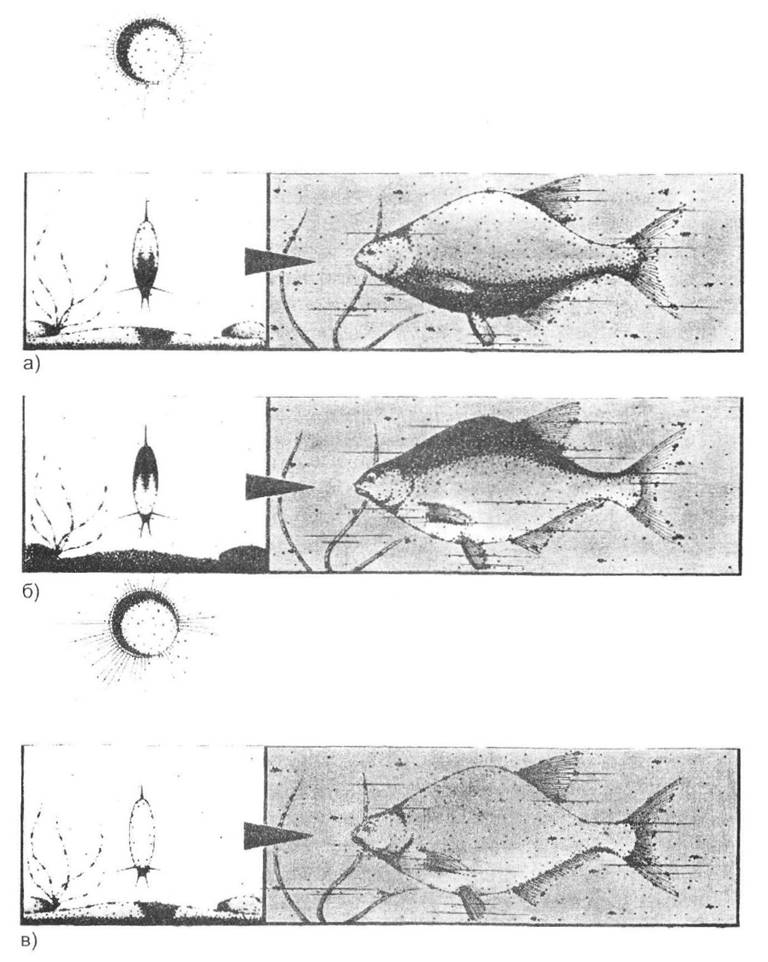
Fig. 8.1. Mechanism of countershading coloration action using a fish as an example (drawing by O.V. Karnaukhov):
a - a uniformly colored fish under sunlight acquires a volumetric appearance due to the shadow appearing on its belly; b - a significant number of fish in natural conditions feature a darker back and a lighter belly; c - such natural coloration under sunlight compensates for the shadow phenomenon, making the fish's body appear flat and inconspicuous
Countershading is one of the most fundamental principles in animal coloration and is widespread throughout nature. It has evolved independently along similar lines across many taxonomic groups of animals in both terrestrial and aquatic environments.
The degree of countershading largely depends on lighting conditions: animals inhabiting dimly lit environments (such as benthic fish or forest dwellers) exhibit weak countershading because the lighting differences between their dorsal and ventral surfaces are minimal. Desert animals also show low contrast in coloration due to the high reflectance of sand. At significant depths (or in caves) where light is completely absent, countershading is entirely non-existent. It reaches its maximum development under strong illumination in contrasting environments, such as those inhabited by pelagic marine organisms, terrestrial steppe species, and others.
There are even examples of reverse countershading (where the belly is darker than the back) in species that specifically orient their ventral side toward the sun. Reverse countershading is characteristic exclusively of the Nile fish Synodontis batensoda, which swims belly-up, as well as certain species of spiders and caterpillars (Fig. 8.2) that feed and rest primarily in this position. Conversely, the similar coloration of skunks serves a dis-masking function, making the animal highly conspicuous (aposematic or warning coloration will be discussed further below).
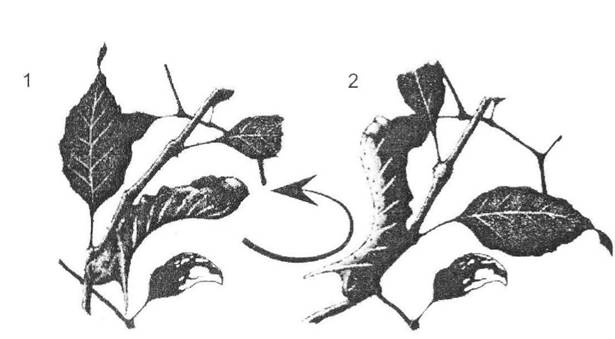
Fig. 8.2. Reverse countershading illustrated by Smerinthus ocellatus (drawing by O.V. Karnaukhova):
1 - normal resting position of the caterpillar beneath a leaf, making it appear flat; 2 - when the twig is inverted, the coloration is further enhanced by sunlight, rendering the caterpillar exceptionally conspicuous.
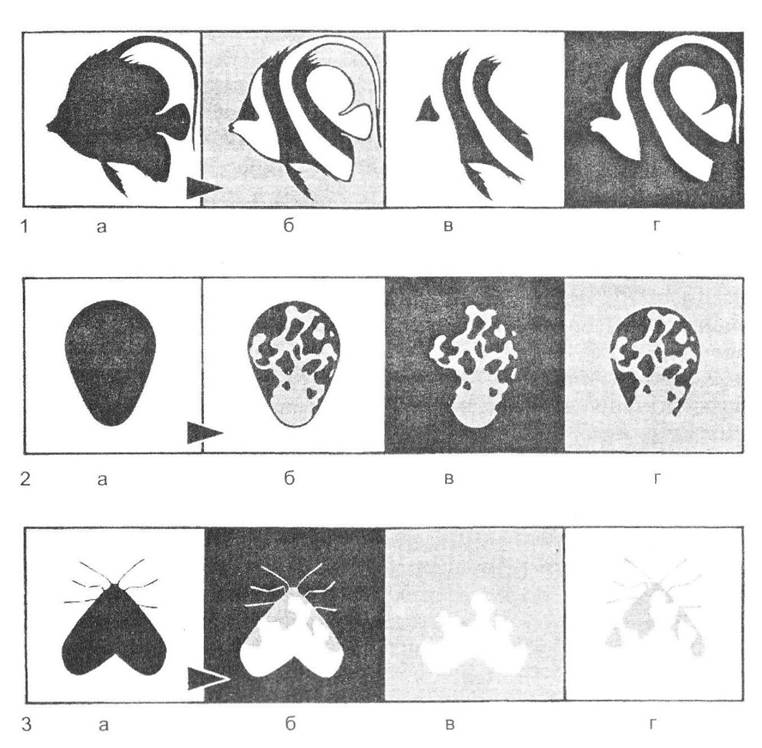
Fig. 8.3. Mechanism of disruptive coloration (drawing by O.V. Karnaukhova)
The body outline of a fish (1), egg (2), or butterfly (3) against a uniform background (a) is highly distinct and easily recognized by potential predators. When an organism possesses disruptive coloration (b), its body shape is much harder to discern. If PARTS OF THE body coloration match the background (c, d), recognizing the organism becomes nearly impossible.
One of the most fascinating types of camouflage is known as disruptive coloration.
The Use of standard types of cryptic coloration—background matching and countershading—allows an animal to blend into a uniform environment. However, such uniform conditions are relatively rare in nature, and the continuous surface of an animal's body can easily betray its Location. The perceived disruption of bodily form is achieved through a special pattern known as disruptive coloration. The spots or stripes in this type of adaptation can be quite striking, yet they effectively render the animal invisible to other species. A prime example of this adaptation is the East African reed frog Rana adspersa, which is colored in brownish-green hues, with a bright yellow stripe running down its back that seemingly divides its body in half. While quite noticeable, this stripe is not associated with the frog itself and prevents the rapid recognition of the organism. Similar patterns are found in certain grasshoppers and snakes, providing effective bodily camouflage. The effectiveness of this adaptation increases dramatically when some color components blend with the background while others stand out quite sharply (Fig. 8.3). Therefore, the overall color palette must not differ from the surrounding environment, and the pattern itself must run counter to the body shape it camouflages, which is achieved by combining contrasting colors (a dark pattern against a light background). The greater the contrast between adjacent pattern elements, the more effective the disruptive coloration becomes.
There are also numerous examples of compound disruptive coloration. While standard disruptive coloration creates the illusion of fractured solid objects, compound disruptive coloration gives the impression of continuity across multiple surfaces. The result of this latter type of camouflage is the inability to recognize the body as a whole, or any of its parts or Organs (Fig. 8.4). For instance, in some animals, the eye—one of the most vital Sensory Organs—is effectively camouflaged. Remarkably, this is achieved in almost identical ways across phylogenetically distant animal groups through the use of longitudinal (and occasionally transverse) darker stripes framing the eye (found in fish, frogs, snakes, lizards, certain mammals, and invertebrates).
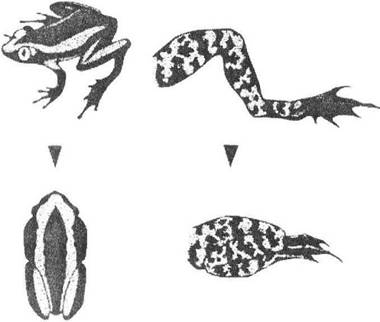
Fig. 8.4. Examples of compound disruptive coloration, where the striping effect emerges only when body parts are aligned
(drawing by O.V. Karnaukhova)
Disruptive patterns are used not only to camouflage body surfaces but also to break up outlines. An animal's contour can easily give it away even if its coloration perfectly matches the surroundings. Patterns designed to disrupt the contour must intersect it and terminate at its border. Conversely, a pattern that runs parallel to the contour emphasizes it, making the animal even more conspicuous (a technique utilized in aposematic coloration).
Disruptive coloration achieves its maximum protective value in species whose overall pattern closely mimics the color structure of their immediate environment—their resting site, where the individual typically remains motionless. Such cryptic coloration is characteristic of many taxonomic groups and depends heavily on the animal's immediate surroundings. In some cases, however, the correct orientation of the organism against the appropriate background is equally crucial (Fig. 8.5), further highlighting The Importance of the individual's behavioral activity.
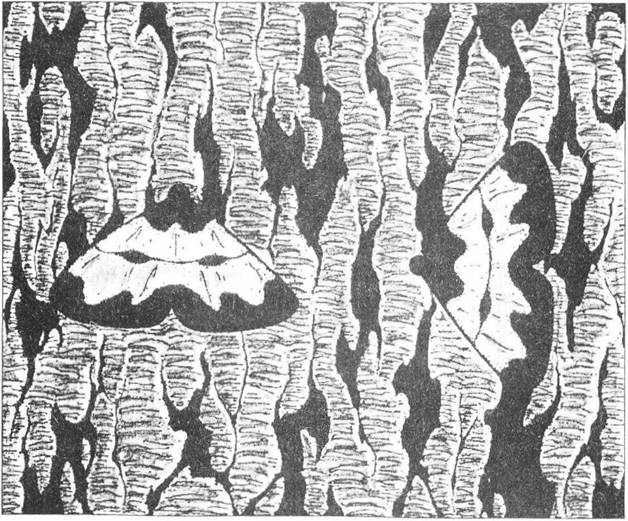
Fig. 8.5. Conspicuous (1) and inconspicuous (2) positioning of a butterfly on tree bark (drawing by O.V. Karnaukhova)
Pattern approximation to a specific habitat is characteristic primarily of stenobiontic species restricted to a specific food plant, breeding site, etc. In other words, highly specialized cryptic coloration occurs exclusively among specialized species with very narrow ecological niches.
Animals with cryptic coloration face The Challenge of cast shadows, which can often be more conspicuous than the animal itself. In all the previous examples of adaptations, shadows were not eliminated, meaning complete invisibility was not achieved. Because shadows are largely diffused on uneven surfaces (dense grass, bushes, foliage), this feature was successfully exploited by inhabitants of open spaces—lizards, birds, and butterflies that rest among rocks, tree trunks, or on bare ground.
Butterflies that rest with their wings folded vertically orient their bodies relative to the sun so that the shadow cast by their wings is reduced to a nearly imperceptible line. To maintain this, these animals continuously adjust their body position to track the movement of the sun (heliotropism). Such adaptations are common among many species, particularly European satyrid butterflies. In the latter, heliotropism may also manifest as tilting the body away from the vertical, and in some species even lying flat (Thecla rubi), allowing the wings to effectively cover their own shadow. The necessity of such adaptations stems from the fact that wing shadows are far more noticeable than the camouflaged animal itself.
Many geckos possess lateral skin flaps on their tails (varying in width across species) that help mask the tail's shadow on relatively flat surfaces such as rocks, walls, or tree trunks (Fig. 8.6). These adaptations reach their peak development in the flat-tailed gecko (Ptychozoon kuhli), which, in addition to broad tail flaps, also features lateral skin folds running along its body. An optical side effect of such flattened body forms is the softening of light and shadow transitions across uneven terrain.
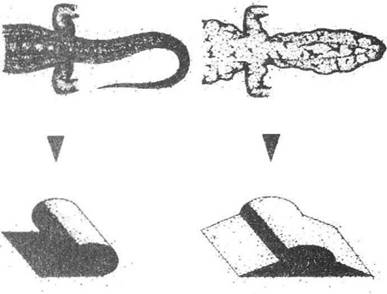
Fig. 8.6. Mechanism of shadow concealment in sunlight (drawing by O.V. Karnaukhova)
This confirms the adaptive value of critical coloration and its absence or weaker manifestation in forms that do not require it. Birds, for instance, as highly active and mobile animals, are in constant motion searching for food and other resources. As a consequence, they experience rapidly changing environments; therefore, most representatives of this group possess a predominantly non-specialized protective coloration system. However, those species that nest or rest in relatively open habitats (bustards, gallinaceous birds, nightjars, etc.) also develop cryptic coloration and corresponding behavior.
Far from all animals possess protective coloration, but this is not because it lacks adaptive value. Such "camouflage" is merely one of the possible Pathways of Adaptation to specific environmental conditions. Since any traits require certain material and energy resources, an organism faces the choice of the most suitable defense mechanism for itself.
Closely related to cryptic coloration is the imitation of the shape, structure, and color of the environment and its components, particularly inanimate or inedible objects. Predators can lie in wait disguised as indifferent or even attractive items, which significantly increases their hunting success, such as the fish-like appendage in the anglerfish (Lophius piscatorius).
Many animals from distant taxonomic groups exhibit the mimicry of the shape and coloration of various leaves (Fig. 8.7). Any leaves—of different colors, shapes, and conditions (dead and alive, dried, withered, etc.)—can serve as a model. However, in all cases, the leaf must be thin, and the illusion of a flat body can be achieved by various means.
This effect is most easily created by various insect species through the flat surfaces of their wings. The most perfect leaf mimicry is observed in butterflies of the Indo-Malayan genus Kallima, whose outline and coloration, along with a simulated petiole, midrib and lateral Veins, pointed apex, and even "damage" caused by diseases and insects, make the general appearance of the animal almost indistinguishable from a leaf.
A similar type of adaptation is also characteristic of many South American forest butterflies (genera Pierella, Anoea, etc.). In some of them (Haetera), the wings are transparent, and the butterflies become almost invisible due to the leaves showing through the wings. In moths, particularly geometrid moths, the wings are spread and resemble a leaf only when folded—forming a composite pattern (Fig. 8.7).
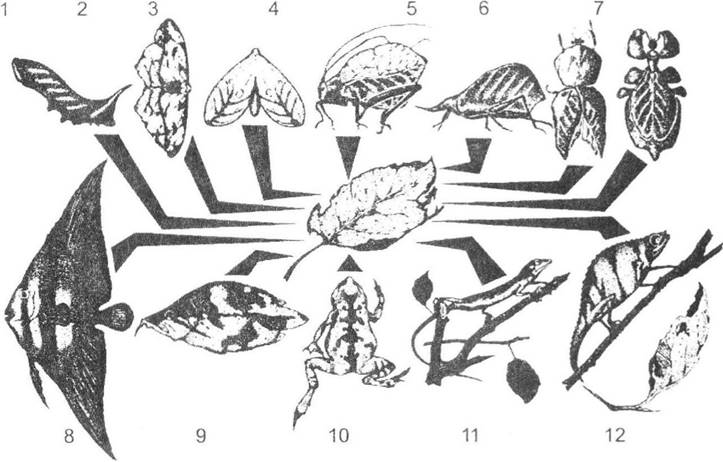
Fig. 8.7. Mimicry of leaf traits by vertebrate and invertebrate animals (illustration by O.V. Karnaukhov):
1 - caterpillar (Smerinthus ocellatus); 2 - geometrid moth (Timandra amata); 3 - butterfly (Minioides ornata); 4 - bush-cricket (Cycloptera sp.); 5 - grasshopper (Systella rafflesii); 6 - mantis (Choeradodis rhomboidea); 7 - walking leaf (Phyllium crurifolium); 8 - fish (Platax vespertilio); 9 - fish (Monocirrus polyacanthus); 10 - toad (Bufo typhonius); 11 - iguana (Polychrus marmoratus); 12 - chameleon (Rhampholeon boulengeri).
A more sophisticated imitation of leaf flatness is achieved through body flattening, which is characteristic of some vertebrate representatives. True flattening is constrained by the necessity of a corresponding reorganization of the animal's Internal Organs.
The Amazonian fish species Monocirrhus polyacanthus (referred to locally as the "leaf fish") strongly resembles a dead leaf (Fig. 8.7). The similarity is so striking that a captured fish is difficult to distinguish from a real fallen leaf. This is achieved through significant lateral flattening of the body, The formation of a leaf-like outline, specialized coloration mimicking venation, and The Development of a "beard" resembling a leaf petiole. This is further complemented by behavioral aspects: this species inhabits only near-stagnant waters and moves very stealthily, like a leaf carried by a weak current. Since this representative is a predator (feeding on small fish), such a complex
of adaptive traits becomes particularly important: the prey must allow it to come close, otherwise the hunt will fail. In other cases, when mimicking leaf structure (the toad Bufo typhonius, insects of the genus Phyllium, etc.), body flattening occurs in the dorsoventral direction. The impression of thinness can be created by the countershading principle (sphinx moth caterpillars, lizards, etc.), through lateral body folds, or by other means.
Tree bark, Lichens, Algae, stones, lianas, animal excrement, and other objects in the animal's immediate surroundings can also be mimicked. Appropriate behavior is likewise essential, without which the imitation loses all meaning.
Aposematic (warning) coloration takes on the opposite significance.
Aposematic coloration, unlike the adaptations mentioned above, pursues a completely different goal: to make the animal highly conspicuous in its habitat. Cryptic coloration, even when using bright colors, blends the animal's overall appearance with its surroundings. Warning coloration, however, employs a color range that is always easily noticed by potential enemies (primarily red, white, black, and yellow colors in the form of sharply defined patches or stripes).
Animal coloration resulting from sexual Selection (Sexual Dimorphism) also aims to draw attention. However, the patterns and colors used in this case are predominantly delicate, unlike the bright and highly conspicuous aposematic coloration.
Aposematic animals also exhibit distinct behavioral differences. While organisms with cryptic coloration shift their activity peaks to twilight (freezing or assuming a specific posture when resting, and moving very swiftly at other times), individuals with warning coloration choose the time of day when they are maximally visible (primarily daytime). They move rather slowly, relying entirely on their defensive properties. This applies to both terrestrial and other forms (the flight of the ladybug—slow and clumsy—can serve as proof of this).
Significant differences are observed even among organisms from closely related taxonomic groups. For instance, most desert lizards rely primarily on their vigilance, speed, protective coloration, and burrowing ability. However, the Gila monster (Heloderma suspectum) and the Mexican beaded lizard (H. horridum), the only venomous representatives of their group, are almost incapable of flight; yet, they possess aposematic coloration (pink and yellow patterns on a black background) and are agile and dangerous when defending themselves.
A diurnal lifestyle is not obligatory for animals with aposematic coloration. The transition to nocturnal activity (skunks and some other mustelid representatives, large beetles such as the ground beetle Anthia sexguttata) is driven by the fact that these animals prey on organisms with a nocturnal lifestyle (primarily insects).
An analysis of annual dynamics reveals that the highest density of such species coincides with the period when the Abundance of other animals is quite high. This is related to the fact that young animals during their "learning" phase, and occasionally adults as well, make mistakes by consuming representatives of aposematically colored species. However, during periods of intense Struggle for Existence, particularly due to food shortages, predators may switch from their preferred prey to any other available food, including unpalatable or even inedible ones. Therefore, aposematic coloration provides the greatest benefit to an animal when predators have a wide choice of edible prey.
In addition to warning attributes, aposematic animals must possess certain defensive properties. This refers to any defense mechanisms that render the animal unappealing or unpalatable to potential enemies.
Venom is one of the most potent and specialized means of defense against enemies. Toxic properties are inherent to many animals, but toxicity is relative, as it depends on the biochemical Properties of the venom and the susceptibility of individual organisms to it. In other words, animals that are toxic to some species may prove edible to others, and conversely, edible organisms may exhibit toxic properties toward certain animals. This is illustrated by E.N. Pavlovsky's cycles of defenselessness in venomous animals (Fig. 8.8).
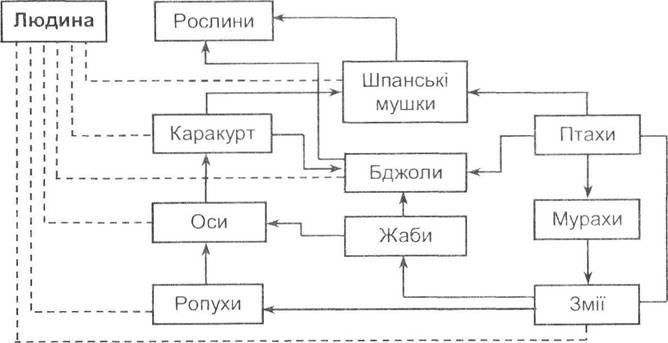
Fig. 8.8. Cycles of defenselessness against venomous organisms (after E.N. Pavlovsky, 1961)
The blister beetle (Lytta vesicatoria) contains cantharidin in its hemolymph and is toxic to humans, yet it is consumed by the Mediterranean black widow spider (Latrodectus tredecimguttatus). The latter, despite possessing venom extremely dangerous to humans, can fall prey to certain species of wasps. Wasp and bee larvae (even with the strong defensive traits of the adults, their social lifestyle, and brood care) remain vulnerable to amphibians—frogs and toads. Amphibians have poison glands in their skin, but their effect does not extend to snakes. Snakes, in turn, may fall prey to ants or other animals, such as pigs. Ants, bees, and blister beetles are consumed by birds without any difficulty.
Despite certain limitations in the practical action of venom, its mere presence increases the likelihood of survival for the respective animals by narrowing down the range of potential predators. There are animal species equipped with true venom glands and specially modified spines or similar structures used as weapons to inflict punctures and deliver venom to a wound. These include certain fish species, such as stingrays (Trygon, Aetobatis), A large number of snakes, Hymenoptera, and others. Another type comprises animals whose very bodies contain toxins. These include pufferfish (Tetrodontidae - Fig. 8.9), amphibians (Salamandra maculosa, Bombinator igneus, Bufo marinus, etc.), and others.
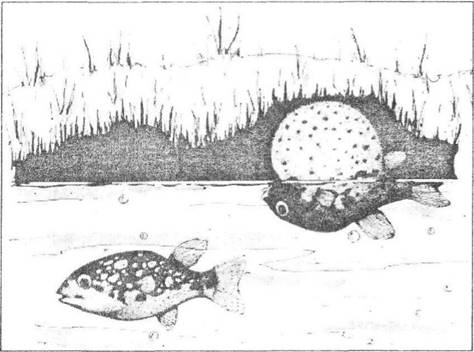
Fig. 8.9. Pufferfish (Tetrodon fluviatilis) in normal and inflated states (illustration by O.V. Karnaukhov)
Irritating or repelling secretions can be considered an effective defense mechanism. It involves the active release of repulsive substances by an animal when threatened by potential predators: thanks to specialized adaptations, it sprays caustic secretions directly at the adversary, stopping it in its tracks. This strategy is employed by bombardier beetles (Brachinus), spitting cobras (Sepedon haemachates), and skunks (Mephitis mephitis).
In simpler cases, an animal secretes a protective substance whose odor or taste deters a predator from feeding on it. This ability is characteristic primarily of insects: a large number of true bugs, certain beetles such as ground beetles, ladybugs, blister beetles, and others.
Closely related in significance and effectiveness is the unpleasant odor or taste of animal Tissues or Body Fluids; that is, the passive inedibility of certain animals makes them relatively protected from potential predators.
Some non-venomous species acquire inedible properties through the accumulation of relevant substances during feeding. For example, monarch caterpillar feeds on milkweeds, which contain cardiac Glycosides—poisons to birds and mammals. Not only are these substances harmless to the insect, but they also accumulate in its body and are passed on to the adult stage (imago), rendering the latter inedible. If the caterpillar feeds on cabbage or milkweeds lacking glycosides, the butterflies will become edible.
The ways in which inedibility is demonstrated in various aposematic animals can differ.
In addition to the warning effect of permanent pigments and patterns, temporary adaptations can be utilized under certain circumstances, instantly conferring aposematic properties on an animal that is otherwise inconspicuous in its normal state.
A relatively simple way to utilize warning properties is through behavioral display by increasing body size. This ability has evolved in systematically distant groups: fish, amphibians, reptiles, etc. The increase in size can be illusory, as seen in mammals or birds through the fluffing up of fur or feathers, respectively.
At the same time, some forms actually increase their body size by inflating their Lungs or digestive tract with air or even water. Sometimes this is coupled with a specific posture directed toward the predator, which amplifies the overall effect.
Examples of true body size enlargement include fish such as pufferfish (Tetrodontidae) and porcupinefish (Diodontidae). The former are defended by extreme bodily toxicity, while the latter possess an almost continuous spiny armor. When disturbed, these animals inflate into a spherical shape (Fig. 8.9). Such an adaptation is also typical of certain reptiles (Chamaeleonidae, Dispholidus typus, etc.) and amphibians (Bufo marinus, Callula pulchra, etc.).
Sometimes a similar effect is achieved by aggregating a large number of small organisms, such as small porcupinefish. If an individual detaches from the group, it is immediately eaten by a predator.
Quite frequently, for warning purposes, animals use local inflation or raise specialized structures—manes, hoods, goiters, etc. Usually, these structures are arranged on a single plane and directed sideways toward the attacker. This combines the display of specific structures with appropriate behavior, as seen in the frilled lizard (Chlamidosaurus kingi) or the neck-inflation in certain snakes (Naja nigricollis, Thelothornis kirtlandii, etc.).
The sudden exposure of bright coloration is one of the warning displays, sometimes combined with the previous type of temporary adaptations. As we can see, a single organism may combine both cryptic and aposematic coloration.
Some animals with brightly colored undersides are capable of flipping onto their backs when threatened, displaying the aposematic properties of their belly to deter a predator. These brightly colored surfaces are normally hidden, and the threat posture is assumed only under special circumstances. The posture adopted by the animal maximally exposes the aposematic areas to the predator.
An example is the fire-bellied toad (Bombina bombina), which flips onto its back, revealing bright spots on its belly. Sometimes the animal raises itself slightly above the substrate, showing the predator a body part with vivid hues, which is characteristic of snakes (cobras, tree snakes, etc.), certain mammals (the marbled polecat stands on its hind legs, displaying its white belly), and many arthropods. In butterflies, the display of bright body areas occurs primarily through wing movements that conceal the bright coloration of the abdomen or hindwings during rest.
The warning mechanism may involve the stretching of skin areas that conceal bright aposematic features. For instance, in the banded bullfrog (Kaloula pulchra), when the body is inflated, the skin stretches, and two broad yellow stripes appear on the back. A similar adaptation is also characteristic of the butterfly lizard (Leiolepis bellina), which has brown cryptic coloration. When threatened, the animal flattens its body and exposes lateral purple stripes with yellow inclusions.
A more complex and specialized mechanism involves the unfolding of fan-like structures, the folds of which conceal warning features. In sea robins (Trigla kumu, Leptotrigla burgeri), the pectoral fins act as fans, warning of the presence of venomous spines through their size and coloration. This type of adaptation reaches its maximum development in the marine iguana (Amblyrhynchus cristatus), which we mentioned earlier. A similar adaptation can be considered the crest of the hoopoe (Upupa epops).
In many cases, aposematic coloration is accompanied by corresponding warning behavior. This may apply to both movements (body swaying, sudden lunges, etc.) and various sounds, which are never excessively loud. These well-known adaptations may be further supplemented by warning odors (porcupines, skunks).
An important characteristic of aposematic animals is their increased resilience. Representatives of these species are very hardy and viable, which is explained by the necessity to endure injuries. A conspicuous appearance may provoke attacks from young, inexperienced animals, after which the aposematic animal remains free of severe injuries that might prove fatal to other species.
One of the most fascinating adaptations associated with body coloration is mimicry.
Mimicry is often viewed broadly—as the imitation of the coloration or shape of certain animals or plant organs. However, we will use this term in a narrow sense: as the imitation of The properties of aposematic animals. Let us immediately note that mimicry as an adaptation plays the same defensive role as cryptic coloration. Therefore, the result of both
types of adaptations is similar—an increase in organism survival. The difference lies solely in the MECHANISM OF ACTION. With cryptic coloration, an organism mimics the properties of objects that are neutral to the predator. In the case of mimicry, the animal becomes conspicuous by imitating features of objects that the predator recognizes and avoids. Specialists distinguish Two Types of mimicry: Batesian and Müllerian.
Batesian mimicry refers to cases where an unprotected, edible species imitates the properties of an inedible or well-protected species. The former is the mimic, and the latter is the model. In other words, the similarity between organisms misleads potential predators, falsely fulfilling the function of warning (pseudoaposematic) coloration (Fig. 8.10).
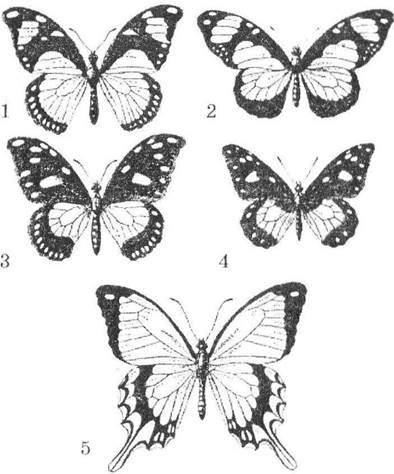
Fig. 8.10. An example of Batesian mimicry in the African swallowtail butterfly (Papilio dardanus) (after M.S. Hlyarov, 1984):
1 - female of the Hippocoon form; 2 - its model (Amauris niavius); 3 - female of the sepsa form; 4 - its model (Amauris echeria); 5 - male of this species lacking mimetic properties
One of the primary rules of this adaptation is that mimics are always fewer in number than models. Otherwise, predators would quickly catch on to the deception, which would diminish the educational value of a predator's attack on an aposematic animal.
Mimetic adaptations lead to significant Changes in the Organization of species, setting them apart from their relatives. Deviations from the typical appearance of the group occur, while foreign traits are adopted instead, acquiring fundamental significance. For instance, certain robber fly species resemble bees of the genus *Hyalurgus* and differ greatly in appearance from their relatives, featuring a broad, hairy abdomen and pigmented wings.
However, these changes are not limited to animal appearance alone; their behavior also undergoes substantial alteration. This may involve the timing of activity, as seen in the hornet clearwing moth (Aegeria crabroniformis), which, unlike most members of the order Lepidoptera, is diurnal, just like its model. Similarities may also extend to movement patterns and even specialized behavioral acts. When caught, the longhorn beetle *Dyrphya*, which resembles an ichneumon wasp in appearance, curves the tip of its abdomen as if attempting to sting, while protruding a white rod that it moves like a stinger.
Mullerian mimicry is the acquisition of a shared appearance by several aposematic species, allowing them to be more easily recognized by predators. This type of adaptation accelerates predator learning regarding the unpalatability of a specific group of aposematic animals due to the uniformity of their warning coloration. Sometimes this phenomenon is also referred to as synaposematic, or joint warning, coloration. In Mullerian mimicry, the morphological similarity between species may be slight, yet the animals share common properties (Fig. 8.11).
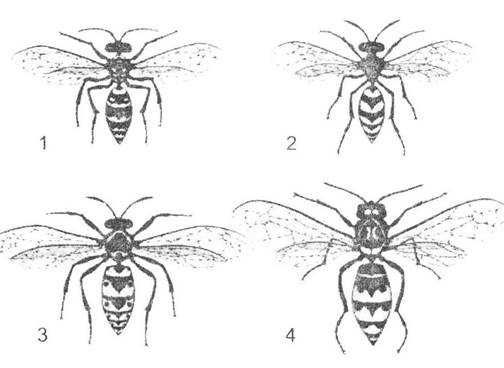
Fig. 8.11. The phenomenon of Mullerian mimicry illustrated by various wasp species (drawing by O.V. Karnaukhov):
1 - paper wasp (Polistes gallicus); 2 - beewolf (Philanthus triangulus); 3 - German yellowjacket (Paravespula germanica); 4 - European hornet (Vespa crabro)
In nature, distinguishing between these two types of mimicry is quite difficult due to the relative nature of "unpalatability" and the presence of shared traits. Forms connected by mimetic resemblance inhabit the same geographic area, as mimicry is effective only under the condition of sympatric existence and shared
exposure to predator attacks. The behavior of these species also converges, as discussed earlier.
A fundamental pattern of mimicry is that the resemblance among animals extends solely to external structures visible to an outside observer. Furthermore, the evolutionary pathways to achieving this similarity may vary and are independent of the animal's underlying Anatomical and morphological structure.
Last update: 07/08/2026
Editorial and Educational Adaptation: This material has been compiled based on the primary/original source text. The project team performed an editorial review, corrected technical inaccuracies, structured sections, and adapted the content for an educational format.
What was processed:
- elimination of formatting defects (OCR errors, structural breaks, corrupted characters);
- editorial organization of content;
- standardization of terminology in accordance with academic sources;
- verification of factual statements against the original source text.
All mentions of the author, publication year, and origin of the primary text have been preserved in accordance with the source.