BOTANY WITH BASICS OF HYDROBOTANY (AQUATIC PLANTS OF UKRAINE) - B.Ye. Yakubenko - 2011
VI. SYSTEM OF THE PLANT WORLD
LOWER SPORE PLANTS
GENERAL CHARACTERISTICS AND FEATURES
Order Batrachospermatales
This order unites Algae with a heterotrichous or pseudoparenchymatous type of Structure, whose thalli are single- or multi-axial. These are freshwater forms that grow as epiphytes in cold mountain rivers or large peat bogs, exhibiting various shades ranging from red to olive-green or blue-green.
Characteristic features include the presence of cruciate tetrasporangia, the absence of auxiliary Cells, and The formation of carpogonia on short carpogonial branches originating from ordinary vegetative cells. Life cycles are haplo-diplontic, with sporic reduction and Morphology/12.html">ALTERNATION OF GENERATIONS.
The genus Batrachospermum (Fig. 16). The thallus is built According to the uniaxial type and appears as delicate, small (3-8 cm tall) bluish-green tufts consisting of separate shoots. The latter resemble beads strung on a thread. The gametophyte thalli are surrounded by a thick layer of mucus, differentiated into a uniseriate central supporting thread and whorled lateral assimilatory branches. The supporting thread consists of a single row of large, colorless cells, from which arise densely branched whorls of assimilators composed of short barrel-shaped cells with numerous METABOLISM/14.html">Chloroplasts. The large Cells of the supporting threads at the Base of the thallus are covered by loosely arranged, thin multicellular cortical threads branching off from the base of the assimilator threads. The macroscopic gametophyte is haploid and develops on a microscopic diploid sporophyte.
Class="center">Water/water.files/image016.jpg" width="524"/>
Fig. 16. General microscopic STRUCTURE OF THE Batrachospermum thallus:
A - general appearance of the gametophyte; B - fragment of the thallus with "cystocarps"
The sporophyte is represented by uniseriate branched threads, in whose apical cells Meiosis may occur. Following meiosis, such cells do not transform into tetrasporangia, but instead directly begin to grow into gametophytes. Spermatangia are formed from the apical cells of the assimilatory threads, while carpogonia develop on very short carpogonial branches, which can be located on various PARTS OF THE gametophyte thallus. After Fertilization, the zygote divides without a resting period to form a dense group of few-celled gonimoblasts, in which the apical cells transform into carpospores. The structure formed by gonimoblasts with carpospores is spherical in shape (somewhat resembling a raspberry fruit), externally covered with a thin mucous envelope, and is called a cystocarp. Carpospores germinate into uniaxial, branched, bushy sporophytes.
The genus Phyllophora Phyllophora. Thalli are bushy, represented by creeping "shoots" from which vertical stems rise. The upper part of each stem is flattened, expands at the margins, and forms a blade with a thickened central part—the midrib. The blade branches profusely, often bearing daughter, younger blades along its margins and midrib. Thalli are formed from a medulla featuring large, colorless cells and a cortical layer consisting of small, densely packed cells arranged in longitudinal vertical rows (1-4).
Reproductive Organs are located on specialized leaflets. Tetrasporangia and sex organs develop in nemathecia situated On the surface of the blades along the midrib (Fig. 17)
Species of this genus are a valuable raw material from which agaroid (Black Sea Agar) is obtained in Ukraine. The largest aggregations of Phyllophora species have been recorded in the northwestern region of the Black Sea (Zernov's Phyllophora Field) and the Karkinit Bay area (Minor Phyllophora Field), where active commercial harvesting (particularly of Phyllophora nervosa) was carried out until the mid-1970s. Currently, "Zernov's Phyllophora Field" has been granted the status of a marine reserve in order to preserve and restore the natural resources of the region.
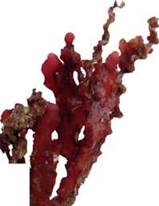
Fig. 17. Phyllophora nervosa -
agaroid producer
Last update: 07/08/2026
Editorial and Educational Adaptation: This material has been compiled based on the primary/original source text. The project team performed an editorial review, corrected technical inaccuracies, structured sections, and adapted the content for an educational format.
What was processed:
- elimination of formatting defects (OCR errors, structural breaks, corrupted characters);
- editorial organization of content;
- standardization of terminology in accordance with academic sources;
- verification of factual statements against the original source text.
All mentions of the author, publication year, and origin of the primary text have been preserved in accordance with the source.