BOTANY WITH THE BASICS OF HYDROBOTANY (AQUATIC PLANTS OF UKRAINE) - B.Ye. Yakubenko - 2011
X. SEED PLANTS
Sedge Family (Cyperaceae).
A large family comprising over 5,600 species distributed almost worldwide. In Ukraine, 140 species are found. They are perennial, or less commonly annual, herbaceous plants with long or short rhizomes. The stems are triquetrous (three-angled) and filled with parenchyma. The leaves are linear, three-ranked, and sheathed; the sheaths are closed. Inflorescences are compound; flowers are small, bisexual, or unisexual (staminate and pistillate), and the plants are monoecious, rarely dioecious. The perianth is reduced, often represented by bristles or scales. There are three stamens, rarely two, and a single pistil with one style and two or three stigmas. They are wind-pollinated. The Ovary is superior. The fruit is a nutlet.
There are 14 genera in Ukraine, 8 of which are of the greatest economic importance.
Genus Flatsedge (Cyperus). Annual and perennial plants. Stems with numerous leaves located in the lower part of the stem. The inflorescence consists of several clusters of spikelets on stalks of varying lengths. Flowers are bisexual. In Ukraine, 7 species occur, six of which are native species growing along the banks of Water bodies. Two species are of practical importance.
Class="center">
Fig. 190. Variable flatsedge
Variable flatsedge (C. difformis L.). An adventive plant with erect, sharply triquetrous stems (Fig. 190). Leaves are shorter than the stem, 2-4 mm wide, acuminate. The inflorescence is umbel-like, consisting of 3-12 rays bearing capitate spikelets 2-8 mm long. Bracts (two to three) are unequal, one of them long, sometimes up to 20 cm. Glumes are reddish-brown with a green keel. Flowers are bisexual, stamens one or two; it flowers in July-August, and the fruit is a nutlet.
It occurs in the steppe regions of Ukraine, in shallow areas of fresh or brackish water bodies with a water depth of up to 25 cm.
A forage, ornamental, industrial, and bank-stabilizing plant, as well as a weed in rice fields.
In the southern regions of Ukraine, yellow nutsedge or chufa (C. esculentus L.) is cultivated as a food plant. The underground tubers and rhizomes are rich in starch and taste like hazelnuts. They are used for food and serve as an excellent vitamin Supplement for livestock and fish feed.
Yellowish flatsedge (Pycreus flavescens (L.) Reichenb). An annual plant with obtusely triquetrous stems, 5-40 cm tall. Leaves are 1-5 mm wide. The inflorescence is umbel-like, with unequal short rays. Spikelets are 5-12 mm long, yellowish or yellowish-brown. Stamens three, pistil with two stigmas. It flowers in June-August. The fruit is a flat nutlet, with its sharp edge facing the axis of the spikelet. A weed in rice fields. It grows along the banks of rivers and lakes, and in marshy meadows. It is common in Transcarpathia, Polissia, and the Forest-Steppe, and in the Steppe, it occurs only on sandy river terraces.
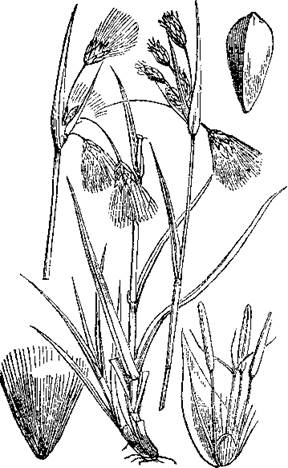
Fig. 191. Common cottongrass
Common cottongrass (Eriophorum angustifolium Honck). A perennial plant with long creeping shoots arising from the rhizome and several erect stems, 20-70 cm tall, cylindrical above and weakly triquetrous below. Leaves are shorter than the stem, linear, 3-5 mm wide, finely channeled, acuminate at the apex (Fig. 191). Sheaths are long, with the lower ones becoming reticulate-fibrous at the end of the growing season. The inflorescence is umbel-like, with a long bract, consisting of three to ten simple spikelets on peduncles of varying lengths. Perianth bristles are white, soft, unbranched at the tips, up to 3 cm long. It flowers in May-June; the fruit is a triquetrous, upwardly pointed nutlet, 1-2.5 mm long.
It grows in herbaceous-moss fens in the Carpathians, Polissia, and sporadically in the Forest-Steppe.
In sphagnum oligotrophic and mesotrophic bogs in the Carpathians, Polissia, and the northern part of the Forest-Steppe, hare's-tail cottongrass (E. vaginatum L.) is occasionally found, distinguished by solitary spikelets lacking a bract. In the northern Regions of the Forest-Steppe, the Carpathians, Cisarpathia, and Polissia, slender cottongrass (E. gracile W. D. J. Koch) and broad-leaved cottongrass (E. latifolium Hoppe) occur, often forming picturesque clumps in wet meadows and sedge-moss fens. They are ornamental, forage, and peat-forming plants.
All cottongrasses are ornamental during fruiting due to their snowy-white cottony heads, making them suitable for decorating water body banks and winter bouquets. They play a major role in The formation of so-called cottongrass peat. Historically, they were used in papermaking and added to sheep's wool, cotton, and silk. The stems of young cottongrasses provide good spring forage for deer and waterfowl. A water decoction of broad-leaved cottongrass stems is used in folk medicine to treat neuralgia, myositis, and colds.
Wood club-rush (Scirpus sylvaticus L.). A perennial plant 40-100 cm tall (Fig. 192). Stems are covered with flat leaves with a prominent midvein. The inflorescence is umbel-like, with three to four bracts; the spikelets are small. The perianth is reduced to six bristles. Stamens three, pistil of three carpels, stigmas three; it flowers in May-June. The fruit is a triquetrous nutlet. It grows in swampy forests, eutrophic fens, and along the shores of lakes and ponds. It is a phytoremediative and ornamental plant. During spring floods, grass carp and common carp feed on its young leaves and stems.

Fig. 192. Wood club-rush
Rooting club-rush (S. radicans Schcuhr). It differs from the previous species by its acute, blackish, lanceolate spikelets, 5-8 mm long, borne singly at the ends of the smooth branches of a spreading paniculate inflorescence. It flowers in June-August. In spring, the plant has a reddish-brown color, later becoming light green. Lateral branches arching toward the water can ROOT at the tips, producing new plants on the water. It is distributed mainly in Polissia and occurs sporadically in the Siverskyi Donets basin. It grows along the shores of water bodies, rivers, lakes, and in wet meadows.
An ornamental and phytoremediative plant, suitable for landscaping large water bodies. The underground Organs contain Coumarins and Flavonoids; in folk medicine, it is recommended as a sedative, somniferum, and antiepileptic agent.
Common club-rush (S. lacustris L., Schoenoplectus lacustris (L.) Palla). A perennial plant with a horizontal rhizome and a leafless stem; stems are 100-250(400) cm tall and 2-3 cm thick, with lanceolate sheaths at the base, and many air cavities (aerenchyma) inside the stem. The inflorescence is umbel-like, with branches ending in clusters of spikelets. Spikelets are brown, 8-12 mm long. The perianth is reduced and has the appearance of bristles; it flowers in May-June. The fruit is a triquetrous nutlet, about 3 mm long, with a long beak.
It grows along the banks of water bodies, in shallow waters, and typically in water throughout Ukraine.
A phytoremediative, industrial, and ornamental plant. Pressed stems are used to make construction Materials and caulk barrels; they are also suitable for coarse weaving. Muskrats sometimes gnaw through the stem and hold it in their Teeth to stay afloat longer. It is a peat-former.
In saline meadows and marshes, along the banks of water bodies in the Forest-Steppe and Steppe zones, Tabernaemontanus' club-rush (S. tabernaemontaniɉ Gmel.) is found, which is distinguished by a corymbose-paniculate, more compact inflorescence, smaller spikelets, and nutlets. It has the same significance as the previous species. In Transcarpathia, on waterlogged meadows and along riverbanks, American club-rush (S. americanus (Pers.) Volkart.) occurs.
Common spike-rush (Eleocharis palustris (L.) Roem.). A perennial plant with a cylindrical stem, 10-60 cm tall and 0.1—0.8 mm in diameter. Leaves are reduced to brownish-red sheaths. The inflorescence is a terminal spike, up to 2 cm long. Flowers are bisexual, spirally arranged; floral scales are brown or reddish-brown with a green or colorless stripe in the middle. Spikelets are small and many-flowered. The perianth is reduced to bristles, four in number, with dentate margins. It flowers in May-June. The fruit is a nutlet, up to 1.5 mm long, with perianth bristles shorter than the nutlet.
It grows along the banks of fresh or brackish water bodies, in coastal shallow waters, and in wet meadows throughout Ukraine.
A forage, bank-protecting, and water-conserving plant, as well as a weed in rice fields. It forms dense thickets and acts as a pioneer species colonizing new territories. It serves as an indicator of habitats with sharp fluctuations in groundwater levels, areas with disturbed substrate surfaces, and unpolluted water bodies.
Needle spike-rush (E. acicularis (L.) Roem. et Schult.). Stems 3—12 cm tall develop on thin, branched rhizomes, forming a dense turf. Leaves are reduced, and the sheaths are membranous and brownish-red. The inflorescence is a spike up to 3(7) mm long, lacking sterile scales at its base. Flowers are bisexual; the perianth consists of three to four bristles up to 1.2 mm long. It flowers in May-July. The fruit is an oblong, ribbed nutlet up to 1.2 mm long.
The plant is characterized by intraspecific diversity, forming both terrestrial and floating forms. It grows along the banks of freshwater bodies, in shallow waters, coastal areas, floodplains, oxbow lakes, and rice fields. It is widespread throughout Ukraine.
A forage, bank-protecting, phytoremediative, and fisheries-supporting plant. Its stems are consumed by carp, crucian carp, crustaceans, and Mollusks. It is promising for controlling weed growth in main canals. It acts as a pioneer species in newly formed water bodies, but massive population growth can adversely affect the gas regime of water bodies. It serves as an indicator of disturbed substrates depleted of calcium compounds, as well as waterlogging processes (during which it vegetates more vigorously).
One-glumed spike-rush (E. uniglumis (Link) Schult.). A rhizomatous plant with numerous stems, 10—30 cm tall, slightly furrowed, erect, and hollow. Leaves are reduced, and the leaf sheaths are purple. The spike is terminal, cylindrical, and 5—15 mm long. There is a single basal glume that almost completely encompasses it. The perianth consists of four bristles, and There are two stigmas. An anemophilous plant, it flowers in May-June; the fruit is a small, obovate, biconvex nutlet.
It grows along the banks of water bodies, in fens, and in wet meadows. It is distributed mainly in the Forest-Steppe zone. Its economic significance is the same as that of the previous species.
Few-flowered spike-rush (E. quanqueflora (Hartm.) O. Schwazz.). A tufted plant with stems 5-25 cm tall; sheaths are brown, rarely green. The spike is ovate or rounded, two- to seven-flowered, 36 mm long. Glumes are ovate, keeled, blackish-brown, with white margins. The perianth consists of six bristles, and there are three stigmas. It flowers in June-July; the fruit is an obovate, triquetrous gray nutlet, up to 2.5 mm long.
It grows in fens, wet meadows, and along the banks of water bodies; it is very rarely distributed in the Vorskla River basin, Poltava Oblast.
Sea club-rush (Bulboschoenus maritimus (L.) Pala). A perennial plant up to 100 cm tall. The rhizome is creeping, with black tuberous swellings that retain The ability to produce shoots for a long time if the water body dries up. The stem is triquetrous, leaves are linear, and blades are up to 40 cm long. The inflorescence is paniculate, consisting of several clustered spikelets on elongated peduncles. Spikelets are many-flowered, 1-1.5(3-4) cm long, dark brown, with long bracts. Flowers are bisexual; the perianth is in the form of one to six barbed bristles; there are three stamens, the pistil consists of two or three carpels, and there are two or three stigmas. It flowers in May-June. The fruit is a nutlet, about 3 mm long, flat on one side and compressed on the other. The plant has ecological forms that vary in inflorescence shape and spikelet color.
It grows in damp meadows, in oligotrophic or mesotrophic water bodies, along lake shores, on wet salt marshes, in canals, streams, and in rice fields almost throughout Ukraine, but is rare in Polissya.
A forage, food, bank-protecting, and ornamental plant, as well as a weed in rice fields. In the event of massive proliferation, it degrades the oxygen balance of the water body. Its thickets perform filtering Functions.
Rhizomes and tubers contain Proteins (up to 8.5%), fats (up to 2.55%), starch (up to 70%), carotene (10 mg/kg), and micro- and macroelements. They are edible both raw and dried. Flour is made from dried tubers, which is added to bread or used to bake pancakes. Up to 15-18 centners of tubers can be harvested from 1 ha.
Swamp saw-grass (Cladium mariscus (L.) Pohl). A perennial plant with stems 100-150 cm tall; leaves are broadly linear, sharply keeled, and rough due to small spines along the margins and keel (Fig. 193). The inflorescence is a terminal compound panicle with many lateral panicles in the leaf axils. Spikelets are clustered in fascicles, brown, 4-6 mm wide and 2.5-5 mm long. It flowers in June-July. The fruit is an ovate nutlet. It grows in marshes and along riverbanks and seashores. It is distributed in Western Polissya, the Western Forest-Steppe, the Danube Delta, and Crimea.

Fig. 193. Swamp saw-grass
An ornamental plant suitable for decorating pools and ponds. It is listed in the Red Data Book of Ukraine. It is protected in the Dzharylhach Sanctuary of national importance. It requires repatriation and conservation of existing populations. In Eastern cuisine, the leaves are used as a spice.
The genus Carex (Sedges). This is the largest genus not only in the family but also among angiosperms, comprising up to 2,500 species distributed mainly in the temperate regions of the Northern Hemisphere. In Ukraine, 92 species grow. These are perennial herbaceous plants with triquetrous stems and indistinct nodes. Leaves are linear,
sheathing, and three-ranked. Flowers are in spikelets arranged in paniculate, racemose, or spike-like inflorescences. The flowers are unisexual; staminate and pistillate flowers are located either in different spikelets or within the same inflorescence. Staminate flowers are naked and have three stamens; pistillate flowers consist of a single pistil enclosed in a perigynium (sac), which is a bract with fused margins. The perigynium is narrowed at the top into a beak, from which a style with two or three stigmas protrudes. The fruit is a small, triquetrous nutlet.
Some tall sedges are used for coarse weaving, as well as ornamental and phytoremediative plants. Almost all sedges have some forage value, and their role in pasture management is significant, as they make up about 5% of the herbage in floodplain meadows and pastures. When fresh, sedges are poorly consumed by livestock because their Cells are impregnated with mineral salts and are very tough. However, if mown when young, they are suitable for silaging, especially in dry years when more valuable forage plants suffer from drought. In terms of chemical composition, they are not much inferior to grasses, containing proteins (up to 13%), fats (3.5%), CARBOHYDRATES (28-30%), and micro- and macroelements. Sedges are consumed by grass carp, as well as primarily by cattle, sheep, and horses. It is not recommended to feed them to young animals, as a calcium deficiency in them can cause Rickets.
Bohemian sedge (C. bohemica Schreb.). A perennial, stems 15-20 cm tall, leaves 2-3 mm wide (Fig. 194). The inflorescence is rounded or oblong, consisting of several closely clustered spikes that resemble a terminal HEAD. The bracts of the spikelets are long, several times exceeding the inflorescence. Glumes are lanceolate, acuminate, green or yellow-green. Perigynia are flat, 7-9 mm long, with a long, bidentate beak. It flowers in June-July.

Fig. 194. Bohemian sedge
It grows on sandy, sparsely vegetated shores of rivers and lakes. It is sporadically distributed in the vicinity of Kyiv, Yavoriv (Lviv Oblast), and in the floodplains of the Dnipro River and its tributaries. It is listed in the Red Data Book of Ukraine and requires protection.
Slender tufted-sedge (C. acuta L., C. gracilis Curtis). A plant with a sharply triquetrous stem, 50-120(150) cm tall, with reddish-brown sheaths at the base. The rhizome is creeping and thick. Leaves are bright green, flat, 5-8 mm wide, and equal to the stem in length. The inflorescence is long, consisting of three to four closely spaced staminate spikes and two to six spaced-out pistillate spikes. Pistillate spikes are cylindrical, up to 10 cm long, on long peduncles, nodding, or less frequently erect. The lowest bract
exceeds or equals the inflorescence. Glumes are acute, dark brown, with a white stripe down the middle. Utricles are obovate, biconvex, rusty brown, 3 mm long. It flowers in May-June. The fruit is a nutlet. The plant is polymorphic, having several subspecies and forms.
It grows along the shores of water bodies, in eutrophic mires, wet meadows, lakes, oxbow lakes, floodplain forests, and alder groves in Polissia, the Forest-Steppe, and the Carpathian foothills, sporadically in the Steppe, and rarely in the Carpathians.
It is a forage, ornamental, water-protecting, bank-stabilizing, and technical plant (used as bedding for livestock). The green mass contains crude protein (22.3%), protein (15.5%), fats (3%), and micro- and macroelements. It is suitable for decorating the banks of water bodies and ponds, growing well in water.
Lesser pond-sedge (C. acutiformis Ehrh.). A plant with an erect, sharply triquetrous stem 50-120 cm tall, with reddish-brown split sheaths at the base. Leaves are flat, keeled beneath, 3-8 mm wide (Fig. 195). The inflorescence is a raceme of four to seven simple spikes; the upper spikes are staminate, while the lowest pistillate spike is on a peduncle up to 1 cm long. Glumes have a single vein. Utricles are up to 4 mm long, grayish-green or olive-green; it flowers in May-June. The beak is short and bidentate. It grows along the shores of meso- and eutrophic water bodies, in mires, wet meadows, ponds, alder groves, floodplain forests, and ditches. It is distributed throughout Ukraine, and in the Steppe zone, only in river valleys.

Fig. 195. Lesser pond-sedge
It is a forage, ornamental, medicinal, and bank-stabilizing plant. The aboveground mass contains protein (11.5%), fats (up to 5.3%), and Inorganic Compounds.
Fibrous tussock-sedge (C. appropinguata Schum.). A perennial plant forming dense tussocks up to 80 cm tall. The inflorescence is 4-10 cm long, panicle-like; staminate spikes are numerous and small, while pistillate ones have matte, ovate utricles that narrow abruptly into an elongated, split beak. It flowers in May-June. It grows in sedge and moss fens, on waterlogged lake shores, in alder groves, and in shrublands in Polissia, the Carpathian foothills, and the Forest-Steppe.
Common sedge (C. nigra (L.) Reichard). Stems are slender, 10-50 cm tall; stem leaves are narrow-linear, glaucous-green, while the leaves at the Base of the stem are reddish-brown and shiny. The upper one or two spikes in the inflorescence are staminate, the lower ones are pistillate; the lowest bract exceeds or equals the inflorescence. Utricles are ovate, 2.5-3 mm long, on a short pedicel, beakless or with a very short, rounded beak. It flowers in May-June.
It grows in wet meadows, mire margins, along the shores of water bodies, and in roadside ditches; it is common in Polissia and the Forest-Steppe, and rare in the Steppe.
Lesser tussock-sedge (С. ^аШта 8Исгаик). Stems are 40-80 cm tall, roots are thin. Leaves are channelled or folded longitudinally; scale-like leaves are black or dark brown, narrow (up to 5 mm wide), and do not disintegrate into fibers. Utricles are ovate, 2.5-3 mm long, chestnut-brown and shiny when ripe, gradually tapering into a beak. It flowers in May-June.
It grows in sedge-moss fens, wet meadows, waterlogged shores of water bodies, and in alder groves in Polissia, and rarely in the Forest-Steppe.
Bottle sedge ((C. diandra Shcrank). A perennial plant 50-100 cm tall (Fig. 196). Stems are obtusely triquetrous, surrounded by brown or reddish-brown reticulate-fibrous sheaths. Leaves are grayish-green, 2-4 mm wide, slightly channeled. The inflorescence consists of two to three staminate and two to three pistillate spikes. Pistillate spikes are cylindrical, 4-10 cm long, on peduncles up to 3 cm long. Staminate spikes are linear, 3-6 cm long. The lowest bract is longer than the inflorescence.
Utricles have a short bidentate beak, are 5-5.5 mm long, globose; it flowers in May-June. The fruit is a nutlet. The plant is characterized by significant morphological Variability associated with Changes in the water regime.

Fig. 196. Bottle sedge
It grows along the shores of meso-eutrophic water bodies, in waterlogged forests, in shallow waters with a water depth of up to 0.6 m, in ditches, and on cutover peatlands in Polissia, the Forest-Steppe, and the Carpathian foothills. Under increased anthropogenic pressure on water bodies, the population areas are gradually shrinking.
It is a forage, ornamental, phytoremediating, and bank-stabilizing plant. The aboveground mass contains protein (9.3%), fats (3.5%), fiber (24.8%), and micro- and macroelements.
Fox sedge (C. vulpina L.). A plant with a thickened, erect, sharply triquetrous, rough stem, 50-100 cm tall. There are blackish-brown split sheaths at the base of the shoots. It forms tussocks. Leaves are linear, 4-10 mm wide. The inflorescence is a dense, spike-like panicle, 3-8 cm long. Glumes are oval, with a rough awn, rusty brown with a green keel, shorter than or equal to the utricles.
Each spike bears staminate flowers at the top and pistillate flowers at the bottom. Utricles are ovate, leathery, bidentate; it flowers in May-June. The fruit is a nutlet. It grows along the shores of eutrophic water bodies, in wet meadows, herb-sedge mires, and in ditches throughout Ukraine, rarely in the Carpathians and Crimea.
It is a forage, ornamental, and bank-stabilizing plant.
Greater pond sedge (С. riparia Curt.). A plant with an erect, sharply three-angled stem, 60–150 cm tall, with brownish or reddish-brown unsplit sheaths at the base. Leaves linear, rigid, 5–15 mm wide, as long as or longer than the stem. Inflorescence of 3–6 approximate staminate and 2–4 pistillate spikes. Staminate spikes cylindrical, 2–6 cm long, with lanceolate and acute scales. Upper pistillate spikes cylindrical, 2–10 cm long, 1 cm thick, dense, erect, while the lower ones are on thickened and smooth peduncles, sometimes nodding. Lower bract longer than the stem. Glumes 3-veined, perigynia 5–6 mm long, bidentate; flowers in May–June. It grows along the shores of meso- and eutrophic water bodies, in shallow waters, marshes, and wet meadows throughout Ukraine, sporadically in the Carpathians, and rarely in Crimea. Populations tolerate both spring flooding and summer drying.
A forage, bank-protecting, ornamental, water-protecting, and industrial plant. The green mass contains protein (9.5%), fiber (32.5%), and minerals.
Cyperus sedge (C. pseudocyperus L). A plant with a sharply three-angled stem, 40–80 cm tall, surrounded by light brown, partly leafless sheaths. Leaves rough, septate, 5–10 mm wide (Fig. 197).
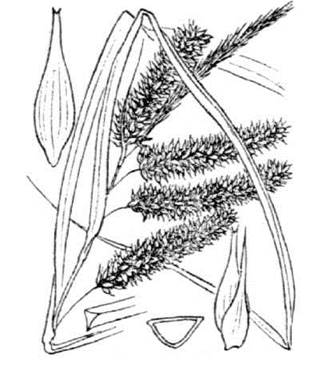
Fig. 197. Cyperus sedge
Inflorescence one-sided, with one staminate and two to six approximate pistillate spikes on slender peduncles up to 5 cm long. Lower bract almost sheathless, many times longer than the inflorescence. Glumes lanceolate-subulate, with a long rough awn, green, 3-veined. Perigynia spreading at right angles to the axis, oblong-lanceolate, 4.5–5.5 mm long, greenish-yellow, shiny, with a long bidentate beak. Flowers in May–June.
It grows along the shores and coastal zones of oligo-mesotrophic water bodies, in herbaceous and alder mires, and in the floodplains of the Dnipro River. Occurs throughout Ukraine.
An ornamental, forage, water-protecting, and bank-protecting plant.
Bladder sedge (C. vesicaria L.). A plant with an erect, sharply three-angled stem, very rough towards the top, 30–100 cm tall. Leaves linear, 3–6 mm wide, green, scabrid, as long as the stem. Inflorescence of one to three more or less approximate staminate spikes and two to three pistillate spikes. Staminate spikes linear, 4–7 mm long, with ferruginous, lanceolate scales. Pistillate spikes with obliquely ascending perigynia, cylindrical, 4–7 mm long, on short peduncles, nodding. Perigynia ovate, 7–8 mm long, beak sharply bidentate. Flowers in May–June.
It grows along the shores and in shallow waters of marshy meso-eutrophic water bodies, in mires, wet meadows, ponds, ditches, and alder forests. Distributed throughout Ukraine, sporadically in the Steppe, and rarely in the Crimean Mountains.
A forage, bank-protecting, water-protecting, and industrial plant. The aboveground biomass contains proteins (8.2%), crude protein (8.4%), fats (4.3%), fiber (35.22%), minerals, and carotene (10.7 mg/kg).
Black-spiked sedge (C. melanostachia Bieb.ex Willd). A plant with a slender stem, rough in the upper part, 15–60 cm tall, with reddish-brown split sheaths at the base. Leaves rough, channeled, with margins rolled inward, located mainly at the base, 2–4 mm wide, almost as long as the stem. Inflorescence is a compound spike of three to seven spikes; the upper ones are approximate, staminate, oblong-clavate, 1.5–3 cm long; the others are pistillate, many-flowered, dense, oblong, sessile or on short peduncles. Lower bract longer than the inflorescence, sheathless or with a very short sheath up to 5 mm. Glumes with a short mucro. Perigynia globose-ovate, coriaceous, 5–6 mm long, shortly bidentate. Flowers in May–June.
It grows on wet, mostly saline shores of water bodies, in moist depressions, in the Steppe, and less frequently in the Forest-Steppe.
A forage, ornamental, and bank-protecting plant.
Among other sedge species, such species as awned sedge (C. atherodes Spreng.), Buxbaum's sedge (C. buxbaumii Wahlenb.), tufted sedge (C.caespitosa L.), thin-rhizomed sedge (C. hordorrhiza Ehrh.), Davall's sedge (C. davalliana Smith), dioecious sedge (C. dioica L.), star/prickly sedge (C .echinata Murray), Hartman's sedge (C. hartmanii Cajand.), and Juncus sedge (C. juncella (Fr.) Nh. Fr.) are rarely found in mires and wet meadows. Their distribution is limited to certain regions of Polissya and the Forest-Steppe.
Torulinium (Torulinium ferax (Rich.) Urb.). A plant with a three-angled stem, 10–120 cm tall; leaves basal, lanceolate, with membranous, whitish-at-the-base sheaths, blade 0.5–10 mm wide. Inflorescence is a many-spiked panicle with four to eight horizontal, reflexed bracts longer than the inflorescence. Glumes persistent, membranous, 1.5(2)—1.7(2) mm long and up to 1 mm wide, with a green midvein. Flowers bisexual, the uppermost flower underdeveloped. Spikelet axis jointed. Stamens three, pistil with three stigmas. Flowers in May–June. Fruit is a three-angled, light brown nutlet.
It grows in coastal shallow waters in waterlogged areas of freshwater bodies, in lakes, oxbow lakes, estuaries, floodplains,
drainage canals, and in rice paddies as a weed. It often forms dense stands. Distributed only in the Danube valley.
An ornamental and forage plant, a pioneer of newly formed substrates.
Last update: 07/08/2026
Editorial and Educational Adaptation: This material has been compiled based on the primary/original source text. The project team performed an editorial review, corrected technical inaccuracies, structured sections, and adapted the content for an educational format.
What was processed:
- elimination of formatting defects (OCR errors, structural breaks, corrupted characters);
- editorial organization of content;
- standardization of terminology in accordance with academic sources;
- verification of factual statements against the original source text.
All mentions of the author, publication year, and origin of the primary text have been preserved in accordance with the source.