MODERN BOTANY - P. RAVEN - 1990
SECTION IV. DIVERSITY
CHAPTER 17. VASCULAR CRYPTOGAMS
Conclusions
Vascular plants possess xylem and phloem. They are characterized by an Morphology/12.html">ALTERNATION OF GENERATIONS, in which the sporophyte is the dominant and nutritionally independent phase.
The bodies of many vascular plants consist entirely of primary Tissues. Today, Secondary Growth is known primarily in seed plants, although it has also been observed in certain unrelated extinct groups of spore-bearing vascular plants. Primary conducting tissues and their associated ground tissues are arranged in three main ways: (1) a protostele consists of a solid strand of conducting tissue; (2) in a siphonostele, the conducting tissue surrounds a pith; and (3) a eustele is a system of strands arranged around a pith and separated from one another by ground tissue.
Roots evolved from the subterranean PARTS OF THE primitive plant body. Leaves arose in various ways. Microphylls, possessing a single vein and leaf traces not associated with leaf gaps, evolved as superficial lateral outgrowths of the stem. They are associated with protosteles and are characteristic of lycophytes. Megaphylls, featuring complex venation and leaf gaps associated with leaf traces, originated from branch systems. Megaphylls are characteristic of forms with siphonosteles and eusteles.
Vascular plants are either homosporous or heterosporous. Homosporous plants produce only a single type of spore, which gives rise to a bisexual gametophyte. Heterosporous plants produce microspores and megaspores that germinate into male and female gametophytes, respectively. The gametophytes of heterosporous plants are much smaller than those of homosporous ones. Heterospory arose multiple times in the evolution of vascular plants. At the same time, there was a prolonged, continuous trend toward the reduction in size and simplification in The Structure of the gametophyte, culminating in angiosperms. Spore-bearing vascular plants possess archegonia and antheridia; the former have been lost in almost all gymnosperms, whereas angiosperms lack both entirely.
Vascular plants have existed for at least 430 million years. The oldest among them, whose structure has been studied in sufficient detail, belong to the phylum Rhyniophyta. The earliest fossil remains of these plants date back to the Silurian period (about 420 million years ago). Rhyniophytes and other contemporary forms were simple, dichotomously branching axes lacking roots and leaves. Through evolutionary specialization, morphological and physiological differences arose between various parts of their body, leading to the differentiation of ROOT, stem, and leaf.
Extant spore-bearing vascular plants are divided into four phyla: Psilophyta (Psilotum and Tmesipteris), Lycopodiophyta (Lycopodium, Selaginella, and Isoetes), Sphenophyta (Equisetum), and Pteridophyta (ferns). Most of these plants are homosporous. Heterospory is observed in Selaginella, Isoetes, and certain aquatic ferns.
The life cycles of all cryptogams are broadly similar, involving an alternation of heteromorphic generations with a dominant, free-living sporophyte. The gametophytes of homosporous plants are bisexual; they produce antheridia and archegonia and are nutritionally independent of the sporophyte. In heterosporous plants (with the exception of a few genera of heterosporous ferns), unisexual, highly reduced gametophytes derive their nourishment from reserves accumulated by the sporophyte. All spore-bearing plants have motile sperm Cells, which require Water to reach the eggs.
Psilophytes differ from other living vascular plants in their lack of leaves (with the possible exception of Tmesipteris) and roots. Lycophytes are characterized by microphylls combined with protosteles; Representatives of the other phyla possess megaphylls associated with siphonosteles and eusteles.
Two of the four phyla of spore-bearing plants that include living species—Lycopodiophyta and Sphenophyta—can be traced back to the Devonian period. Among cryptogams, only ferns, whose earliest remains date to the Carboniferous, are represented by a vast number (about 12,000) of extant species.
During the Carboniferous swamps, five phyla of vascular plants were dominant, including three spore-bearing phyla: Lycopodiophyta, Sphenophyta, and Pteridophyta. The other two belonged to gymnosperms—seed ferns and cordaites.
Appendix: Carboniferous Plants
The amount of carbon dioxide annually sequestered into Photosynthesis is 100 billion tons, which is about 10% of its total atmospheric content. Approximately the same amount of CO2 is returned to the cycle through Biological Oxidation; the difference is a mere 0.01%. This slight imbalance is caused by the burial of organisms in silt and sedimentary rocks under oxygen-free conditions and incomplete decomposition. The accumulation of partially decomposed plant remains occurs in the form of peat (see p. 277), which is sometimes overlain by sediments and thus subjected to increased pressure. Depending on time, Temperature, and other factors, it can be compressed into coal—one of the types of so-called fossil fuels.
During certain periods of Earth's history, The rate of fossil fuel formation was higher than in others. One such epoch was the Carboniferous period (360–286 million years ago; see Figs. 17-9 and 18-1). The planet was dominated by lowlands covered with shallow seas and swamps, and where the temperate regions of Europe and North America are now located, conditions were favorable for year-round plant growth. The climate of these regions was tropical and subtropical; the equator at that time intersected the Appalachians, passing through Northern Europe and Ukraine. The swampy landscapes were dominated by five groups of vascular plants, including three spore-bearing phyla: Lycopodiophyta, Sphenophyta (calamites), and ferns. The other two groups were represented by gymnosperms—seed ferns (Pteridospermales) and cordaites (Cordaitales).
Arborescent Lycophytes
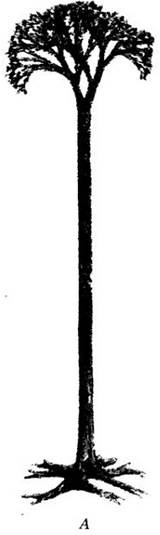
Throughout two-thirds of the "coal age" in the Late Carboniferous (Pennsylvanian subperiod), the planet was dominated by arborescent lycophytes, most of which reached heights of 10–35 m and featured sparse branching (Fig. A). After a plant reached more than half its maximum height, its trunk underwent successive dichotomous branching, producing increasingly slender shoots until, finally, the tissues at their tips lost the capacity for further growth. The branches bore long microphylls. The mechanical support in arborescent lycophytes was provided by a massive periderm surrounding a relatively small volume of xylem. Because their root system was shallow, these tall swamp plants were likely easily uprooted by wind.
Like Selaginella and Isoetes, arborescent lycophytes were heterosporous and formed sporophylls aggregated into strobili (cones). Seed-like structures are known in some of them.
As the swamps began to dry out toward the end of the Carboniferous due to Changes in the climate of Euramerica, arborescent lycophytes vanished very rapidly in geological terms. Coexisting with them were herbaceous lycophytes, similar to modern clubmosses and spike mosses, some representatives of which have survived to the present day, giving rise to four modern genera of this phylum.
Calamites
Calamites, or giant horsetails, were arborescent plants that exceeded 18 m in height (see Fig. 18-1). Much like modern horsetails, the body of calamites consisted of a branching aboveground SHOOT system and a subterranean rhizome. Leaves and branches were likewise arranged in whorls at the nodes, and the stems, despite an astonishing structural similarity, differed only in the presence of secondary xylem, which was the primary cause of their large diameter (up to 1/3 m). Comprising several genera, calamites are now considered representatives of the same order as the modern genus Equisetum.
The fertile appendages, or sporangiophores, of calamites were aggregated into strobili. Most of them were homosporous plants, but some were heterosporous. Unlike most arborescent lycophytes, calamites survived the Carboniferous period and were abundant in the Permian.
Ferns
Many well-known fossil ferns are believed to belong to the same families as modern primitive representatives of this division. During the "Age of Ferns" in the Late Carboniferous, arborescent genera such as Psaronius dominated. Reaching 8 m in height, this plant featured a stele that expanded in volume toward the apex; at the base, the stele was surrounded by adventitious roots, which played a primary role in supporting the plant. The stem terminated in a cluster of large pinnate leaves (see Fig. 18-1).
Seed Plants
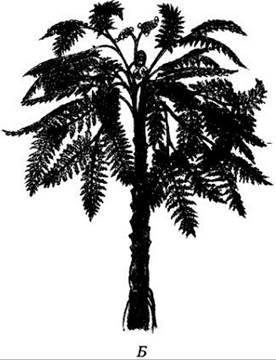
Seed ferns and cordaites represent two other groups of plants that dominated the Euramerican lowlands. Remains of the former are common in Carboniferous rocks (Fig. B). Their large, pinnately compound leaves bear such a close resemblance to fern fronds that for a long time they were classified as such.
Class="center">A. One of the dominant trees of the Late Carboniferous was the lycopsid Lepidodendron, individual specimens of which exceeded 40 m in height
B. Among the most intriguing gymnosperms are the seed ferns, an extensive group of primitive plants that emerged in the Late Devonian and flourished for nearly 125 million years. Fossils of these remarkable plants frequently occur in Carboniferous deposits and have been known to paleobotanists for over a century. Their vegetative structures bear such a striking resemblance to ferns that they were long grouped with them. The figure illustrates a reconstruction of the Carboniferous seed fern Medullosa noei, approximately 5 m in height
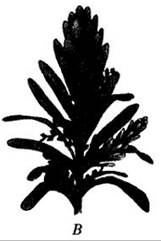
C. The apex of a young branch of the primitive conifer Cordaites, showing long strap-shaped leaves and "cones."
However, in 1905 F. W. Oliver and D. H. Scott demonstrated that these plants produced seeds, meaning they were gymnosperms. Many of their species were small, shrubby, or climbing, whereas others grew into large, towering trees. The leaves located near the apex of the stem or trunk bore microsporangia and seeds. These plants survived into the early Mesozoic Era. Although they were once thought to share a common ancestor with ferns, Figure 17-7 illustrates a more probable hypothesis of their evolutionary relationships.
Cordaites were widespread during the Carboniferous period in both swamps and drier habitats. Although some species were shrubby, this order also included many tall (15–30 m), heavily branched trees that formed extensive forests. Long (up to 1 m), strap-shaped leaves were arranged spirally at the tips of the youngest branches (Fig. C). A bulky pith occupied the center of the stem, and the cambium produced a continuous cylinder of secondary xylem. The Root System at the Base of the plant likewise contained secondary xylem. Pollen-producing strobili and seed-producing cone-like structures were borne on separate branches. Cordaites flourished abundantly throughout the drier and cooler Permian period (286–248 million years ago) that followed the Carboniferous.
The arborescent lycopsids that dominated Euramerica during the Carboniferous—the tropical swamp plants responsible for major coal deposits—died out shortly before the Permian period, a time marked by increased drought in the tropics and extensive glaciation in polar and temperate regions. Only the herbaceous relatives of the Carboniferous arborescent horsetails and lycophytes, along with certain families of ferns that emerged during that same era, continued to flourish and have survived to the present day. Seed ferns and cordaites eventually disappeared. Only a single group of Carboniferous gymnosperms—the conifers (which were not dominant at the time)—persisted and continued to evolve new life forms throughout the Permian period. Modern conifers are discussed in detail, along with other seed plants, in Chapter 18.
Last update: 07/08/2026
Editorial and Educational Adaptation: This material has been compiled based on the primary/original source text. The project team performed an editorial review, corrected technical inaccuracies, structured sections, and adapted the content for an educational format.
What was processed:
- elimination of formatting defects (OCR errors, structural breaks, corrupted characters);
- editorial organization of content;
- standardization of terminology in accordance with academic sources;
- verification of factual statements against the original source text.
All mentions of the author, publication year, and origin of the primary text have been preserved in accordance with the source.