MODERN BOTANY - P. RAVEN - 1990
SECTION IV. DIVERSITY
CHAPTER 18. SEED PLANTS
Class="center">Fig. 18-1. Reconstruction of a Late Carboniferous wetland forest dominated by arborescent lycophytes such as Lepidodendron (forming the upper canopy on the left side of the illustration). In their youth, these trees were unbranched (resembling bottle brushes), later branching sparsely and ultimately forming a dense forest canopy. On the elevated ground (on the right side of the illustration), Sigillaria is visible—a lycophyte adapted to drier conditions (a tree crowned with tufts of long leaves). Calamites (giant horsetails, shown on the left edge and in the foreground center) and tree ferns of the genus Psaronius (with trunks tapering toward the top, on the right edge) are also spore-bearing vascular plants. Seed plants are likewise quite numerous, including Medullosa, a seed fern with forked fronds (in the center and on the right edge), and cordaites, represented both by mangrove-like forms with roots submerged in Water (bottom right) and tall trees (upper canopy on the right)


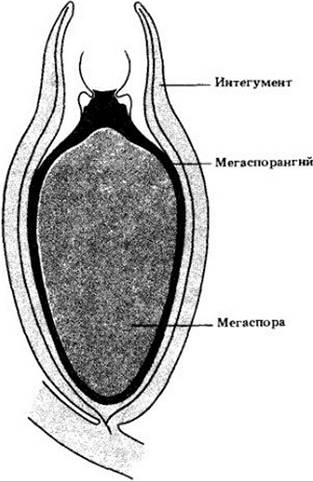
All seed plants are heterosporous, and their highly reduced megagametophyte is enclosed within a megaspore. The megaspore, in turn, resides inside a fleshy megasporangium referred to here as the nucellus. Unlike seedless heterosporous plants, the nucellus is enveloped by one or two additional tissue layers known as integuments. These completely enclose the megasporangium, leaving only a small opening, the micropyle, at its apex. The nucellus and integument(s) together constitute the ovule (Fig. 18-2).
Fig. 18-2. Section through the ovule of Eurystoma angulare, illustrating the relative positions of the integument, megasporangium (nucellus), and megaspore. Fertilization transforms ovules into seeds; in other words, seeds are fertilized, mature ovules
Following fertilization, the integuments develop into the seed coat, and the seed is formed. In other words, a seed develops from an ovule and is frequently defined as a mature ovule. In most extant seed plants, the embryo, or young sporophyte, develops within the seed prior to its shedding; however, in many ancient members of this group (see, for example, Figs. 18-2 through 18-4), seeds were probably shed before the embryo had formed. The former strategy likely provides superior survival under cold and harsh conditions, and the Permian period—during which conifers, cycads, and ginkgophytes arose—was undoubtedly a time of climatic extremes. In addition to the embryo and seed coat, all seeds contain a supply of stored nutrients, further enhancing the young plant's chances of survival.
The oldest known seeds date back to the Late Devonian (approximately 360 million years ago) (Fig. 18-3). Over the subsequent 50 million years, a vast array of seed plants emerged, notably seed ferns, cordaites, and conifers (Fig. 18-4). The earliest vascular plants, including the three extinct phyla described in Chapter 17, were far more widely distributed than their seed-bearing descendants. This is because seeds are not dispersed over distances as vast as those reached by spores. With the advent of seed plants, the composition of floras—that is, the assemblages of species in various Regions of the planet—began to diverge more markedly from one another.
Fig. 18-3. A. Reconstruction of a fertile branch of the Late Devonian plant Archeosperma arnoldis, bearing seed-like structures. Cupules—cup-shaped structures that partially enclosed the megasporangia—occurred in pairs; each cupule contained two flask-shaped seeds measuring about 4 mm in length with lobed apices. B. Diagram showing THE POSITION OF the megaspore within the seed. C. Megaspore extracted from the seed via maceration. This fossil find from Pennsylvania represents the oldest known seed (360 million years old)

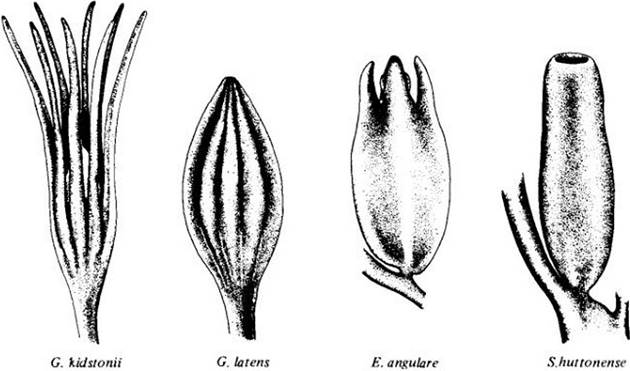
Fig. 18-4. Seed-like structures of several Paleozoic plants, illustrating the evolutionary trajectory of seeds. In Genomosperma kidstonii (from the Greek genos meaning "birth" and sperma meaning "seed"), the nucellus was surrounded by 8 to 11 separate finger-like projections originating from the Base of the megasporangium. Integuments were not yet present. In Genomosperma latens, the integumentary lobes fused for approximately one-third of their length, forming a rudimentary seed coat. In Eurystoma angulare, fusion is nearly complete, whereas in Stamnostoma huttonense it is fully complete
Seed plants (all of which possess megaphylls) comprise five extant phyla: Cycadophyta (cycads), Ginkgophyta (ginkgo), Coniferophyta (conifers), Gnetophyta (gnetophytes), and Anthophyta (flowering plants). Before examining these groups, we will briefly review another assemblage of seedless vascular plants: the progymnosperms, known exclusively from the fossil record. They are discussed here rather than in Chapter 17 because they are the probable ancestors of gymnosperms.
Angiosperms, or flowering plants—currently the dominant group of vascular plants—are definitively known from the Early Cretaceous (approximately 127 million years ago). Their evolution is examined and compared with that of gymnosperms in Chapter 29. Although angiosperms must be somewhat older than their surviving fossil record indicates, they nevertheless arose relatively recently in the vast timeline of vascular plant evolution.
Progymnosperms
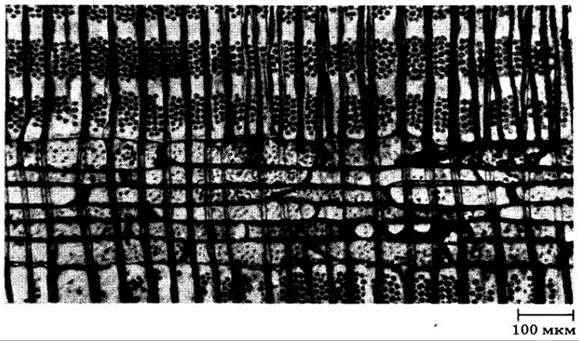
During the Late Paleozoic, a group of plants known as progymnosperms existed, bridging the morphological gap between trimerophytes and gymnosperms. Although progymnosperms reproduced via freely dispersed spores, they possessed secondary xylem remarkably similar to that of gymnosperms (Fig. 18-5). They also differed from all Devonian trees in producing secondary phloem. Progymnosperms and Paleozoic ferns are likely descendants of more ancient trimerophytes (see Fig. 17-8, B), from which they differed primarily in having more complex branching systems and, consequently, more highly developed vascular systems. It is also possible that ferns evolved from progymnosperms. Since trimerophytes gave rise to the latter, and ferns originated from one of these lineages, the question is merely one of the timing of fern emergence.
Fig. 18-5. Radial section of the secondary xylem, or wood, of the progymnosperm Callixylon newberryi. This fossil wood, featuring regular rows of pitted tracheids, bears a striking resemblance to the wood of certain gymnosperms
The single most important progressive feature distinguishing progymnosperms from trimerophytes is the presence of a bifacial cambium—that is, a cambium that produces secondary xylem and phloem. This type of cambium is characteristic of seed plants and apparently first appeared in progymnosperms.
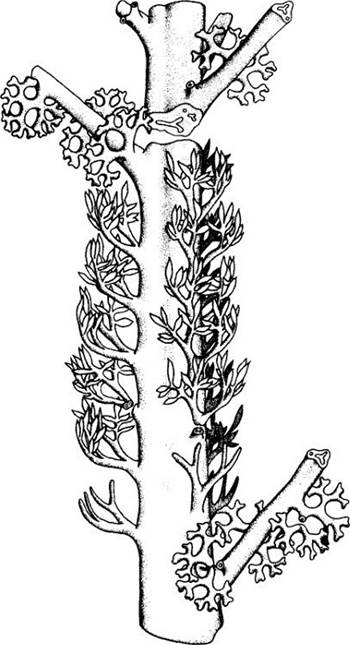
Some members of this phylum (the Aneurophyton group), which lived during the Devonian period (approximately 360 to 380 million years ago), were characterized by three-dimensional branching (Fig. 18-6) and possessed protosteles. In their structural Organization, they resembled certain early seed ferns, leading some paleobotanists to suggest that the branch systems of these plants were the evolutionary precursors to the frond-like leaves of the latter.
Fig. 18-6. Reconstruction of the branching pattern of Triloboxylon ashlandicum, a progymnosperm belonging to the Aneurophyton group. The main axis bears vegetative branches (at the top and bottom of the illustration), interspersed with axes bearing sporangia
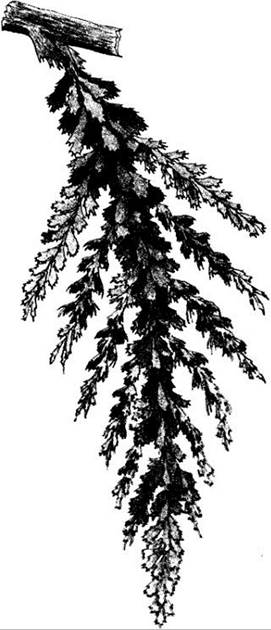
Another major group of progymnosperms, the Archaeopteridales, also appeared in the Devonian (about 370 million years ago) and became extinct in the Early Carboniferous, around 340 million years ago (Fig. 18-7). This group is considered more advanced because its lateral branch systems were flattened into a single plane and bore lamina-like structures, a sort of primitive leaves (Fig. 18-8). These leafy branches resemble the shoots of ancient conifers. The larger branches of archaeopterids possessed a pith. Most progymnosperms were homosporous, but heterospory has been discovered in certain species of Archaeopteris.
Fig. 18-7. Reconstruction of the progymnosperm Archaeopteris, whose fossil remains are frequently found in eastern North America. Species of this genus grew to heights of over 20 m, and some of them apparently formed extensive forests.
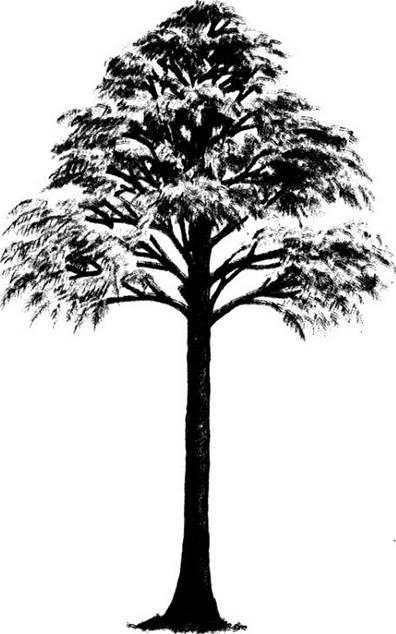
Fig. 18-8. Reconstruction of the frond-like lateral branch System of the progymnosperm Archaeopteris macilenta. Fertile leaves with maturing sporangia are visible on the first-order branches in the middle region.
Fossil trunks of Archaeopteris exceed a meter in diameter and reach up to 10 m in length, meaning that at least some species in this group were large trees. The spatial distribution of the finds suggests that Archaeopteris dominated vast forests in certain regions. As the reconstruction in Fig. 18-7 shows, its branching pattern may have resembled that of conifers, although this remains a hypothesis.
Morphological data accumulated over the past few decades strongly support the view that gymnosperms evolved from progymnosperms concurrently with the Evolution of the seed. However, it is impossible to say with certainty whether the seed originated once or multiple times within this evolutionary Lineage. It also remains unclear which specific group or groups of progymnosperms gave rise to gymnosperms.
Last update: 07/08/2026
Editorial and Educational Adaptation: This material has been compiled based on the primary/original source text. The project team performed an editorial review, corrected technical inaccuracies, structured sections, and adapted the content for an educational format.
What was processed:
- elimination of formatting defects (OCR errors, structural breaks, corrupted characters);
- editorial organization of content;
- standardization of terminology in accordance with academic sources;
- verification of factual statements against the original source text.
All mentions of the author, publication year, and origin of the primary text have been preserved in accordance with the source.