BIOLOGY Volume 2 - A Guide to General Biology - 2004
17. ANIMAL COORDINATION AND REGULATION
17.8. Innate Behavior
Innate behaviors do not form a single clearly defined category; rather, they represent a diverse set of reactions inherited alongside specific neural or cytoplasmic pathways in multicellular and unicellular organisms, respectively. Thanks to these "hard-wired" pathways, a given stimulus will always elicit the same response. These behaviors have evolved and been refined over many generations through Selection; in other words, they are adaptive, meaning they contribute to the survival of the species. Another important feature of innate behavior is that it ensures the economical use of Neural Pathways in Multicellular animals, as it does not require information Processing by higher centers of The Nervous system.
There is a gradient of complexity in innate behavioral responses, reflecting The complexity of the neural pathways involved in organizing specific actions. Innate behaviors include biorientation (Taxes and kineses), unconditioned Reflexes, and instincts. The latter can sometimes be extremely complex and encompass biological rhythms, territorial behavior, courtship, mating, aggression, altruism, social hierarchy, and social Organization. In plants, every form of behavior is innate.
Taxes
A taxis is a directed movement of an entire Organism in response to an external stimulus, or cue. Such movement may be directed toward the stimulus (positive taxis), away from it (negative taxis), or at a specific angle relative to the stimulus. In addition, taxes are classified According to the Nature of the signal (light, sound, etc.). Some types of taxes are listed in Table 16.2. The ability to move at a specific angle determined by a signal is often striking. For example, certain species of ants are known to find their way back to the nest by orienting themselves relative to the Sun. Other organisms orient themselves in space such that a particular side of the body (usually the dorsal side) is always kept uppermost (dorsal light reaction); this type of response can be observed, for instance, in flatfishes, which undergo significant Symmetry changes during their development.
Many organisms determine the direction of a signal source by moving their HEAD—where the main Sense Organs are located—from side to side. This phenomenon, known as klinotaxis, allows the stimulus to be perceived using symmetrically positioned head receptors, such as photoreceptors. If both receptors are stimulated equally, the organism will move forward in an approximately straight line. This type of behavior can be observed in the planarian flatworm (Planaria) moving toward a food source (positive chemotaxis), or in blowfly larvae moving away from a light source (negative phototaxis). It is believed that in all cases of klinotaxis, sufficiently frequent stimulation of receptors on both sides of the body is necessary so that the "Brain" continuously receives information, as these organisms lack long-term memory.
Kineses
A kinesis is an undirected locomotor reaction in which The rate of movement depends on the intensity of the stimulus rather than on its direction. For example, the tentacles of Hydra move slowly in various directions while searching for food, but if saliva, Glutathione, or Daphnia are placed in close proximity to the hydra, the tentacles begin to move faster.
Kinesis and taxis can be observed in the woodlouse experiment described below, conducted using a "choice chamber" (the term used for an apparatus that allows an animal to make several behavioral choices in response to a given stimulus).
Experiment 17.1. Studying orientation in woodlice using a simple choice chamber
Materials and Equipment
Old tights
Two Petri dishes (without lids)
Glue
Hot metal rod
Cotton wool
Anhydrous calcium chloride
Adhesive tape
10 woodlice
Plasticine
1. Cut a 10 cm diameter circle from the old tights, stretch it over an 8.5 cm Petri dish, and glue it in place, holding the fabric with a rubber band until the glue dries.
2. Melt a hole about 1 cm in diameter in the bottom of this dish using a hot metal rod.
3. Divide the bottom of the second Petri dish in half using a plasticine "barrier" 8.5 cm long, 1.4 cm high, and 0.5 cm wide.
4. Place Water-soaked cotton in one half of this dish, and anhydrous calcium chloride granules in the other.
5. Attach the dish prepared in steps (1–2) to the dish prepared in steps (3–4) using adhesive tape, as shown in Fig. 17.57.
Class="center">
Fig. 17.57. Apparatus for studying orientation in woodlice.
6. Introduce 10 woodlice into the chamber through the opening in the upper dish. At 1-min intervals, record the total number of animals and the number of active individuals in each half of the chamber in a table similar to Table 17.15.
Table 17.15. Sample data table for the results of Experiment 17.1
Moist environment |
Dry environment |
||||
Time, min |
total number of woodlice |
number of active woodlice |
total number of woodlice |
number of active woodlice |
active woodlice in the dry half, % |
0 |
4 |
1 |
6 |
4 |
40% |
1 |
5 |
2 |
5 |
5 |
50% |
2 |
etc. |
etc. |
|||
3 — — — |
|||||
20 |
|||||
7. After 20 min, plot graphs of the number of woodlice in each half of the chamber against time.
8. Calculate the percentage of active woodlice in the dry half for each recording interval and plot a graph of this value against time.
9. Explain the obtained results based on The concepts of kineses and taxes.
Simple experiments of this type make it possible to study organismal responses to environmental conditions corresponding to the extremes of the studied variable. A manifestation of taxis in such cases is the preference shown by animals for a specific environment. For example, woodlice in the described experiment, where they can choose between high and low humidity, accumulate in greater numbers in the moist half, thereby exhibiting positive hydrotaxis. In more complex experiments involving a combination of stimuli of different nature, it is possible to determine which of them dominates, i.e., dictates the final response.
By recording The activity of woodlice in each half of the chamber, say, every 20 s, we could study kinesis. The results of such a study show that immediately after being placed into the chamber at the boundary between two areas with different conditions, some woodlice crawl randomly while others remain motionless. However, soon all woodlice begin to move, and their rate of movement is always higher in the dry half. This increased mobility in the dry half, which appears to be random, can be understood as an attempt to find optimal conditions; once the woodlice find such conditions, their mobility decreases. Such responses serve as an example of orthokinesis. In the moist half of the chamber, woodlice move more slowly and consequently tend to accumulate there. Their preference for the moist chamber indicates a positive taxis with respect to humidity.
The Nature of orientation behavior is not rigidly programmed and can vary depending on various factors, such as the degree of hunger, thirst, illumination, Temperature, and environmental humidity.
17.8.1. Unconditioned reflexes in vertebrates
A simple, or unconditioned, reflex is an involuntary, stereotyped response of a part of the organism to a given stimulus. It is determined by innate neural pathways that form reflex arcs passing through the Spinal Cord and/or brain. Their Structure and function are described in Section 17.2.
Behaviorally, simple spinal reflexes represent either withdrawal movements that pull a limb away from a noxious stimulus, or stretch reflexes that maintain posture and balance. Both types of actions are fundamentally involuntary and generally do not require coordination and integration beyond that performed at the spinal cord level. However, both types of responses can be modified by the brain depending on circumstances and past experience. When this occurs, innate and acquired behavioral responses overlap, and the reflex is then termed a conditioned reflex (see Table 17.16). Many unconditioned reflexes mediated by the brain can also become conditioned, such as blinking in response to a sudden rapid movement in front of the eyes.
Table 17.16. MAIN TYPES OF learning according to the Classification proposed by Thorpe (1963)
Type of learning |
Behavioral characteristics |
Habituation |
Repeated presentation of a stimulus not associated with reward or punishment (reinforcement) leads to a decline in the response to it; for example, birds cease to be frightened by a scarecrow, i.e., they learn to ignore it. This is of great importance in the behavioral development of young animals, helping them recognize environmental elements that are irrelevant to survival (neutral elements) such as wind-blown object movements, cloud shadows, wave action, etc. Habituation is the result of Changes in the nervous system rather than a form of sensory adaptation, since the new behavior remains stable and subsequently never evokes a response again |
|
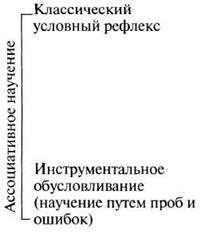
Demonstrated in studies by I. P. Pavlov on dogs. The method consisted of establishing a conditioned salivary reflex, where the animal begins to respond not only to the unconditioned stimulus (the sight of food), but also to a novel conditioned stimulus (metronome beats) presented to the dog in conjunction with the unconditioned stimulus. The animal learns to associate unconditioned and conditioned stimuli and to respond to either of them. For example, birds do not eat black and orange heliconiid caterpillars after learning from personal experience (see next item) that they are unpalatable, but birds likewise avoid eating all similarly colored caterpillars even if they are perfectly edible |
Demonstrated in studies by Skinner on pigeons. Whenever a bird performed a certain action, it was rewarded (positive reinforcement) or "punished" (negative reinforcement). Pairing this action with a reward or punishment respectively increases or decreases the likelihood of the action being repeated in the future. The effectiveness of this type of learning, as in classical conditioning, increases with a series of repeated trials. This was shown in studies on cuttlefish |
|
Latent learning |
Not all forms of behavior are directed toward satisfying immediate physiological needs or obtaining a reward. Sometimes animals explore a new environment and acquire information that may become useful or even vital in the future. For example, a good knowledge of the surroundings of a burrow can help a mouse escape from a predator, whereas at the time this knowledge was acquired, it seemed to have no value whatsoever. The acquisition of the species-specific song by chaffinches in nature apparently also belongs to this category (Section 17.8.2) |
Insight |
Insight is probably the highest form of learning. It is not the immediate result of trial-and-error learning, but rather appears to be based on information acquired earlier under different circumstances. Insight is possible only with a sufficient level of intellectual development. An example is Köhler's observations on chimpanzees: bananas were hung high out of reach from the ceiling of the cage in which the ape was kept, and wooden boxes were placed in the cage at the same time. The animal quickly "figured out" that to accomplish the task, it had to stack several boxes on top of each other and climb onto them. Observations showed that these actions were preceded by a period of "thought." The correct solution in this case was facilitated by prior play with the boxes (i.e., latent learning) |
Imprinting |
A simple, specialized form of learning that occurs during a critical (sensitive) period in the first days of a animal's life. The acquired behavior becomes relatively permanent and is difficult to modify. Imprinting consists of the young animal's brain locking onto the image of another individual, usually a parent or a large object, and forming a special "attachment" to it. This phenomenon was described by Lorenz, who observed newly hatched goslings and ducklings, deprived of their mother, following at his heels and taking him for their mother. Bottle-fed lambs behave similarly, which can have a profound and not always desirable effect on the animal's entire subsequent life, hindering the establishment of normal relationships with other members of its species. In nature, the adaptive role of imprinting is obvious: offspring tend to stay close to their parents, quickly picking up essential survival skills such as flying from them, and becoming familiar with environmental features (for example, in salmon, this may be the "scent" of the river where they hatched and to which they will return to spawn). |
Last update: 06/08/2026
Editorial and Educational Adaptation: This material has been compiled based on the primary/original source text. The project team performed an editorial review, corrected technical inaccuracies, structured sections, and adapted the content for an educational format.
What was processed:
- elimination of formatting defects (OCR errors, structural breaks, corrupted characters);
- editorial organization of content;
- standardization of terminology in accordance with academic sources;
- verification of factual statements against the original source text.
All mentions of the author, publication year, and origin of the primary text have been preserved in accordance with the source.