BIOLOGY Volume 2 - A Guide to General Biology - 2004
16. PLANT COORDINATION AND REGULATION
16.2. Plant Growth Substances
16.2.2. Auxins and Geotropism
It is easy to observe that roots exhibit positive geotropism, meaning they grow downwards, whereas shoots (at least the main ones) show negative geotropism, meaning they tend to grow upwards. The fact that the stimulus triggering this response is gravity can be demonstrated using an instrument called a clinostat (Fig. 16.11). As the chamber rotates, gravity acts equally and alternately on all PARTS OF THE seedlings. To neutralize the unilateral EFFECT OF GRAVITY and force shoots and roots to grow horizontally, four rotations of the chamber per hour are sufficient. Stationary control seedlings maintain their normal gravitational response, with the SHOOT growing upwards and the roots downwards. Throughout the experiment, it is crucial to ensure uniform lighting from all sides (or to conduct the experiment in the dark) to rule out any directional response to light.
Class="center">
Fig. 16.11. A clinostat with broad bean seedlings that have been rotated in it for several days.
The Role of Auxins in geotropism can be demonstrated in the experiment shown in Fig. 16.12, using the technique proposed by Went. Auxin moves from the horizontally positioned coleoptile tip while "flowing" downwards along the way. The higher concentration of auxin on the lower side of the intact coleoptile leads to enhanced stimulation of Cell elongation in this region, resulting in upward growth of the coleoptile.

Fig. 16.12. The Effect of gravity on auxin movement in a horizontally positioned coleoptile tip. The distribution of the phytohormone (%) was studied using Went's bioassay.
Removing the ROOT tip renders it insensitive to gravity; however, demonstrating auxin movement in this case is more difficult due to its very low concentration in the root, which prevents obtaining conclusive results in bioassays like the one described above. Nevertheless, very interesting results have been obtained in the experiment shown in Fig. 16.13.

Fig. 16.13. The effect of asymmetric auxin distribution on the growth of decapitated coleoptiles and roots.
Observations of this kind led to the hypothesis schematically illustrated in Fig. 16.14. According to this hypothesis, the opposite growth responses of roots and shoots to auxin are due to their different sensitivities to it. Later on, we will discuss various modifications of this hypothesis in light of recently obtained data.

Fig. 16.14. Hypothesis explaining auxin redistribution in a horizontally positioned seedling.
The different sensitivity of roots to auxin (see Fig. 16.10) can also explain the negative phototropism occasionally observed in them. Increased accumulation of auxin on the shaded side inhibits growth, causing Cells on the illuminated side to elongate more rapidly, thereby forcing the root to grow away from the light. Thus, an important aspect of the humoral regulation of plant growth has been revealed: the response depends not only on The Nature of the phytohormone (qualitative control) but also on its concentration (quantitative control).
Mechanism of Gravity Sensitivity
The pronounced geotropism in plants led scientists to ponder The Mechanism of this response even before the discovery of auxins. Darwin was the first to show that removing the root cap—a group of large parenchymal cells protecting the root tip as it grows through the soil—abolishes its positive geotropism. A cross-section of the root cap reveals large starch grains housed within amyloplasts (colorless Plastids) in its cells (Fig. 16.15).
As early as 1900, it was suggested that these cells function as statocytes, acting as gravity receptors, while the starch grains play the role of statoliths—structures that shift under METABOLISM/18.html">The Influence of gravity. According to the so-called starch-statolith hypothesis, starch grains sediment at the lower end of the cells (Fig. 16.15). This somehow affects the distribution of growth substances, which are produced sometimes in the root tip, sometimes in the root cap, and occasionally in both structures simultaneously. Much evidence Supports this hypothesis. All gravity-sensitive plant Organs contain statocytes; for instance, they are present in the bundle sheath of stems (starch sheath). Plants in which starch grains have been disrupted by one means or another lose gravitropism, but this ability is restored once they are allowed to accumulate starch again.
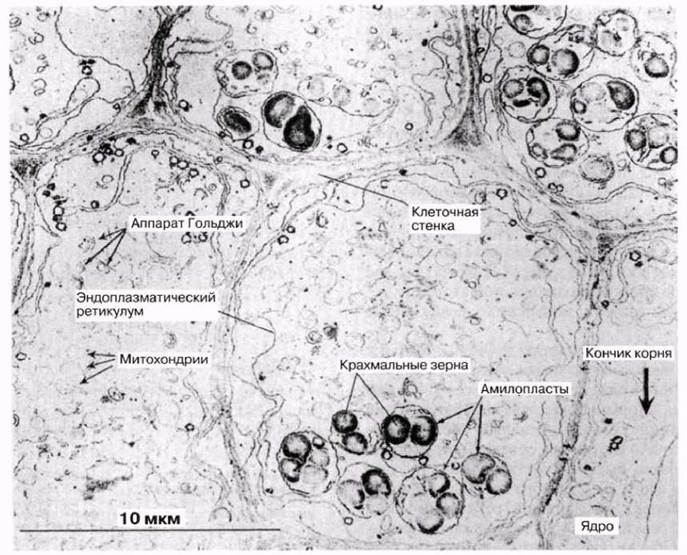
Fig. 16.15. Transmission electron micrograph of a root cap section showing amyloplasts containing starch grains accumulated at the bottom of the cells.
16.11. What are the similarities between the mechanisms of gravity perception in plants and animals?
Modern Hypotheses of Gravitropism
As mentioned above, the gravitropism of coleoptiles appears to be mediated by auxins, but in most shoots, a geotropic response is observed even after Decapitation. Therefore, it remains unclear whether this response is linked to auxin movement. Auxins do indeed redistribute in roots, but this shift is apparently not substantial enough to fully account for the Observed changes in growth rate. It has been shown that a certain inhibitor is indeed transported from the root cap to the elongation zone, though this does not necessarily have to be auxin. Several research groups failed to detect auxin in the root caps of corn seedlings, yet successfully isolated Abscisic acid—a well-known growth inhibitor—from them. Another growth inhibitor, Ethylene, may also play a role. Finally, it has been found that the concentration of Gibberellins (growth stimulants) on the faster-growing side of stems and roots is significantly higher than normal during a geotropic response.
16.12. What Conclusion can be drawn from the experiments illustrated in Fig. 16.16? No bending is observed in the control (with untreated Agar). If IAA was used instead of abscisic acid, there was also no noticeable bending.

Fig. 16.16. Effect of abscisic acid on the geotropism of decapitated roots (experimental data by Pilet, 1975).
Last update: 06/08/2026
Editorial and Educational Adaptation: This material has been compiled based on the primary/original source text. The project team performed an editorial review, corrected technical inaccuracies, structured sections, and adapted the content for an educational format.
What was processed:
- elimination of formatting defects (OCR errors, structural breaks, corrupted characters);
- editorial organization of content;
- standardization of terminology in accordance with academic sources;
- verification of factual statements against the original source text.
All mentions of the author, publication year, and origin of the primary text have been preserved in accordance with the source.