BIOLOGY Volume 1 - A Guide to General Biology - 2004
4. ENZYMES
Enzymes can be defined as biological catalysts. A catalyst is a substance that accelerates a chemical reaction without being consumed or permanently changed by it. Because enzymes are protein molecules synthesized within living Cells, they are referred to as biological catalysts. Every Cell in The Human Body contains thousands of enzymes. They catalyze numerous Chemical Reactions that take place at temperatures compatible with life, i.e., within the range of 5 to 40 °C. For these same reactions to occur at an equivalent rate outside a living Organism, extremely high temperatures and drastic changes in other conditions would be required, which would be lethal to The Cell. Enzymes are absolutely essential because, without them, cellular reactions would proceed far too slowly to sustain life.
The substance upon which an enzyme acts is called its substrate. By binding to the substrate, the enzyme forms a short-lived enzyme-substrate complex. Within such a complex, the probability of the reaction occurring increases significantly. Upon completion of the reaction, the enzyme-substrate complex dissociates into a product (or products) and the enzyme itself. The enzyme remains unchanged by the reaction and, once finished, is free to bind with a new substrate molecule:
Class="center">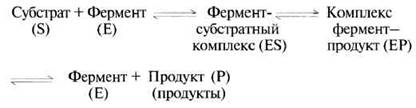
or

Anabolism and Catabolism
The sum total of all chemical reactions occurring within a cell constitutes what we call METABOLISM. Metabolism is divided into anabolism and catabolism—two distinct types of pathways that often take place in different compartments of the cell. Catabolic reactions, or breakdown pathways, are typically accompanied by the release of energy and generally involve oxidation and Hydrolysis. Anabolic reactions, or biosynthetic pathways, conversely, require an input of energy and are frequently Condensation reactions. All of these processes are enzyme-mediated. An example of an enzyme involved in anabolism is Glutamine Synthetase, which catalyzes the Synthesis of the amino acid glutamine from glutamic acid and ammonia:

(ATP — adenosine triphosphate; ADP — adenosine diphosphate; Pi — inorganic phosphate). An example of an enzyme involved in catabolism is maltase:

Metabolic Pathways
Typically, a given initial substance is converted into a product (or products) through a series of intermediate compounds, mediated by several enzymes acting sequentially. Such a sequence of reactions forms what is known as a metabolic pathway. Numerous metabolic pathways operate simultaneously within a cell. These reactions proceed in a coordinated and tightly regulated manner, owing to the specific nature of enzymes. A single enzyme typically catalyzes only one specific reaction. Thus, enzymes serve to regulate cellular reactions and ensure they proceed at the appropriate rates.
4.1. Properties of Enzymes
Enzymes are characterized by the following fundamental properties.
1. All enzymes are Globular Proteins.
2. The information for their synthesis, like that for other proteins, is encoded in DNA.
3. Enzymes function as catalysts (see above).
4. Their presence does not affect the nature or Properties of the final reaction product(s).
5. Enzymes are exceptionally efficient, meaning that very small amounts of an enzyme can bring about The conversion of large quantities of substrate. For instance, at body Temperature, a single molecule of catalase can break down approximately 600,000 molecules of hydrogen peroxide into Water and oxygen per second. The efficiency of catalase can be compared with that of an inorganic catalyst such as manganese dioxide by adding them separately to hydrogen peroxide and measuring The rate of oxygen evolution. (Liver is a rich source of catalase.) On average, enzymes are capable of catalyzing about 1,000 reactions per second. Without catalysts, these reactions would proceed millions of times slower.
6. Enzymes exhibit high Specificity, meaning that a single enzyme generally catalyzes only one specific reaction. Catalase, for example, catalyzes exclusively the decomposition of hydrogen peroxide.
7. Enzyme-catalyzed reactions are reversible.
8. Enzyme activity varies with pH and temperature, as well as with the concentrations of both the substrate and the enzyme itself (these factors will be discussed in Section 4.3).
9. Enzymes lower the activation energy of the catalyzed reaction (Section 4.1.1).
10. The enzyme molecule contains an Active Site that interacts with the substrate. This active site has a specific shape (sec. 4.1.2).
4.1.1. Activation Energy
Let us imagine a mixture of gasoline and oxygen. From a thermodynamic standpoint, a reaction between these two substances is feasible, but it will not proceed without an input of some energy, such as that introduced by a simple spark. The same holds true for a match. The chemicals contained in the match HEAD can react in a process that ultimately releases energy, but to initiate this reaction, a small amount of energy must first be expended (the thermal energy generated by striking the match against the box is sufficient). The energy required to cause substances to react is called activation energy. Acting as catalysts, enzymes lower the activation energy (Fig. 4.1). They increase the overall reaction rate without significantly altering the temperature at which the reaction takes place.

Fig. 4.1. A. Activation energy for catalyzed and uncatalyzed reactions. B. An analogous situation — rolling a boulder down a hill releases more energy than was expended to push it up and start it rolling.
Last update: 06/08/2026
Editorial and Educational Adaptation: This material has been compiled based on the primary/original source text. The project team performed an editorial review, corrected technical inaccuracies, structured sections, and adapted the content for an educational format.
What was processed:
- elimination of formatting defects (OCR errors, structural breaks, corrupted characters);
- editorial organization of content;
- standardization of terminology in accordance with academic sources;
- verification of factual statements against the original source text.
All mentions of the author, publication year, and origin of the primary text have been preserved in accordance with the source.