BIOLOGY Volume 1 - A Guide to General Biology - 2004
4. ENZYMES
4.1. Properties of Enzymes
4.1.2. Mechanism of Enzyme Action
Enzymes exhibit a very high degree of Specificity. In 1890, Emil Fischer suggested that this specificity is due to a specific shape of the enzyme molecule, which precisely complements the shape of the substrate molecule (or molecules). This hypothesis is often referred to as the "lock-and-key" model, in which the substrate is compared to a "key" that fits precisely into a "lock", i.e., the enzyme. This is shown schematically in Fig. 4.2. The region of the enzyme molecule that comes into contact with the substrate is called the Active Site of the enzyme, and it is specifically this active site that possesses a unique conformation.
Class="center">
Fig. 4.2. A. Diagram illustrating the "lock-and-key" hypothesis proposed by Fischer to explain enzyme action. B. A more detailed schematic representation of the enzyme-substrate complex. The amino acid residues forming the Active Site of the enzyme are numbered according to their position in the Introduction/19.html">Primary Structure of the enzyme.
Most enzyme molecules are significantly larger than the substrate molecules upon which they act. The active site, however, constitutes only a very small fraction of the enzyme molecule, typically comprising 3 to 12 amino acid residues. The Role of the remaining Amino Acids that make up the bulk of the enzyme is to maintain the proper globular conformation of the molecule, which, as we will see later, is essential for the most efficient functioning of the active site.
The resulting product molecules no longer fit the active site of the enzyme. They dissociate from it (diffuse into the surrounding medium), after which the freed active site is ready to bind new substrate molecules.
In 1959, Daniel Koshland proposed a new interpretation of the lock-and-key hypothesis, known as the induced-fit hypothesis. Based on evidence indicating that enzymes and their active sites are physically more flexible than initially thought, he concluded that the binding of a substrate induces Conformational Changes in the enzyme's active site. The amino acid residues that make up the active site assume a specific conformation that enables the enzyme to perform its function with maximum efficiency (Fig. 4.3). A fitting analogy for this is a glove that adjusts its shape when put onto a hand. As the details of various reaction mechanisms are elucidated, refinements continue to be made to this hypothesis.
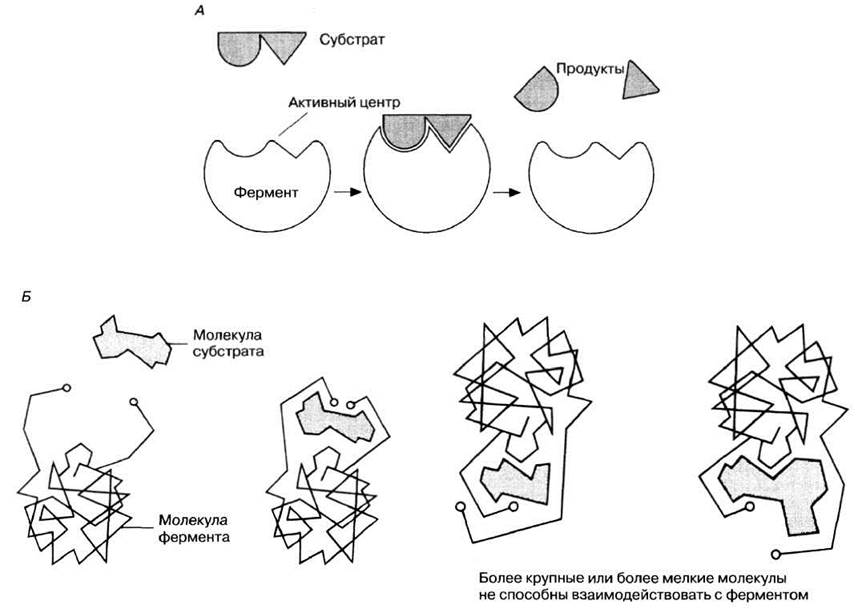
Fig. 4.3. Diagrams illustrating Koshland's induced-fit hypothesis. A. A simplified diagram explaining the MECHANISM OF ACTION. Upon binding of the substrate to the active site, the enzyme undergoes a slight change in shape, becoming correspondingly more bulky. B. A more detailed diagram. Upon binding with the enzyme, the substrate induces a conformational change that brings the active groups of the enzyme into closer proximity. (From J. C. Marsden, C. F. Stoneman (1977), Enzymes and equilibria, Heinemann Educational Books.)
Insight into how an enzyme works can be gained through X-ray crystallography and computer modeling. Fig. 4.4 illustrates this using the enzyme Lysozyme as an example.

Fig. 4.4. Computer-generated models of the Tertiary Structure of lysozyme before and after substrate binding, demonstrating how this enzyme Functions. A. Side view. The active site takes the form of a cleft running across the bulk of the molecule. B. Side view. The active site with a substrate molecule bound within it. Note the slight conformational change in the enzyme induced by substrate binding. This is an example of the "induced fit" postulated by Koshland in 1959. The substrate of lysozyme is a short oligosaccharide chain that easily fits into the active site and is cleaved by the enzyme. Such Oligosaccharides are components of bacterial Cell walls, and their degradation leads to bacterial death—The Cell walls lose their inherent rigidity and the Cells lyse under osmotic pressure. Lysozyme is a widely distributed defensive enzyme found in tears, saliva, and nasal mucus. C. Front view. The active site with a substrate molecule bound within it. D. Computer model of lysozyme with the substrate in the active site.
Last update: 06/08/2026
Editorial and Educational Adaptation: This material has been compiled based on the primary/original source text. The project team performed an editorial review, corrected technical inaccuracies, structured sections, and adapted the content for an educational format.
What was processed:
- elimination of formatting defects (OCR errors, structural breaks, corrupted characters);
- editorial organization of content;
- standardization of terminology in accordance with academic sources;
- verification of factual statements against the original source text.
All mentions of the author, publication year, and origin of the primary text have been preserved in accordance with the source.