BIOCHEMISTRY - L. Stryer - 1984
VOLUME 3
PART V. MOLECULAR PHYSIOLOGY
CHAPTER 33. IMMUNOGlobulins
33.8. Are Antibodies Formed by Selection or Instruction?
Enzyme Specificity has evolved over millions of years of evolution. Specific Antibodies appear in the Blood of an animal just a few weeks after exposure to a foreign determinant. How is The production of specific antibodies achieved in such a short time?
1. In 1940, Linus Pauling proposed the so-called instructive theory, which suggested that the antigen acts as a template determining the conformation of a newly synthesized antibody polypeptide chain. It was assumed that antibody molecules with a given Amino Acid Sequence possess the potential capacity to form antigen-binding sites of A wide variety of specificities; The Emergence of a specific conformation depends on The Nature of the antigen present during the folding of the polypeptide chain. According to the instructive theory, a specific antibody cannot be formed in the absence of the corresponding antigen.
2. The clonal Selection theory, put forward in the 1950s by Macfarlane Burnet and Niels Jerne, postulates that the antigen merely regulates the quantity of specific antibodies synthesized. According to this theory, the antigen-binding sites of specific antibodies are fully determined even before encounter with the antigen.
33.9. The Demise of the Instructive Theory
The instructive theory predicted that if an antibody molecule were unfolded (denatured) and then allowed to refold (renatured), its specificity would be lost. This prediction contradicted experimental data on Ribonuclease renaturation obtained in Christian Anfinsen's laboratory. Recall that denatured ribonuclease spontaneously regains its original three-dimensional Structure, specificity, and catalytic activity after the removal of the denaturing agent (Section 2.12). The presence of the substrate is not required for renaturation. This crucially important fact regarding ribonuclease stimulated similar experiments with antibodies (Fig. 33.11). Fab fragments of anti-DNP antibodies were used; employing relatively small fragments rather than whole antibodies greatly simplifies the experiment. The Fab fragment was treated with a highly efficient denaturing agent, 7 M guanidine hydrochloride. The Fab fragment denatured in this way lost its affinity to the hapten (DNP). Hydrodynamic and optical analyses indicated that the conformation of the denatured Fab closely approximated a random coil. Next, the guanidine-HCl was removed by dialysis; upon this Treatment, the denatured Fab restored its original Spatial Structure in the absence of the DNP hapten. Most strikingly, the renatured Fab exhibited high affinity for dinitrophenol haptens. Because renaturation occurred in the absence of the hapten, there remained no doubt that the Specificity of the antigen-binding site is determined solely by The amino acid sequence of the antibody protein. The result of this experiment favored selection and contradicted the primary prediction of the instructive theory. Furthermore, it was discovered that antibody-producing Cells are capable of synthesizing them in large quantities in the absence of antigen. This decisively confirmed the core thesis of the selection theory: the antigen influences The amount of specific antibodies produced, but not their amino acid sequence or three-dimensional structure.
Class="center">Fig. 33.11. The Fab fragment of anti-DNP antibodies regains its ability to bind DNP after Denaturation (unfolding of the structure) and subsequent renaturation (restoration of the original structure) in the absence of antigen. This experiment demonstrates that specificity is determined by the Nature of the amino acid sequence

33.10. Myeloma Immunoglobulins and Hybridomas Are Homogeneous
How can specific antibodies be synthesized before the appearance of Antigens? Antibody heterogeneity and the difficulties of analyzing mixtures of their molecules hindered The Study of this problem for many years. A breakthrough came through The Use of a research model: multiple myeloma, a malignant disorder of antibody-producing cells. In this type of Cancer, a single lymphocyte or plasma Cell undergoes malignant transformation, leading to uncontrolled Cell Division. Consequently, A large number of cells of a single type are formed. They constitute a clone, meaning they derive from a single cell and share identical properties. Such tumors secrete large amounts of a single immunoglobulin. Myeloma IMMUNOGLOBULINS possess a normal structure and correspond to normal immunoglobulins in every respect, but each represents a homogeneous sample of one of the numerous antibodies present in the Organism. Myelomas develop in mice. These tumors can be transplanted to other mice; following transplantation from one mouse to another, the tumor proliferates. Moreover, such antibody-producing tumors synthesize the exact same antibody generation after generation. It is precisely this circumstance that led to the major breakthroughs in molecular immunology being associated with the study of homogeneous myeloma immunoglobulins.
Cesar Milstein and Georges Kohler discovered that antibodies of virtually any predetermined specificity can be produced in large quantities by fusing an antibody-producing cell with a myeloma cell. To achieve this, a mouse is immunized with a specific antigen, and its Spleen is removed a few weeks later. A mixture of immunocompetent cells from this spleen is then taken and fused in vitro with myeloma cells. Hybrid cells are subsequently isolated by culturing The Cell mixture in a medium that Supports the growth of only the hybrid (and not the parental) cells. Some of the resulting hybrid cells retain the neoplastic Properties of the myeloma cells while synthesizing antibodies of the predetermined specificity. Such hybridoma cells stably produce large quantities of homogeneous antibodies whose specificity is dictated by the original spleen cell, both in the initial generation and in all subsequent ones. To date, many different Monoclonal Antibodies have been obtained in this manner and are used analytically as highly specific Reagents. For example, monoclonal antibodies against a specific drug or hormone make it possible to determine its level in Body Fluids even at extremely low concentrations.
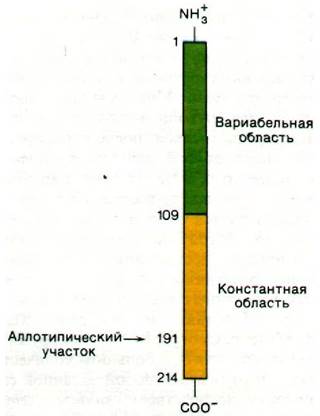
Fig. 33.12. The light chain of an immunoglobulin consists of Variable and constant regions
Last update: 06/08/2026
Editorial and Educational Adaptation: This material has been compiled based on the primary/original source text. The project team performed an editorial review, corrected technical inaccuracies, structured sections, and adapted the content for an educational format.
What was processed:
- elimination of formatting defects (OCR errors, structural breaks, corrupted characters);
- editorial organization of content;
- standardization of terminology in accordance with academic sources;
- verification of factual statements against the original source text.
All mentions of the author, publication year, and origin of the primary text have been preserved in accordance with the source.