BIOCHEMISTRY - L. Stryer - 1984
VOLUME 2
PART II GENERATION AND STORAGE OF METABOLIC ENERGY
CHAPTER 19. PHOTOSYNTHESIS
19.5. Photosynthetic Oxygen Derives from Water
Let us now turn to the chemical changes that occur during Photosynthesis. A crucial key to elucidating The Mechanism of photosynthesis is the source of the oxygen released by green plants. Comparative studies of photosynthesis in numerous organisms led to the discovery of this source as early as 1931. Certain photosynthetic Bacteria convert hydrogen sulfide into sulfur in the presence of light. Cornelis Van Niel discovered that the photosynthetic reactions in green plants and green sulfur bacteria are strikingly similar:
Class="center">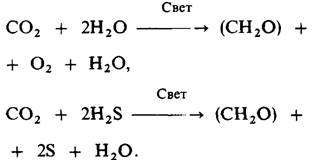
The sulfur produced by photosynthetic bacteria is analogous to the oxygen released by plants. Van Niel proposed a general formula for photosynthesis:

The hydrogen donor H2A is H2O in green plants and H2S in photosynthetic sulfur bacteria. Thus, photosynthesis in green plants can be formulated as the reduction of CO2 by hydrogen derived from Water. The evolution of oxygen is then a necessary consequence of this dehydrogenation process. The Essence of this view of photosynthesis can be expressed simply: water is split by light.
In 1941, the heavy isotope of oxygen, 18O, became available, making it possible to directly test this hypothesis. Indeed, when photosynthesis was carried out in water enriched with 18O, this isotope was detected in the evolved oxygen. This result confirmed the hypothesis that the O2 produced in photosynthesis originates from water.

Fig. 19.8. Schematic diagram of the energy levels for the excited states of antenna chlorophylls and the reaction center

19.6. The Hill Reaction: Illuminated Protoplasts Evolve Oxygen and Reduce an Artificial Electron Acceptor
In 1939, Robert Hill discovered that isolated METABOLISM/14.html">Chloroplasts, when irradiated in the presence of a suitable electron acceptor such as ferricyanide, evolve oxygen. Concurrently, ferricyanide is reduced to ferrocyanide. The Hill reaction represents a turning point in uncovering the mechanism of photosynthesis for the following reasons:

1. It revealed the essence of photosynthesis by demonstrating that oxygen evolution can proceed without the reduction of CO2. CO2 can be replaced by artificial electron acceptors such as ferricyanide.
2. It confirmed that the evolved oxygen originates from water rather than from CO2, since no CO2 was present in the system.
3. It showed that isolated chloroplasts can carry out a significant portion of the constituent reactions of photosynthesis.
4. It established that the primary event in photosynthesis is a light-driven Electron transfer from one substance to another against a chemical potential gradient. The light-induced reduction of ferric to ferrous ion represents The conversion of light into chemical energy.
19.7. Photosynthesis Requires the Cooperation of Two Types of Photosystems
Numerous experimental studies have established that chloroplasts contain two distinct Photosystems. The rate of photosynthesis was investigated as a function of light wavelength. The rate of photosynthesis divided by the number of quanta at each wavelength yields the relative quantum yield of the process. For a single photoreceptor, the quantum yield should be independent of wavelength outside its absorption band. This rule does not hold for photosynthesis: the quantum yield of photosynthesis drops sharply at wavelengths exceeding 680 nm, even though chlorophyll still absorbs light in the 680–700 nm range (Fig. 19.9). However, the rate of photosynthesis driven by long-wavelength light can be boosted by supplementing it with shorter-wavelength light, such as 600 nm. The rate of photosynthesis in the presence of light of two wavelengths—600 and 700 nm—exceeds the sum of the rates driven by each wavelength individually. Based on these observations, known as the "red drop" and the enhancement effect, Emerson proposed that photosynthesis requires the cooperation of two light reactions: both are driven by light of wavelengths shorter than 680 nm, but only one of them operates at longer wavelengths.
Fig. 19.9. The quantum yield of photosynthesis drops sharply when the wavelength of the exciting light exceeds 680 nm

19.8. The Role of Two Photosystems
Photosystem I, which can be excited by light with a wavelength of less than 700 nm, generates a strong reducing agent that leads to The formation of NADPH. In contrast, Photosystem II, which requires light with a wavelength of less than 680 nm, produces a strong oxidizing agent leading to the evolution of O2. In addition, photosystem I produces a weak oxidizing agent, whereas photosystem II yields a weak reducing agent. The interaction between these two systems results in The production of ATP. This component of the photosynthetic process, discovered by Daniel Arnon, is known as photosynthetic phosphorylation, or Photophosphorylation.
Fig. 19.10. Interaction of photosystems I and II in photosynthesis

Table 19.1. Composition of photosystems I and II

Photosystems I and II differ in their Structure. Treatment of thylakoid membranes with detergents preferentially releases particles containing photosystem I. Density gradient centrifugation makes it possible to separate particles exhibiting only photosystem I activity from those enriched in photosystem II activity. Most chlorophyll molecules are associated with specific Proteins. From photosystem I-containing particles, a complex has been isolated consisting of 14 chlorophyll a molecules bound to a 110 kDa protein. The second type of complex, formed by photosystem II particles, contains 3 chlorophyll a molecules and 3 chlorophyll b molecules associated with a 28 kDa protein. The best-characterized chlorophyll-protein complex isolated from green bacteria consists of three 50 kDa subunits, each containing seven bacteriochlorophyll molecules (Fig. 19.11). One of the Functions of the protein in these complexes is to maintain the optimal geometry for energy transfer between chlorophyll molecules.
Fig. 19.11. STRUCTURE OF THE bacteriochlorophyll-protein complex from a photosynthetic green bacterium

Last update: 06/08/2026
Editorial and Educational Adaptation: This material has been compiled based on the primary/original source text. The project team performed an editorial review, corrected technical inaccuracies, structured sections, and adapted the content for an educational format.
What was processed:
- elimination of formatting defects (OCR errors, structural breaks, corrupted characters);
- editorial organization of content;
- standardization of terminology in accordance with academic sources;
- verification of factual statements against the original source text.
All mentions of the author, publication year, and origin of the primary text have been preserved in accordance with the source.