BIOCHEMISTRY - L. Stryer - 1984
VOLUME 2
PART II GENERATION AND STORAGE OF METABOLIC ENERGY
CHAPTER 19. PHOTOSYNTHESIS
19.2. Chlorophylls Are Photoreceptor Molecules
Mayer stated: "Nature has set herself Structure/149.html">The problem of how to catch the light streaming earthward and how to store the most elusive of all powers in rigid form." What is the mechanism for capturing this most elusive energy? The first step is the absorption of light by a photoreceptor molecule. The principal photoreceptor in the METABOLISM/14.html">Chloroplasts of green plants is chlorophyll a, a substituted tetrapyrrole. Four nitrogen atoms of the pyrrole rings are coordinated with a magnesium atom. Thus, chlorophyll is a magnesium porphyrin, whereas heme is an iron porphyrin. The porphyrin ring structure of chlorophyll differs from that of heme in several respects: 1) one of the pyrrole rings is partially reduced; 2) a cyclopentanone ring is fused to one of the pyrrole rings; 3) both acidic side chains of chlorophyll are esterified, whereas they are free in heme. One of the acidic chains in chlorophyll is a methyl ester, and the second is an ester of phytol (C20C39OH). This polyhydric alcohol consists of four isoprene units, which confer high Hydrophobicity upon it. Chlorophyll b differs from chlorophyll a in The Nature of the substituent on one of the pyrrole rings: in chlorophyll b, this is a formyl group instead of the methyl group found in chlorophyll a.
These chlorophylls are highly efficient photoreceptors because they contain a network of alternating single and double bonds. In other words, they are polyenes. They strongly absorb in the visible region of the spectrum, which corresponds to the maximum solar radiation reaching the Earth. The peak extinction coefficients of chlorophylls a and b exceed 1015cm-1m-1 and rank among the highest values known for Organic compounds.
The absorption spectra of chlorophylls a and b are distinct (Fig. 19.4). Light that is not appreciably absorbed by chlorophyll a—for example, at 460 nm—is captured by chlorophyll b, which exhibits intense absorption precisely at this wavelength. Thus, the Two Types of chlorophyll Complement each other in absorbing sunlight. At the same time, There is a large spectral region, from 500 to 600 nm, where Light absorption is relatively weak. Most plants, however, do not need to capture light in this spectral region, as the light absorbed in the blue and red PARTS OF THE spectrum is sufficient for them.
Class="center">Fig. 19.4. Absorption spectra of chlorophylls a and b

19.3. The Primary Events of Photosynthesis Take Place in a Highly Organized Membrane System
Chloroplasts, the Organelles of Photosynthesis, typically reach 5 µm in length. Like Cell/35.html">Mitochondria, a chloroplast has outer and inner membranes separated by an intermembrane space (Fig. 19.5). The inner membrane encloses the stroma, which contains soluble Enzymes and membrane structures called thylakoids, which are flattened sacs. Stacks of such sacs form grana. The various grana are interconnected by membrane segments known as stroma lamellae. The thylakoid membranes separate the thylakoid lumen from the stromal space. Thus, chloroplasts contain Three types of membranes (outer, inner, and thylakoid) and three separate compartments (the intermembrane space, the stromal space, and the thylakoid lumen). In developing chloroplasts, thylakoids arise from invaginations of the inner membrane and are therefore analogous to mitochondrial cristae.
Fig. 19.5. Schematic diagram of a chloroplast

Thylakoid membranes contain chlorophyll molecules and Other components of the energy-transducing machinery. Lipids and Proteins are present in roughly equal amounts. The Lipid Composition is highly specific: galactolipids account for about 40% of total lipids, sulfolipids for 4%, whereas Phospholipids make up only 10%. Like The inner mitochondrial membrane, the thylakoid membrane is impermeable to most molecules and ions. The stroma contains soluble enzymes that use the NADPH and ATP synthesized by the thylakoids to convert CO2 into sugar. Chloroplasts possess their own DNA (Section 29.9) and the machinery for RNA and Protein Synthesis. Thus, the chloroplast is an organelle of considerable autonomy. The inner chloroplast membrane, which contains translocators for A number of compounds such as ATP and dicarboxylic acids, serves as the site of interaction between the chloroplast and the rest of The Cell. The outer chloroplast membrane, like that of the mitochondrion, is highly permeable to small molecules and ions.
19.4. The Photosynthetic Unit: Photons Flow into the Reaction Center
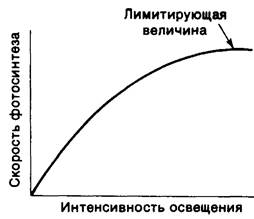
When The rate of photosynthesis is measured as a function of light intensity, it is found to increase linearly at low intensities and reach a saturation plateau at high intensities (Fig. 19.6). This saturation level occurs under high light conditions because the Chemical Reactions utilizing the absorbed photons become rate-limiting. Thus, photosynthesis can be divided into light and dark reactions. As will be discussed shortly, the light reactions generate NADPH and ATP, and these energy-rich molecules are used in the dark reactions to reduce CO2.
Fig. 19.6. The rate of photosynthesis reaches a limiting value when the light intensity is sufficient to excite only a small fraction of the chlorophyll molecules
In 1932, Robert Emerson and William Arnold measured the oxygen yield of photosynthesis when Chlorella Cells were exposed to brief flashes of light lasting several microseconds. They hypothesized that the photosynthetic yield per flash would increase with flash intensity until every chlorophyll molecule had absorbed a photon, which would then be utilized in the dark reactions. The experimental result was completely unexpected: a saturating light flash resulted in the evolution of only one O2 molecule for every 2500 chlorophyll molecules.
These investigations led to the postulate of the photosynthetic unit. Hans Gaffron suggested that light is absorbed by hundreds of chlorophyll molecules, which then transfer their excitation energy to the site where chemical reactions take place (Fig. 19.7). This site is called the reaction center. Thus, the function of the majority of chlorophyll molecules in the photosynthetic unit is to absorb light. Only a small fraction of chlorophylls—those localized in the reaction centers—participate in converting light into chemical energy. The chlorophylls in the reaction center are chemically identical to the other chlorophylls of the photosynthetic unit but possess unique properties conferred by their specialized environment. One difference is that the energy level of the excited state of reaction-center chlorophylls is lower than that of other chlorophylls, enabling them to trap the energy. Energy absorbed by chlorophyll molecules migrates through the photosynthetic unit until it reaches the reaction-center chlorophyll. Energy transfer to the reaction center is extremely rapid, taking less than 10-10 s.
Fig. 19.7. Scheme of the photosynthetic unit. Antenna chlorophyll molecules (designated by blue letters C) transfer their excitation energy to a specialized chlorophyll in the reaction center (designated by a red letter C)

Last update: 06/08/2026
Editorial and Educational Adaptation: This material has been compiled based on the primary/original source text. The project team performed an editorial review, corrected technical inaccuracies, structured sections, and adapted the content for an educational format.
What was processed:
- elimination of formatting defects (OCR errors, structural breaks, corrupted characters);
- editorial organization of content;
- standardization of terminology in accordance with academic sources;
- verification of factual statements against the original source text.
All mentions of the author, publication year, and origin of the primary text have been preserved in accordance with the source.