BIOCHEMISTRY - L. Stryer - 1984
VOLUME 2
PART II GENERATION AND STORAGE OF METABOLIC ENERGY
CHAPTER 12. GLYCOLYSIS
12.7. Formation of Pyruvate and Generation of the Second ATP Molecule
We now come to The final stage of Glycolysis. It occurs in three steps, resulting in The conversion of 3-phosphoglycerate to Pyruvate and The formation of a second molecule of ATP.
The first of these reactions is an intramolecular rearrangement. In the conversion of 3-phosphoglycerate to 2-phosphoglycerate, catalyzed by phosphoglyceromutase, a phosphoryl group is shifted. In general, a mutase is an enzyme that catalyzes the intramolecular shift of a chemical group, such as a phosphoryl group.
Class="center">
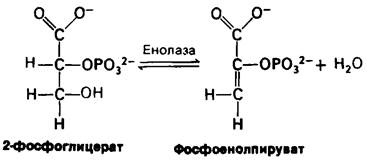
The second reaction is the formation of an enol by the dehydration of 2-phosphoglycerate. The formation of phosphoenolpyruvate is catalyzed by enolase. The phosphoryl group transfer potential is significantly elevated As a result of the dehydration reaction. An enol phosphate is characterized by a high phosphoryl group transfer potential, whereas for a phosphate ester of an ordinary alcohol, this potential is low. The reasons for this difference will be discussed later.
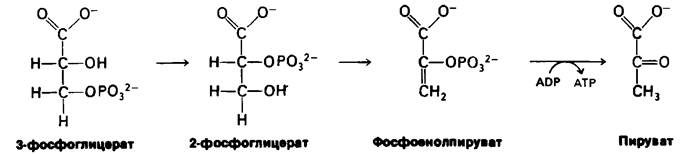
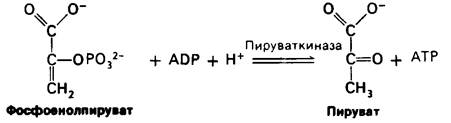
The final reaction is the formation of pyruvate with the simultaneous generation of ATP. The transfer of a phosphoryl group from phosphoenolpyruvate to ADP is catalyzed by pyruvate kinase. This phosphorylation is non-oxidative, in contrast to the reaction catalyzed by glyceraldehyde 3-phosphate dehydrogenase.
12.8. Energy Yield in the Conversion of Glucose to Pyruvate
The net reaction for the conversion of glucose to pyruvate is as follows:
Glucose + 2 Pi + 2ADP + 2NAD+ → 2 Pyruvate + 2ATP + 2NADH + 2H+ + 2H2O.
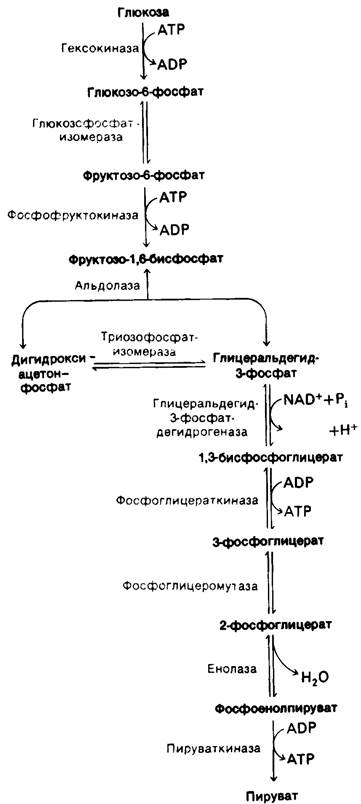
Thus, two molecules of ATP are generated during the conversion of glucose to pyruvate. A Summary of the steps in which ATP is consumed or generated is given in Table 12.1. Recall that two three-carbon fragments are formed from fructose 1,6-bisphosphate. The reactions of glycolysis are summarized in Table 12.2 and Figure 12.8.
Table 12.1. ATP consumption and generation in glycolysis
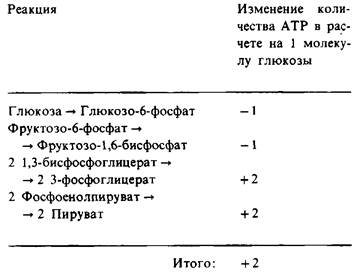
Table 12.2. Reactions of glycolysis
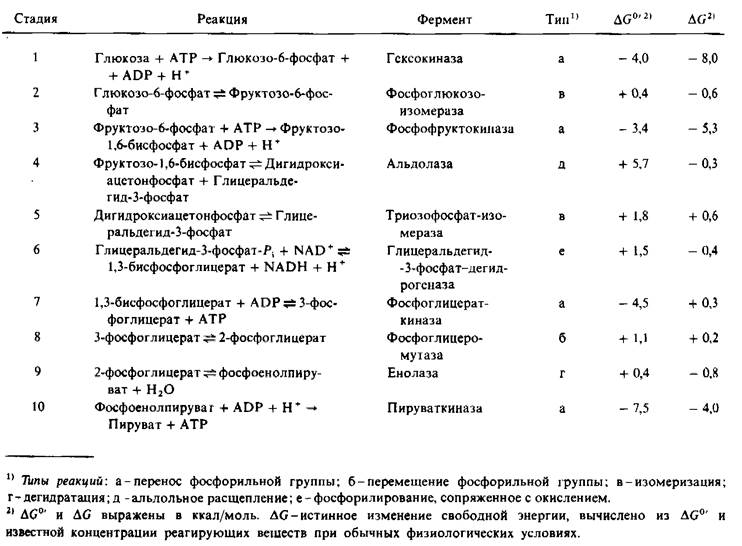
Figure 12.8. The Glycolytic Pathway
12.9. Phosphofructokinase Is a Key Enzyme in the Regulation of Glycolysis
The glycolytic pathway has a dual role: it generates ATP from the degradation of glucose, and it provides building blocks for synthetic reactions, such as the formation of long-chain Fatty acids. The rate of conversion of glucose to pyruvate is regulated to meet these two major cellular needs. In metabolic pathways, Enzymes catalyzing essentially irreversible reactions are potential sites of control. In glycolysis, the Reactions Catalyzed by hexokinase, Phosphofructokinase, and pyruvate kinase are virtually irreversible and, therefore, can play both regulatory and catalytic roles. Indeed, all three enzymes serve as control sites where the glycolytic pathway is regulated.
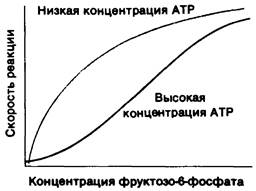
Phosphofructokinase is the most important regulatory component of glycolysis. This tetrameric enzyme is inhibited by high concentrations of ATP, which decrease its affinity for fructose 6-phosphate. When the reaction occurs in the presence of high ATP concentrations, The kinetics of the phosphofructokinase reaction is described by a sigmoidal curve rather than a hyperbolic one (Fig. 12.9). This allosteric effect is enhanced when ATP binds to a highly specific regulatory site, which is distinct from the catalytic site. The inhibitory effect of ATP is reversed by AMP. Consequently, the enzyme activity increases as the [ATP]/[AMP] ratio decreases. In other words, glycolysis is stimulated under conditions of low cellular energy charge. As previously mentioned, glycolysis also provides the carbon Skeleton for biosynthetic processes. Therefore, signals indicating an Abundance or scarcity of building blocks will also exert a regulatory effect on phosphofructokinase. Indeed, phosphofructokinase is inhibited by citrate, an early intermediate in The Citric Acid Cycle (Sec. 13.2). A high concentration of citrate indicates that biosynthetic precursors are abundant and that no additional glucose breakdown is required for this purpose. Citrate inhibits phosphofructokinase activity by enhancing the inhibitory effect of ATP. Thus, phosphofructokinase is most active when The Cell requires both energy and building blocks, as signaled by a low [ATP]/[AMP] ratio and a low citrate concentration. The enzyme exhibits moderate activity when There is a demand for either energy or the carbon skeleton. If both of these factors are in excess, phosphofructokinase activity drops nearly to zero.
Fig. 12.9. Allosteric Regulation of phosphofructokinase. A high concentration of ATP inhibits the enzyme by lowering its affinity for fructose 6-phosphate. AMP reduces, and citrate enhances, the inhibitory effect of ATP
Hexokinase and pyruvate kinase also participate in regulating the rate of glycolysis. Muscle and Liver pyruvate kinase is allosterically inhibited by ATP, and thus the conversion of phosphoenolpyruvate to pyruvate is blocked under conditions of high energy charge. Hexokinase is allosterically inhibited by glucose 6-phosphate. The concentration of fructose 6-phosphate rises when phosphofructokinase activity is inhibited; this leads to a corresponding increase in The amount of glucose 6-phosphate, which is in equilibrium with fructose 6-phosphate. Consequently, the inhibition of phosphofructokinase by a high [ATP]/[AMP] ratio or a high citrate concentration leads to the inhibition of hexokinase. In the liver, glucose is phosphorylated to glucose 6-phosphate even at high concentrations of the latter, due to the presence of glucokinase, an enzyme distinct from hexokinase. Glucokinase is characterized by a high KM value for glucose and is therefore active only when glucose is abundant. The Role of glucokinase is to provide glucose 6-phosphate for the synthesis of Glycogen, the storage form of glucose (Ch. 16). The high Km of liver glucokinase allows the Brain and Muscles to have priority in utilizing glucose when its supply is limited.
Why does phosphofructokinase, rather than hexokinase, play the leading role in glycolysis? This becomes clear when we recall that glucose 6-phosphate is not solely an intermediate of the glycolytic pathway. It can also be converted into glycogen or oxidized via the Pentose Phosphate Pathway (Ch. 15) to yield NADPH. The first irreversible reaction unique to the glycolytic pathway, known as the committed step, is the phosphorylation of fructose 6-phosphate to fructose 1,6-bisphosphate. This highlights The Significance of phosphofructokinase as the primary regulatory element of glycolysis. In general, The enzyme catalyzing the committed step in a metabolic pathway is almost always the most important regulatory element of that pathway.
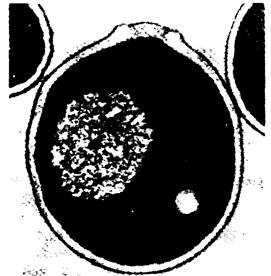
Fig. 12.10. Electron micrograph of a Yeast cell
Last update: 06/08/2026
Editorial and Educational Adaptation: This material has been compiled based on the primary/original source text. The project team performed an editorial review, corrected technical inaccuracies, structured sections, and adapted the content for an educational format.
What was processed:
- elimination of formatting defects (OCR errors, structural breaks, corrupted characters);
- editorial organization of content;
- standardization of terminology in accordance with academic sources;
- verification of factual statements against the original source text.
All mentions of the author, publication year, and origin of the primary text have been preserved in accordance with the source.