BIOCHEMISTRY - L. Stryer - 1984
VOLUME 1
PART I. CONFORMATION AND DYNAMICS
CHAPTER 10. AN INTRODUCTION TO BIOLOGICAL MEMBRANES
10.2. Phospholipids are the major class of membrane lipids
Lipids are a group of Biomolecules that are fundamentally different from Amino Acids and Proteins. By definition, lipids are insoluble in Water but highly soluble in organic Solvents, such as chloroform. Lipids serve various biological Functions; they are used as fuel for oxidation, as an efficient form of energy storage, and as membrane components. The first two functions will be discussed in detail in Chapter 18. Here, we focus on lipids in the context of membranes. Membranes contain three Major Types of lipids: Phospholipids, Glycolipids, and Cholesterol.
Class="center">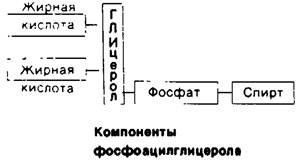
We begin with phospholipids, as they are the quantitatively predominant class of Membrane Lipids. Phospholipids are derived from either glycerol, a three-carbon alcohol, or sphingosine, a more complex alcohol. Phospholipids derived from glycerol are called phosphoacylglycerols. A phosphoacylglycerol consists of a glycerol backbone, two fatty acid chains, and a phosphorylated alcohol.
The fatty acid chains in Phospholipids and glycolipids usually contain an even number of carbon atoms—typically between 14 and 24, but most commonly 16 or 18. In animals, Fatty acids have unbranched hydrocarbon chains. Fatty acids can be saturated or unsaturated. Double bonds in Unsaturated fatty acids almost always have the cis configuration. As will be shown later, membrane fluidity depends heavily on the length and degree of unsaturation of the fatty acid chains. Figure 10.3 shows the structures of the ionized forms of two common fatty acids—palmitic acid (a C16 saturated fatty acid) and oleic acid (a C18 fatty acid with one double bond). We will refer to them hereafter as palmitate and oleate, emphasizing the fact that they are ionized under physiological conditions. Fatty Acid Nomenclature is presented in Chapter 18.
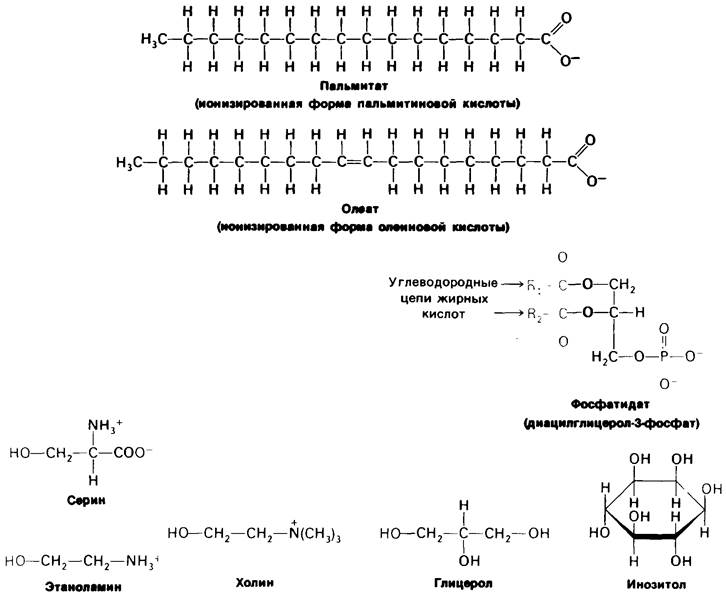
In phosphoacylglycerols, the hydroxyl groups at C-1 and C-2 of glycerol are esterified with the carboxyl groups of two fatty acids. The third hydroxyl group of glycerol is esterified with phosphoric acid. The resulting compound, called phosphatidate (or diacylglycerol 3-phosphate), is the simplest phosphoacylglycerol. Phosphatidate is present in only minor amounts in membranes. However, this compound is a key intermediate in The Biosynthesis of other phosphoacylglycerols.
All major phosphoacylglycerols are derivatives of phosphatidate. They are formed by esterifying the phosphate group of phosphatidate with the hydroxyl group of alcohols, such as Serine, ethanolamine, Choline, glycerol, and Inositol.
By combining some of these components, we obtain phosphatidylcholine, a phosphoacylglycerol present in virtually all membranes of higher organisms.
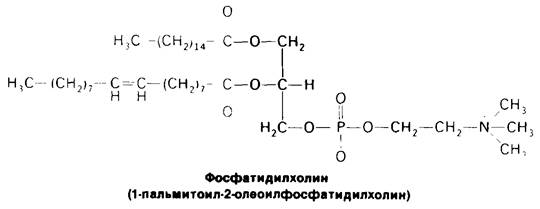
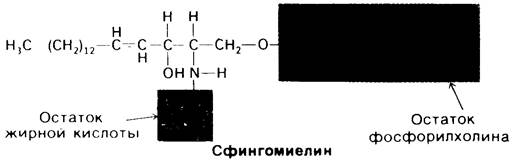
Figure 10.5 shows the structural formulas of other major phosphoacylglycerols, namely phosphatidylethanolamine, phosphatidylserine, phosphatidylcholine, phosphatidylinositol, and diphosphatidylglycerol.
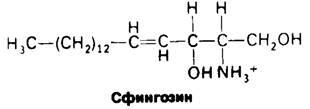
Fig. 10.5. Structures of some phosphoacylglycerols

Sphingomyelin is the only membrane phospholipid that is not derived from glycerol.
Its backbone is sphingosine, an amino alcohol with a long, unsaturated hydrocarbon chain. In sphingomyelin, the amino group of the sphingosine backbone is linked to a fatty acid by an amide bond. In addition, the primary hydroxyl group of sphingosine is esterified to phosphorylcholine. As we shall see, the conformation of sphingomyelin is similar to that of phosphatidylcholine.
10.3. Most membranes also contain glycolipids and cholesterol
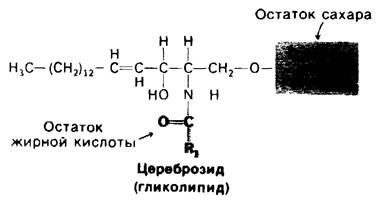
Glycolipids, as their name implies, are sugar-containing lipids. Like sphingomyelin, glycolipids in animal Cells are derived from sphingosine. The amino group of the sphingosine backbone is acylated by a fatty acid, just as in sphingomyelin. Glycolipids differ from sphingomyelin in The Nature of the unit linked to the primary hydroxyl group of the sphingosine backbone. In glycolipids, one or more sugar residues (rather than phosphorylcholine) are attached at this position. The simplest glycolipid is a cerebroside, which contains only a single sugar residue (either glucose or galactose). More complex glycolipids, such as gangliosides, contain a branched chain of several (up to seven) sugar residues.
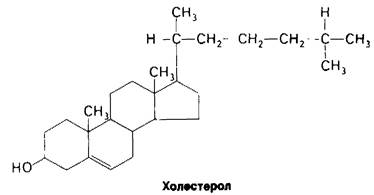
Cholesterol is another major lipid component of many membranes. It is present in eukaryotes but absent from most prokaryotes. Generally, eukaryotic Plasma Membranes are rich in cholesterol, whereas the membranes of intracellular Organelles contain relatively little of this neutral lipid.
Last update: 06/08/2026
Editorial and Educational Adaptation: This material has been compiled based on the primary/original source text. The project team performed an editorial review, corrected technical inaccuracies, structured sections, and adapted the content for an educational format.
What was processed:
- elimination of formatting defects (OCR errors, structural breaks, corrupted characters);
- editorial organization of content;
- standardization of terminology in accordance with academic sources;
- verification of factual statements against the original source text.
All mentions of the author, publication year, and origin of the primary text have been preserved in accordance with the source.