BIOCHEMISTRY - L. Stryer - 1984
VOLUME 1
PART I. CONFORMATION AND DYNAMICS
CHAPTER 10. AN INTRODUCTION TO BIOLOGICAL MEMBRANES
10.4. Phospholipids and Glycolipids Readily Form Bilayers
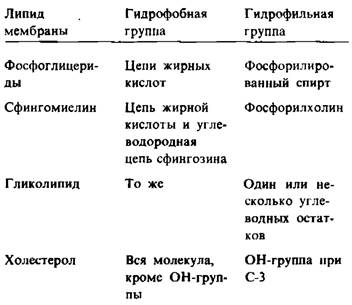
The properties of Membrane Lipids are so diverse that they can easily seem overwhelming. However, There is a unifying principle in their structural Organization: membrane lipids are amphipathic molecules. Their molecules contain both hydrophilic and hydrophobic moieties (Table 10.1).
Class="center">Table 10.1. Hydrophobic and hydrophilic groups in membrane lipids
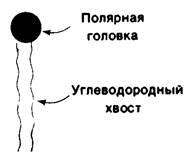
Consider a space-filling model of a phosphoacylglycerol, such as phosphatidylcholine (Fig. 10.6). In its overall shape, it resembles a rectangle. The two fatty acid chains are oriented nearly parallel to each other, while the phosphorylcholine moiety points in the opposite direction. A similar conformation is characteristic of sphingomyelin (Fig. 10.7). In Glycolipids, the sugar moiety is positioned much like the phosphorylcholine group in sphingomyelin. This has led to a common shorthand representation of membrane lipids: the hydrophilic part, also called the polar HEAD, is depicted as a circle, while the hydrocarbon tails are shown as straight or wavy lines (Fig. 10.8).
Fig. 10.6. Space-filling model of a phosphatidylcholine molecule
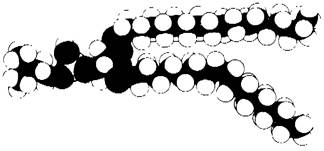
Fig. 10.7. Space-filling model of a sphingomyelin molecule
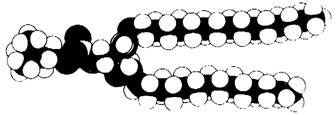
Fig. 10.8. Schematic representation of a phospholipid or glycolipid molecule
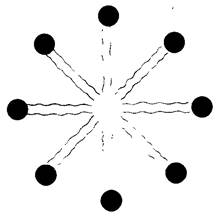
Let us now examine how Phospholipids and glycolipids behave in an aqueous environment. It is quite evident that their polar heads have an affinity for Water, whereas their hydrocarbon tails are hydrophobic. Consequently, in an aqueous medium, phospholipids and glycolipids can form micelles, in which the polar heads are On the surface and the hydrocarbon tails are sequestered inside (Fig. 10.9).
Fig. 10.9. Schematic diagram of a section of a micelle formed by phospholipid molecules
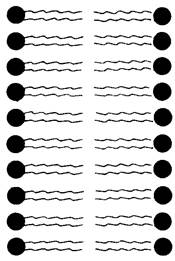
Another mode of organization that satisfies the hydrophilic and hydrophobic requirements of membrane lipids is The formation of a bimolecular sheet, or lipid bilayer (Fig. 10.10). It turns out that in an aqueous environment, most phospholipids and glycolipids form a bimolecular sheet rather than a micelle. This favored formation of bilayer structures is of immense biological significance. This is because micelles are typically small—less than 200 Å in diameter. Bimolecular sheets, by contrast, can reach macroscopic dimensions, up to a millimeter (107 Å). Phospholipids and glycolipids are key membrane components precisely because they readily form bimolecular sheets. Furthermore, despite their fluid state, these bilayers can serve as effective permeability barriers.
Fig. 10.10. Schematic diagram of a section of a bilayer membrane formed by phospholipid molecules
The formation of lipid bilayers is a self-assembly process. In other words, the capacity to form bilayers is inherent in The Structure of lipid molecules and is primarily driven by their amphipathic properties. The formation of lipid bilayers from glycolipids or phospholipids in water occurs rapidly and spontaneously. The primary driving force for bilayer self-assembly is hydrophobic interactions. Recall that hydrophobic interactions also play a major role in the folding of protein molecules in aqueous solution. As the hydrocarbon tails of membrane lipids sequester into the interior, nonpolar region of the bilayer, they lose their surrounding water molecules. This release of water leads to a large increase in Entropy. In addition, Van der Waals interactions occur between the hydrocarbon tails, promoting close packing of the lipid tails within the bilayer. Finally, bilayer formation is favored by electrostatic and hydrogen-bonding attractions between the polar heads and water molecules. Thus, all the forces that mediate molecular interactions in biological systems participate in stabilizing lipid bilayers.
10.5. Lipid Bilayers Are Noncovalent Cooperative Structures
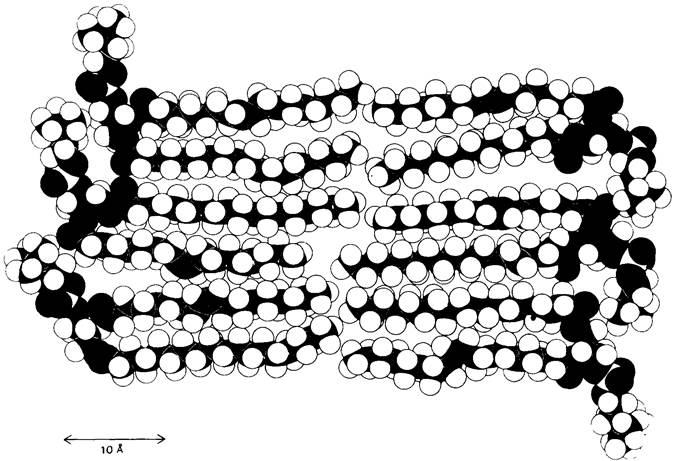
Another key property of Cell/29.html">The Lipid Bilayer is its cooperative structure. The integrity of the bilayer is maintained by many mutually reinforcing noncovalent interactions. In water, phospholipids and glycolipids form clusters in which the contact of hydrocarbon chains with water is minimized. This situation can be compared to sheep huddling closely together in cold weather to reduce heat loss. Cluster formation is also favored by van der Waals interactions between adjacent hydrocarbon chains. These energetic factors have three biologically important consequences: 1) lipid bilayers tend to be extensive; 2) lipid bilayers tend to close on themselves so that there are no exposed hydrocarbon edges in contact with water, resulting in a sealed compartment; 3) Lipid bilayers are self-sealing, because any hole in the bilayer is energetically unfavorable.
Fig. 10.11. Space-filling model of a section of a highly fluid phospholipid bilayer membrane
Last update: 06/08/2026
Editorial and Educational Adaptation: This material has been compiled based on the primary/original source text. The project team performed an editorial review, corrected technical inaccuracies, structured sections, and adapted the content for an educational format.
What was processed:
- elimination of formatting defects (OCR errors, structural breaks, corrupted characters);
- editorial organization of content;
- standardization of terminology in accordance with academic sources;
- verification of factual statements against the original source text.
All mentions of the author, publication year, and origin of the primary text have been preserved in accordance with the source.