BIOCHEMISTRY - L. Stryer - 1984
VOLUME 1
PART I. CONFORMATION AND DYNAMICS
CHAPTER 6. INTRODUCTION TO ENZYMOLOGY
QUESTIONS AND PROBLEMS
1. The Hydrolysis of pyrophosphate to orthophosphate plays a crucial role in driving biosynthetic reactions, such as DNA Synthesis. In E. coli, this hydrolysis is catalyzed by pyrophosphatase, which has a Molecular Weight of 120 kDa and consists of 6 identical subunits. The Vmax of the purified pyrophosphatase is 2,800 units per 1 mg of protein. One unit of enzyme activity is defined as The amount of enzyme that hydrolyzes 10 µmol of pyrophosphate in 15 min at 37°C under standard assay conditions.
a) How many moles of substrate are hydrolyzed per second by 1 mg of enzyme, provided that the Substrate Concentration is significantly higher than Km?
b) How many moles of active sites are contained in 1 mg of enzyme? Assume that each subunit contains one Active Site.
c) What is the turnover number of this enzyme? Compare it with the turnover numbers of Other Enzymes mentioned in this chapter.
2. Penicillin is hydrolyzed and thereby inactivated by penicillinase, an enzyme found in various resistant strains of Bacteria. The molecular weight of penicillinase from Staphylococcus aureus is 29.6 kDa. The amount of penicillin hydrolyzed in 12 ml of solution over 1 min in the presence of 10-9 g of purified penicillinase was measured as a function of penicillin concentration. Assume that the penicillin concentration remained practically unchanged during the assay.
Class="center">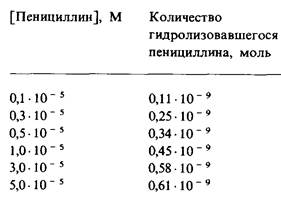
a) Plot these data as 1/V versus 1/[S]. Does penicillinase obey Michaelis-Menten kinetics? If so, what is the value of Km?
b) What is the value of Vmax?
c) What is the turnover number of penicillinase under these experimental conditions? Assume that each enzyme molecule has one active site.
3. The kinetics of an enzymatic reaction was measured as a function of substrate concentration in the presence and absence of an inhibitor (I), yielding the following data:
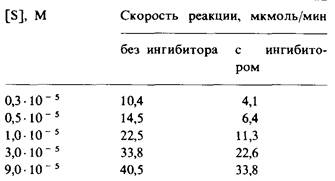
a) What are Vmax and Km in the absence of the inhibitor? In its presence?
b) What is the type of inhibition?
c) What is the inhibition binding constant?
d) If [S] = 1 • 10-5 M and [I] = 2 • 10-3 M, what fraction of the enzyme molecules have bound substrate? What fraction have bound inhibitor?
e) If [S] = 3 • 10-5 M, what fraction of the enzyme molecules have bound substrate in the presence of 2 • 10-3 M inhibitor versus in its absence? Compare The ratio of these values with the ratio of reaction rates under the same conditions.
4. The kinetics of the enzyme examined in Problem 3 was analyzed in the presence of another inhibitor added at a concentration of 10-4 M:
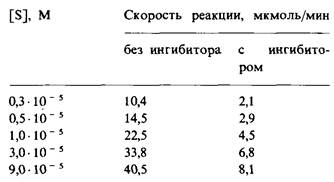
a) What are The values of Vmax and Km in the presence of the inhibitor? Compare them with the values obtained in Problem 3.
b) What is the type of inhibition?
c) What is the dissociation constant of this inhibitor?
d) At [S] = 3 • 10-5 M, what fraction of the enzyme molecules is bound to the substrate in the presence of 10-4 M inhibitor? In its absence?
5. The plot of 1/V versus 1/[S] is known as the Lineweaver–Burk plot. Kinetic data can also be represented in V versus V/[S] coordinates, i.e., the Eadie–Hofstee plot.
a) Transform the Michaelis–Menten Equation to express V as a function of V/[S].
b) What is the physical Significance of the slope and the intercepts of the curve with the x-axis and y-axis in the V versus V/[S] plot?
c) Sketch how the dependence of V on V/[S] should appear in the absence of an inhibitor, in the presence of a competitive inhibitor, and in the presence of a noncompetitive inhibitor.
6. In the case of allosteric enzymes, an inhibitor at low concentrations often exerts an activating effect. Why? (Hint: consider the analogy with CO-Hemoglobin.)
7. The hormone progesterone contains two ketone groups. Very little is known about The properties of the receptor protein that recognizes progesterone. Which amino acid side chains could form Hydrogen Bonds with progesterone at pH 7? (Assume that the side chains in the receptor protein have the same pK values as in free Amino Acids dissolved in Water.)
8. Suppose that substrates A and B compete for an enzyme. Derive an expression relating the ratio of the utilization rates of A and B (VA/VB) to the concentrations of these substrates and their k3 and Km values. (Hint: express VA as a function of k3/Km for substrate A and then do the same for substrate B.) Can it be assumed that Specificity is determined solely by Km?
Last update: 06/08/2026
Editorial and Educational Adaptation: This material has been compiled based on the primary/original source text. The project team performed an editorial review, corrected technical inaccuracies, structured sections, and adapted the content for an educational format.
What was processed:
- elimination of formatting defects (OCR errors, structural breaks, corrupted characters);
- editorial organization of content;
- standardization of terminology in accordance with academic sources;
- verification of factual statements against the original source text.
All mentions of the author, publication year, and origin of the primary text have been preserved in accordance with the source.