BIOCHEMISTRY - L. Stryer - 1984
VOLUME 1
PART I. CONFORMATION AND DYNAMICS
CHAPTER 6. INTRODUCTION TO ENZYMOLOGY
Summary
Biological catalysts are Enzymes; all enzymes are Proteins. Enzymes are highly specific and possess enormous catalytic power, typically increasing reaction rates by a factor of at least 107. Enzymes do not alter reaction equilibria; rather, they function as catalysts by lowering the activation energy of Chemical Reactions.
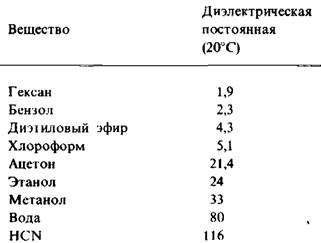
Class="center">Table 6.5 Dielectric constants of selected Solvents
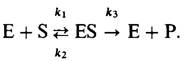
The kinetic parameters of certain enzymes are described by the Michaelis-Menten model. According to this model, an enzyme (E) combines with a substrate (S) to form an enzyme-substrate complex (ES), which either proceeds to form the reaction product (P) or dissociates into E and S:
The velocity (V) of product formation is described by the Michaelis-Menten Equation:
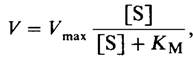
where Vmax is the reaction velocity at full enzyme saturation with substrate, and Km is the Michaelis constant, equal to the Substrate Concentration at which the reaction velocity is half-maximal. The maximum velocity Vmax is equal to the product of k3 and the total Enzyme Concentration. The kinetic constant k3, referred to as the turnover number, indicates the number of substrate molecules converted to product per unit time per catalytic site when the enzyme is fully saturated with substrate. For most enzymes, the turnover number ranges from 1 to 104 s-1.
Certain specific low-molecular-weight substances and ions are capable of inhibiting enzymes. In irreversible inhibition, the inhibitor binds covalently to the enzyme or binds so tightly that its dissociation is extremely slow. In contrast, reversible inhibition is characterized by the rapid establishment of equilibrium between the enzyme and the inhibitor. A competitive inhibitor prevents substrate binding at the Active Site, thereby decreasing the reaction velocity by reducing the proportion of enzyme molecules that have bound the substrate. In noncompetitive inhibition, the inhibitor decreases the turnover number of the enzyme. Unlike noncompetitive inhibition, competitive inhibition can be overcome by increasing the substrate concentration, which provides a means to distinguish between these Two Types of inhibition.
The catalytic activity of many enzymes is subject to regulation in vivo. Allosteric interactions—that is, interactions between spatially separated sites on the enzyme—play a particularly important role in this regard. All known allosteric enzymes consist of two or more subunits. Allosteric interactions are mediated by conformational changes transmitted from one subunit to another. The plot of reaction velocity V versus substrate concentration [S] for allosteric enzymes is sigmoidal rather than hyperbolic. Two models have been proposed to explain certain properties of these enzymes: the concerted model and the sequential model.
Reversible molecular interactions in biological systems arise from The formation of Hydrogen Bonds, as well as electrostatic and Structure/103.html">Van der Waals interactions. Water exerts a profound influence on these interactions due to its polarity, high cohesive force, and ability to act as both a Hydrogen bond donor and acceptor. The Presence of water weakens Electrostatic Interactions and hydrogen bonds between other molecules and ions. Conversely, the presence of water enhances the interaction of nonpolar molecules. For instance, when a substrate binds to an active site located within a cleft on the enzyme, water is excluded from this cleft. The absence of water strengthens the electrostatic interactions and hydrogen bonds between the enzyme and the substrate. The association of nonpolar groups of the substrate and the enzyme's active site provides a significant portion of the binding energy. The Specificity of the enzyme-substrate interaction is based, firstly, on hydrogen bonds, which possess a strongly directional character, and, secondly, on the shape of the enzyme's active site, which prevents the binding of non-complementary molecules. The recognition of a substrate by enzymes is frequently a dynamic process accompanied by conformational changes within the enzyme's active site.
Last update: 06/08/2026
Editorial and Educational Adaptation: This material has been compiled based on the primary/original source text. The project team performed an editorial review, corrected technical inaccuracies, structured sections, and adapted the content for an educational format.
What was processed:
- elimination of formatting defects (OCR errors, structural breaks, corrupted characters);
- editorial organization of content;
- standardization of terminology in accordance with academic sources;
- verification of factual statements against the original source text.
All mentions of the author, publication year, and origin of the primary text have been preserved in accordance with the source.