BIOCHEMISTRY - L. Stryer - 1984
VOLUME 1
PART I. CONFORMATION AND DYNAMICS
CHAPTER 7. ENZYME ACTION: LYSOZYME AND CARBOXYPEPTIDASE
In 1922, the London bacteriologist Alexander Fleming caught a cold. Never one to miss an opportunity, he quickly realized he could use his illness as a chance to conduct an experiment. Placing a few drops of nasal mucus on an Agar plate seeded with Bacteria, he was thrilled to observe a short time later that the bacteria surrounding the mucous discharge had dissolved. Fleming hypothesized that the mucus likely contained a universal antibiotic, which he had been actively searching for. He soon identified The Nature of this antibacterial substance: it was an enzyme that he named Lysozyme—lyso because it dissolved (lysed) bacteria, and zyme because it was an enzyme. Furthermore, Fleming discovered a new species of bacteria particularly sensitive to lysozyme; he named these small, round bacteria Micrococcus lysodeikticus (“deiktikos” meaning capable of showing). Fleming also found that lysozyme is abundant in tears. Tears were obtained from volunteers who were subjected to a “lemon test”—having a little lemon juice dropped into their eyes. Around that time, St. Mary’s Hospital Gazette published a cartoon depicting children who had come to Fleming’s laboratory for a few pennies, with one assistant beating them up and another collecting their tears! Fleming was disappointed, however, to discover that lysozyme was ineffective against the most dangerous microbes. Seven years later, he finally discovered the highly effective antibiotic penicillin, strikingly confirming Louis Pasteur’s remark that chance favors the prepared mind.
7.1. Lysozyme Cleaves Bacterial Cell Walls
Lysozyme dissolves the Cells of certain bacteria by cleaving the polysaccharide component of their Cell walls. The primary function of bacterial cell walls is to provide mechanical strength. A bacterium stripped of its Cell wall typically bursts due to the high internal osmotic pressure. We will examine the Structure of Bacterial Cell Walls in detail in a subsequent chapter; here, we will focus solely on The structure of their polysaccharide component.
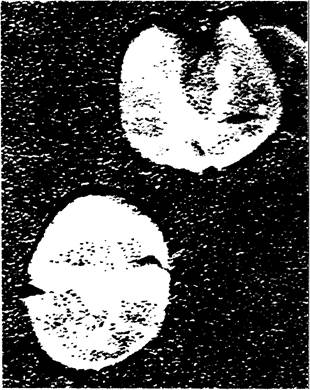
Class="center">Fig. 7.1. Electron micrograph of isolated cell walls of Micrococcus lysodeikticus
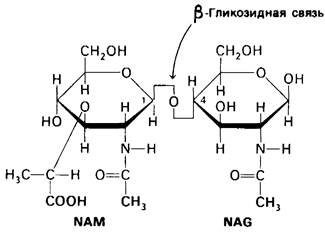
The Cell wall polysaccharide contains Two Types of sugars: N-acetylglucosamine (NAG) and N-acetylmuramic acid (NAM). Both sugars are derivatives of glucosamine with an acetylated amino group (Fig. 7.2). In NAM, the C-3 carbon of the carbohydrate ring forms an ether linkage with a lactate side chain. In the Introduction/37.html">Bacterial cell wall, NAM and NAG are linked by a glycosidic bond between C-1 of one sugar residue and C-4 of the other. The oxygen atom of the glycosidic bond is located either above or below the plane of the carbohydrate rings: in the α configuration, the oxygen atom lies below the sugar plane, whereas in the β configuration, it lies above this plane (for a more detailed Discussion of sugar properties and nomenclature, see Chapter 12). All glycosidic bonds in cell wall Polysaccharides have the β configuration (Fig. 7.3). NAM and NAG alternate along the chain. Thus, the bacterial cell wall polysaccharide is a polymer of alternating NAM and NAG residues joined by β(1 → 4) glycosidic bonds. Additionally, individual polysaccharide chains are cross-linked by short Peptides attached to the NAM residues.
Fig. 7.2. Sugar residues in the bacterial cell wall polysaccharide
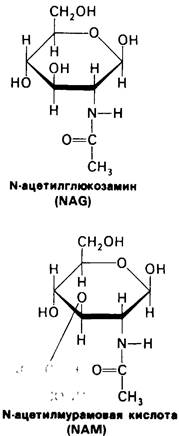
Fig. 7.3. NAM is linked to NAG by a β(1 → 4) glycosidic bond
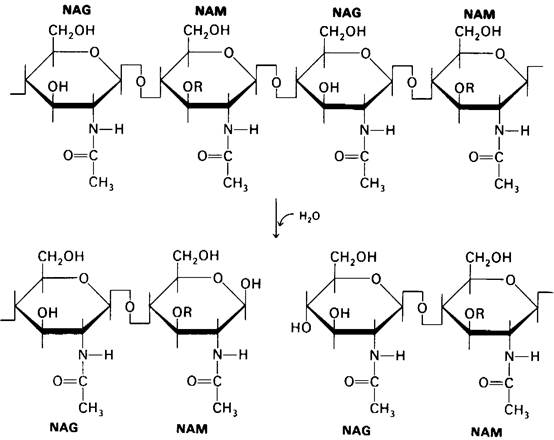
Lysozyme hydrolyzes the glycosidic bond between C-1 of NAM and C-4 of NAG (Fig. 7.4). The alternative glycosidic bond—between C-1 of NAG and C-4 of NAM—is not cleaved. Another substrate for lysozyme is Chitin, the polysaccharide found in the exoskeletons of crustaceans. Chitin consists exclusively of NAG residues linked together by β(1 → 4) glycosidic bonds.
Fig. 7.4. Lysozyme hydrolyzes the glycosidic bond between NAM and NAG (R is the lactyl group of NAM)
Last update: 06/08/2026
Editorial and Educational Adaptation: This material has been compiled based on the primary/original source text. The project team performed an editorial review, corrected technical inaccuracies, structured sections, and adapted the content for an educational format.
What was processed:
- elimination of formatting defects (OCR errors, structural breaks, corrupted characters);
- editorial organization of content;
- standardization of terminology in accordance with academic sources;
- verification of factual statements against the original source text.
All mentions of the author, publication year, and origin of the primary text have been preserved in accordance with the source.