Principles of Protein Structural Organization - G. Schultz 1982
Covalent Protein Structure
Chain Assemblies
Functional and Structural Domains
The general principle regarding the functional form of a protein—produced via Polypeptide chain synthesis on Ribosomes followed by spontaneous folding, introduced at the beginning of Section 1.1—requires considerable elaboration. This chapter discusses a series of important biological facts and phenomena that help to refine this concept.
The core idea that a single structural Gene* corresponds to a single polypeptide chain equivalent to a single functional unit [74] needs refinement. Today, it appears impractical to equate the polypeptide chain with the functional unit. Beginning in 1969 [75], a substantial body of evidence has emerged [76] indicating that the "domain," rather than the polypeptide chain, should be considered the fundamental unit, and that all other categories ought to be reduced to this baseline.
Functional domains and functionally autonomous Regions of the polypeptide chain. Domains were first identified through correlations between gene and polypeptide structures [77]. Domains are subregions of a polypeptide chain (encoded by subregions of a structural gene) that are autonomous in the sense that they possess all the characteristics of an entire globular protein. Many such subregions have been discovered as products of Limited proteolysis [76]. This implies that individual subregions can often be isolated from a polypeptide chain without losing their properties.
* In higher organisms, less than 10% of the total nucleotide sequence of a structural gene—the so-called structural zones [78, 79]—actually encodes the protein. Studies of genes encoding globin, Ovalbumin, as well as certain SV40 and polyoma virus Proteins, confirm the mosaic Nature of the eukaryotic structural gene. The DNA nucleotide sequences that are translated into Amino acid sequences are not uniform in Structure, but are interrupted by stretches of non-translated DNA. The primary RNA transcript contains internal regions that must subsequently be excised, and the mature mRNA represents a "spliced" product (see the concise review [78]).
The Significance of the domain concept is most evident in certain Enzymes involved in His and Trp Biosynthesis (Section 9.4). In this case, protein function requires A large number of domains. It turns out that this function can be independently performed by domains located either on a single polypeptide chain, on separate polypeptide chains held together by non-covalent forces, or on entirely different chains.
Class="center">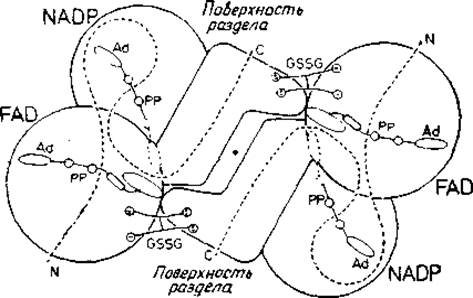
Fig. 4.1. Schematic diagram of the dimeric enzyme Glutathione reductase.
Each subunit consists of three domains: one binds FAD (flavin adenine dinucleotide), another binds NADP (nicotinamide adenine dinucleotide phosphate), and the third forms the interface. The overall course of the polypeptide chain is indicated by the dashed line. The FAD and NADP Cofactors bind in extended Conformations. The glutathione substrate (GSSG) is positioned between the subunits. Each Active Site is formed by four domains [124].
Structural domains as geometrically distinct entities. Because the subregions described above are identified by observable chain properties (such as Ligand-binding or enzymatic activity), they represent "functional domains" [76]. As structural protein analysis advanced, it became clear that functional domains consist of one or more "structural domains." Structural domains have been discovered through The Study of many three-dimensional protein structures, notably glutathione reductase (Fig. 4.1). These are geometrically distinct entities with a Molecular Weight of approximately 20,000. Almost all Globular proteins can be subdivided into such subregions. Apparently, most functional domains with a molecular weight exceeding 20,000 consist of more than one structural domain. The "active site" of such a functional domain is typically located at the interface of two structural domains.
Proteins can be constructed using modular systems. The vital role of structural domains as fundamental units is evident from the comparison of three-dimensional protein structures. The same structural domains, identifiable by their characteristic chain folding, occur in different proteins. Typical Examples of repeated structural domains include immunoglobulin domains (Fig. 4.2), the NAD-binding domain (Fig. 5.17, b), or the TIM barrel (Fig. 5.17, e) found in Triosephosphate isomerase and Pyruvate kinase [80].
The subdivision of globular proteins into structural domains of roughly uniform size, along with the presence of identical structural domains in different proteins, led to the hypothesis that most proteins are constructed as modular systems, with structural domains serving as modules (see also Section 9.4). According to this hypothesis, excessive emphasis should not be placed on the entire polypeptide chain; instead, attention should focus on functional and, wherever possible, structural domains. Consequently, the fundamental concept [74] should be reformulated as follows: "one polypeptide chain = one or more functional domains; one functional domain = one or more structural domains."
Last update: 06/08/2026
Editorial and Educational Adaptation: This material has been compiled based on the primary/original source text. The project team performed an editorial review, corrected technical inaccuracies, structured sections, and adapted the content for an educational format.
What was processed:
- elimination of formatting defects (OCR errors, structural breaks, corrupted characters);
- editorial organization of content;
- standardization of terminology in accordance with academic sources;
- verification of factual statements against the original source text.
All mentions of the author, publication year, and origin of the primary text have been preserved in accordance with the source.