Biochemistry - The Chemical Reactions of Living Cells, Volume 2 - D. Metzler 1980
Organization of Metabolism: Catabolic Pathways
Fermentation: "Life Without Oxygen"
Fermentation Based on the Embden-Meyerhof Pathway
a. Homolactic and Alcoholic Fermentation
We have already briefly discussed (Section D, 1, b) The conversion of glucose into lactate or, as occurs in Yeast Cells, into ethanol and CO2. The overall scheme for these two fermentation processes is presented in equation (9-19). Solid lines indicate the conversion of glucose to lactate, while dashed lines correspond to alcoholic fermentation with the conversion of Pyruvate to ethanol. Equation (9-19) illustrates A number of features common to all fermentation processes. The NADH formed in the oxidation step (left side of the equation) is reoxidized, reducing the substrate to the final product. NAD alternates between its oxidized and reduced forms. Such a coupling of Oxidation and reduction stages with strict adherence to equivalence is characteristic of all true (anaerobic) fermentations. Similarly, all fermentation processes involve The formation of ATP from ADP and Pi via substrate-level phosphorylation. The stoichiometry is usually very simple. For example, according to equation (9-10), 2 moles of ATP are formed per 1 mole of fermented glucose.
Class="center">
b. Energetic Relations
If we set aside ATP synthesis, the reactions depicted in scheme (9-19) yield equations (9-20) and (9-21). Note that the changes in Free energy are negative and sufficiently large in magnitude for the reactions to proceed virtually to completion. However, the fermentation process is coupled with the synthesis of two molecules of ATP from ADP and inorganic phosphate, and for this reaction [equation (9-22)], ∆G' is a large positive value:

To determine the total change in free energy, we must add 2 × 34.5 = +69.0 kJ to the ∆G' values for equations (9-20) and (9-21). When we do this, we find that the free energy change still remains substantially negative, so the reactions must go to completion and, consequently, fermentation can well be utilized by organisms to obtain energy.
Biochemists often calculate the energetic "efficiency" of a process by relating the ∆G of ATP Synthesis Coupled with the process under consideration (in this case, +69 kJ) to the decrease in free energy for the process uncoupled from ATP synthesis (196 or 235 kJ∙mol-1). Here, the efficiency characterizes the coupling of equation (9-22) (for 2 moles of ATP) with equations (9-20) and (9-21), yielding 35% and 29%, respectively. According to this calculation, nature uses only about one-third of the metabolic free energy for ATP synthesis. However, it must be clearly understood that such an "efficiency" calculation has no strictly defined thermodynamic meaning. Furthermore, The Cell subsequently consumes ATP (for various purposes) with far less than 100% efficiency.
How can we explain such a large decrease in free energy in the processes described by equations (9-20) and (9-21)? No overall oxidation takes place; only a redistribution of preexisting bonds between substrate atoms is observed. Why should this redistribution yield such a large negative value of ∆G? To find the answer, one should analyze the number of bonds of each type in the substrate and products. During the conversion of glucose into two molecules of lactate, one C—C bond, one C—O bond, and one O—H bond disappear, while one new C—H bond and one C = O bond are formed. If we sum up these bond energies (Table 3-6), we find that the ∆H difference in passing from substrate to products is only about 20 kJ∙mol-1. However, lactic acid contains a carboxyl group, and carboxyl groups acquire exceptionally high stability due to Resonance. The additional resonance energy of the carboxyl group (Table 3-6) is 117 kJ (28 kcal) per mole, or 234 kJ/mol for two carboxyl groups. This value is very close to the free energy change [equation (9-20)] obtained during the fermentation of glucose to lactate. Thus, the released energy is mainly determined by the bond redistribution leading to the Formation of the carboxyl group of lactate. The resonance stabilization of CO2, estimated by Pauling to be 151 kJ/mol, accounts for the magnitude of ∆G in alcoholic fermentation [equation (9-21)].
We can now formulate a general rule: fermentation can proceed when substrates consisting predominantly of atoms linked by single bonds, as well as groups such as carbonyl with relatively weak resonance stabilization, are converted into products containing carboxyl groups or into CO2. Assuming an efficiency of 30%, exactly enough energy is released per newly formed carboxyl group or CO2 molecule to synthesize one ATP molecule. It should be kept in mind, however, that a specific mechanism must exist for ATP formation. Interestingly, ATP Synthesis in most cases is directly linked to the same chemical processes that yield carboxyl groups or CO2 molecules during fermentation. The most important reaction is The oxidation of the aldehyde group of glyceraldehyde 3-phosphate to the carboxyl group of 3-phosphoglycerate (Fig. 8-13).
Let us compare the fermentation of glucose with its complete oxidation to carbon dioxide and Water [equation (9-23)], i.e., the process that yeast cells (as well as our own cells) carry out in the presence of oxygen:

The overall free energy change is more than 10 times higher than that of fermentation, allowing cells to generate a vastly greater amount of ATP. The ATP yield from reaction (9-23) is 38 moles of ATP—19 times greater than that from glucose fermentation. Thus, Pasteur's observation that yeast metabolizes much less sugar in air than in the absence of air receives a straightforward explanation. At the same time, it becomes clear why cells must metabolize huge amounts of substrate under anaerobic conditions (recall what was stated in Chapter 3, Section D, 1: producing 10 g of cells requires ~1 mol of ATP energy).
c. Variants of Alcoholic and Homolactic Fermentation
The course of fermentation often varies greatly depending on specific conditions. A number of additional Metabolic pathways are shown in Fig. 9-9. We have already considered the conversion of glucose to triose phosphate and further via pathway a to pyruvate, and then via pathway c to lactate or via pathway d to ethanol.
If bisulfite is added to a culture of fermenting yeast, the acetaldehyde produced in reaction d is removed from the subsequent process by forming a bisulfite adduct; this blocks the reduction of acetaldehyde to ethanol—a reaction necessary for fermentation according to equation (9-21). Yeast cells adapt to these conditions by utilizing the accumulating NADH to reduce half of the formed triose phosphate to glycerol via pathway b. This process requires two Enzymes: a dehydrogenase and a phosphatase that hydrolytically removes phosphate. The overall reaction is described by the equation

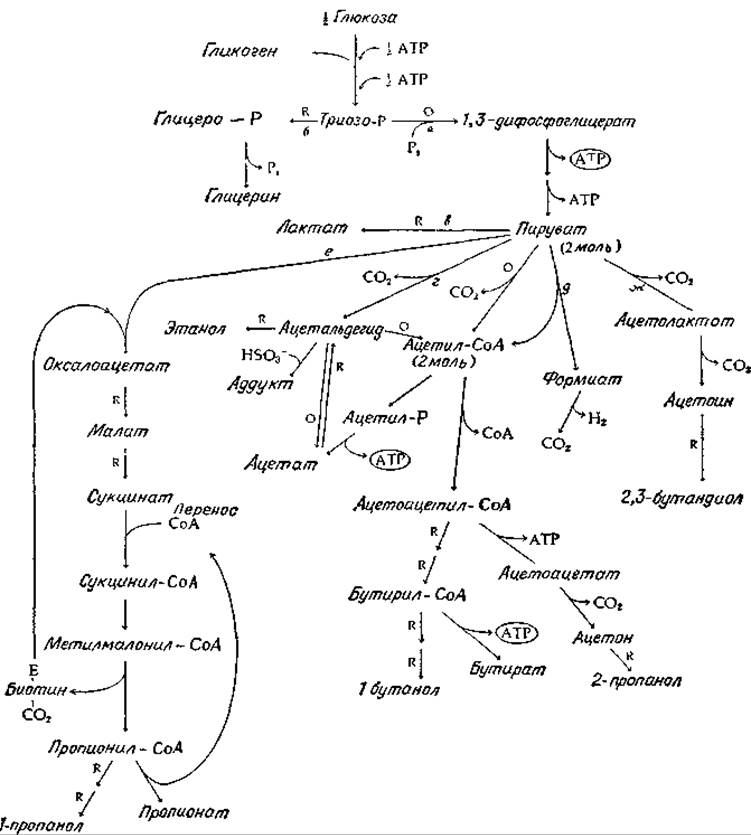
FIG. 9-9. Reaction sequences of Fermentation Based on the Embden-Meyerhof pathway. Oxidative stages (with NADH formation) are designated by "O", and reductive stages (utilizing NADH) by "R".
Note that one molecule of CO2 is formed in the process, and the overall decrease in free energy is quite sufficient to make the reaction highly spontaneous. However (referring again to Fig. 9-9), we can see that the total amount of synthesized ATP now becomes zero. Such fermentation obviously cannot support cell growth; nevertheless, it is used industrially to produce glycerol.
A similar variant of alcoholic fermentation is observed when yeast is grown in an alkaline medium. Under these conditions, acetaldehyde is oxidized by an NAD+-dependent dehydrogenase to acetate. The NADH formed at this stage is used to reduce an equivalent amount of acetaldehyde to ethanol. Simultaneously, the NADH generated by triose phosphate oxidation is used to reduce half of the formed triose phosphate molecules to glycerophosphate. The overall reaction is described by the equation

This reaction proves favorable for the cell because the resulting acetic acid neutralizes the alkali; the medium pH shifts toward neutral values, after which the standard alcoholic fermentation process resumes. The overall value of ∆G' is so significant that it could theoretically support the synthesis of two or three ATP molecules, although it remains unknown where and how this occurs. Obviously, the most logical coupling would be with the oxidation of acetaldehyde to acetate, which might proceed via the Formation of Acetyl-CoA and acetyl phosphate (Fig. 9-9)—a pathway utilized in many bacterial fermentations. However, yeast contains an enzyme that oxidizes acetaldehyde directly to acetate, and no coupled ATP synthesis has been detected in this process.
The reduction of dihydroxyacetone phosphate to glycerophosphate also occurs in the flight Muscles of insects; it apparently represents an alternative pathway to lactic acid formation in these Tissues. Although the conversion of free glucose to glycerophosphate and pyruvate yields no net gain in ATP, it should be noted that in muscles the starting material is Glycogen, which, compared to free glucose, requires half as much ATP for priming reactions. Furthermore, the dismutation of triose phosphate leading to the formation of glycerophosphate and pyruvate can ensure rapid ATP production during intense contractions of the powerful insect flight Muscle. During the slower recovery phase, glycerophosphate is presumably reoxidized upon entering the Mitochondria of these highly aerobic cells. Thus, The transport of glycerophosphate into mitochondria serves as a means of delivering reducing equivalents derived from NADH to the mitochondria. Therefore, The Significance of glycerophosphate in muscle METABOLISM is likely related primarily to its transport function rather than its participation in rapid ATP generation.
Last update: 06/08/2026
Editorial and Educational Adaptation: This material has been compiled based on the primary/original source text. The project team performed an editorial review, corrected technical inaccuracies, structured sections, and adapted the content for an educational format.
What was processed:
- elimination of formatting defects (OCR errors, structural breaks, corrupted characters);
- editorial organization of content;
- standardization of terminology in accordance with academic sources;
- verification of factual statements against the original source text.
All mentions of the author, publication year, and origin of the primary text have been preserved in accordance with the source.