Biochemistry: The Chemical Reactions of Living Cells, Volume 2 - D. Metzler 1980
Coenzymes: specific, naturally occurring specialized reagents
Flavin Coenzymes
Flavin adenine dinucleotide (FAD) and riboflavin-5'-phosphate (FMN, Fig. 8-14) are arguably the most versatile of all oxidative Coenzymes. The term flavin adenine dinucleotide is actually a misnomer because the D-ribityl group does not form a glycosidic bond with riboflavin; consequently, the molecule is not a dinucleotide. Nevertheless, this term has become firmly entrenched in biochemical nomenclature. Flavin mononucleotide (FMN) is an even less appropriate designation for riboflavin-5'-phosphate.
The Role of riboflavin in Biological Oxidation was established As a result of the intense interest biochemical researchers took in cellular Respiration. In the 1920s, Warburg discovered that oxygen reacts with some sort of iron-containing respiratory catalyst. It was later shown that the dye methylene blue could frequently replace oxygen as an oxidizing agent. The oxidation of glucose-6-phosphate by methylene blue in erythrocytes required the presence of both an "enzyme" and a "coenzyme," which was later identified as NADP+. It was found that a yellow protein isolated from Yeast possessed the remarkable property of being bleached by a reducing system containing glucose-6-phosphate, protein, and the erythrocyte "coenzyme."
Class="center">
FIG. 8-14. Flavin Coenzymes FAD and riboflavin-5'-phosphate. The dashed line indicates the region whose Structure changes upon reduction. Note that an older numbering system for the isoalloxazine ring was formerly used in the literature. Riboflavin is now designated as 7,8-dimethyl-10-(1'-D-ribityl)-isoalloxazine; the former name was 6,7-dimethyl-9-(1'-D-ribityl)-isoalloxazine. Position 5 was formerly numbered 10.
Warburg and Christian demonstrated that the yellow color of this so-called "old yellow enzyme" was due to a flavin-type pigment and suggested that its cyclic reduction and reoxidation played a crucial role in cellular oxidation. After NADP+ was isolated, this concept was expanded into the Respiratory Chain theory. According to this concept, two hydrogen carriers, NADP+ and flavin, function sequentially, linking glucose dehydrogenation to the iron-containing catalyst that interacts with oxygen. It has now been shown that the "old yellow enzyme" was a form of dihydrolipoyl dehydrogenase (Sec. K, 2) which does not actually accept electrons from NADPH; nevertheless, METABOLISM/2.html">THE CONCEPT OF the respiratory chain was correct.
Theorell in Stockholm showed that the "old yellow enzyme" contains riboflavin-5'-phosphate. By 1938, it was established that FAD is the coenzyme for another yellow protein, D-Amino Acid Oxidase from Kidney tissue. Like the pyridine NUCLEOTIDES, the new flavin coenzymes were reduced by dithionite to a virtually colorless dihydro form (Figs. 8-14 and 8-15). Thus, the chemical basis for their function as hydrogen carriers was self-evident.
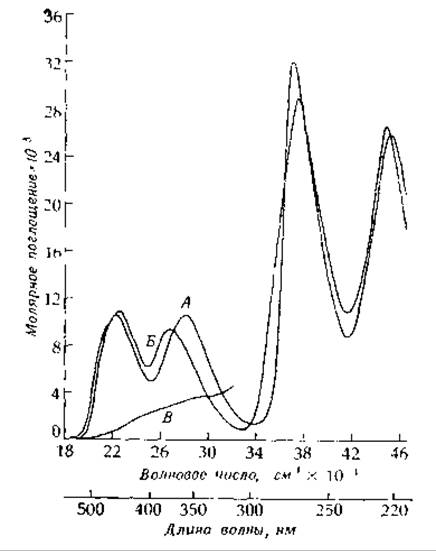
FIG. 8-15. Absorption spectra of riboflavin (A), riboflavin anion (B), and the dihydro form (C), obtained by photoreduction in the presence of EDTA. A 1.1×10⁻⁴ M riboflavin solution containing 0.01 M EDTA was illuminated with a 40 W incandescent lamp placed at a distance of 11.5 cm from the solution for 30 min.
Three facts account for the cellular requirement for both flavin and pyridine nucleotide coenzymes. First, flavins are generally stronger oxidizing agents than NAD+. This makes them well-suited to function in the Mitochondrial Electron Transport chain, which requires a sequence of progressively stronger oxidizing agents, and makes them ideal oxidants in various other dehydrogenation reactions. Second, flavins can be reduced in both one- and two-electron processes. This enables them to participate in free-radical oxidation reactions and reactions involving Metal Ions. Third, reduced flavins are subject to rapid, direct reoxidation by molecular O2 (i.e., they are autooxidizable)—a property shared by relatively few other Organic compounds. For example, NADH and NADPH are not spontaneously oxidized by oxygen. This "autooxidizability" allows the flavins of certain Enzymes to transfer electrons directly to O2 and also provides the basis for flavin function in hydroxylation reactions.
Box 8-E
Riboflavin

Chemists were initially attracted by the intense orange-yellow color and vivid greenish fluorescence of riboflavin. Blyth isolated the vitamin from whey in 1879, and later other researchers obtained this same fluorescing yellow compound from chicken eggs, Muscle, and urine. Eventually, the identity of all these compounds was established, and they were named flavins because of their yellow color.
The structure of riboflavin was elucidated in 1933 by Kuhn and his coworkers, who isolated 30 mg of the pure substance from 30 kg of dried egg white (10,000 eggs). The high fluorescence of riboflavin was utilized during the final purification steps. The vitamin was synthesized in 1935 by Karrer.
Riboflavin is a yellow solid that is sparingly soluble (~100 mg/L at 25°C). Three crystalline forms of riboflavin are known. One of them (the "easily soluble form") dissolves 10 times better than the other forms and can be used to prepare metastable solutions of higher concentration. One of the forms crystallizes as plates and occurs naturally in the tapetum (see Box 7-F) of the aye-aye (or nocturnal lemur).
Daily requirement: about 2 mg per day. Because of the widespread occurrence of riboflavin in foodstuffs, human deficiency is rare, manifesting primarily as lesions of the eyes and Skin. In industry, large quantities of riboflavin are produced using Fungi (such as Eremothecium ashbyi) which, apparently due to some metabolic disturbance, synthesize the vitamin in such Abundance that it crystallizes directly in the culture medium.
Riboflavin is thermostable, but extremely sensitive to light—a fact of great importance for proper dietary management. Do not leave milk exposed to bright sunlight (see Fig. 2-34)!
Last update: 06/08/2026
Editorial and Educational Adaptation: This material has been compiled based on the primary/original source text. The project team performed an editorial review, corrected technical inaccuracies, structured sections, and adapted the content for an educational format.
What was processed:
- elimination of formatting defects (OCR errors, structural breaks, corrupted characters);
- editorial organization of content;
- standardization of terminology in accordance with academic sources;
- verification of factual statements against the original source text.
All mentions of the author, publication year, and origin of the primary text have been preserved in accordance with the source.