Biochemistry: The Chemical Reactions of Living Cells, Volume 2 - D. Metzler 1980
Coenzymes — special naturally occurring specialized reagents
Flavin Coenzymes
Mechanism of Action of Flavin Dehydrogenases
At the beginning of Section J, it was pointed out that all hydrogenation and dehydrogenation reactions can be explained based on the concentrations of a hypothetical hydride ion H-, which acts as a nucleophile and is either cleaved from a reduced coenzyme or accepted by an oxidized coenzyme. A plausible hydride-transfer mechanism for flavoprotein dehydrogenases can be written in the following form:
Class="center">
The hydride ion adds to position 5, and a proton adds to position 1. In this way, The oxidation of alcohols, amines, ketones, and reduced pyridine NUCLEOTIDES can be represented.
Although only very few flavoprotein-catalyzed reactions have been successfully reproduced in model systems, the non-enzymatic oxidation of NADH by flavins proceeds at a moderate rate in aqueous solution at room Temperature. Studies conducted with various flavins and dihydropyridine derivatives, as well as the electronic effects observed in these reactions, are consistent with a hydride-transfer mechanism [114].
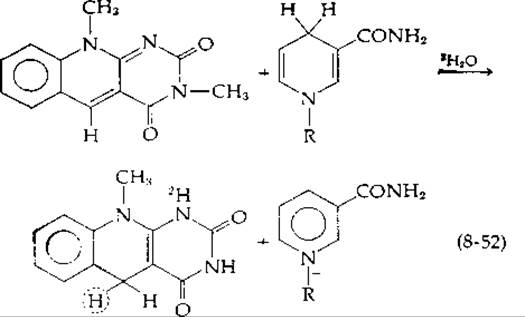
According to the mechanism described by equation (8-51), a hydride ion could be transferred directly from a carbon atom in the substrate molecule to the flavin, much like the reduction of NAD+ or NADP+ by dehydrogenases. However, if labeled hydrogen were transferred to position 5, it would immediately exchange with the medium, since hydrogens bound to nitrogen are characterized by rapid exchange. To circumvent this difficulty, Bruice and Bruice used 5-deazaflavin for the non-enzymatic oxidation of NADH [115] [equation (8-52)].
If the reaction is carried out in a 2Н2О medium, no 2Н incorporation occurs at C-5 of the product. This indicates that the hydrogen atom [circled in equation (8-52)] is transferred directly from NADH to position 5. A similar direct transfer to the C-5 position of 5-deazariboflavin-5'-phosphate has been observed for the flavoprotein N-methylglutamate synthetase [116]. (This enzyme catalyzes the two-step type-c reaction shown in Table 8-4, in which glutamate reacts with methylamine to form N-methylglutamate and ammonia.) A direct stereospecific transfer of 3Н from a-3Н-Alanine to deaza-FAD has also been described [116a]. Although these experiments confirm direct hydrogen transfer, they do not prove the involvement of a hydride-ion mechanism.
Based on studies of addition Reactions Involving the isoalloxazine ring of flavins, another possible mechanism for flavin reduction has been proposed. The sulfite ion adds to position 5, forming an N—S bond. Meanwhile, Hamilton [117] suggested that a more common attachment site for nucleophiles is carbon atom 4a, which, together with the N-5 atom, forms a cyclic Schiff base. According to Hamilton, other electrophilic centers in the molecule, such as the 2-, 4-, and 10a-carbon atoms, would be unreactive due to their participation in amide- and amidine-type resonances. An alcohol (or other substrate1)) can add to the flavin as follows [step a in equation (8-53)].

Cleavage of the newly formed C—O bond can then occur via electron displacement from the alcohol moiety of the adduct to the flavin [equation (8-53), step b]. The products are reduced flavin and an aldehyde. Hydride-ion transfer from the carbon atom of the alcohol leads to the same result, but in this case, hydrogen is detached from the carbon as a proton. In fact, both hydrogens of the original substrate (at the oxygen and the carbon) dissociate as protons, while the electrons are transferred as an electron pair during adduct cleavage. Hamilton argued that hydride transfer is a rare phenomenon in biochemical processes, one reason being that an isolated hydride ion has a large diameter compared to a proton, which is relatively small and highly mobile. Based on this, Hamilton believed that dehydrogenation is most commonly accomplished via proton-transfer mechanisms.
Experimental confirmation of a proton-transfer mechanism analogous to the one shown in equation (8-53) was obtained using D-chloroalanine as a substrate for D-Amino Acid Oxidase [118]. The product of this reaction should be chloropyruvate, but under anaerobic conditions, Pyruvate is formed [equation (8-54)].

Kinetic data obtained with [а-2Н]- and [а-3Н]-substrates strongly suggest the presence of a common intermediate in both reactions of equation (8-54). This intermediate could be the anion (8-I) formed by the abstraction of H+ from an adduct similar to the one shown in equation (8-53).
A chloride ion can be cleaved from this anion, as indicated by the dashed arrows in the scheme, which would lead to The formation of pyruvate without flavin reduction. At the same time, electrons could be transferred from the carbanion to the flavin, reducing it similarly to the reaction in (8-53). This process occurs only in the presence of O2, indicating that the situation here is considerably more complex. Oxygen must bind before flavin reduction can take place; however, where and how it binds remains to be established.

1) Hamilton suggested that adducts with acyl-CoA derivatives may form via the interaction of the substrate carbonyl oxygen with the 4a-carbon atom of the flavin. The reader may outline detailed mechanisms for dehydrogenation reactions involving The intermediate formation of such compounds, if desired.
The question arises: is the direct hydrogen transfer mentioned in the previous section consistent with mechanisms of the type shown in equation (8-53)?
A third possible mechanism for flavin-catalyzed dehydrogenation involves the sequential transfer of a hydrogen atom and an electron, with the intermediate formation of radicals of both the flavin and the oxidized substrate. This mechanism fully exploits the propensity of flavins to form stable radicals, a topic to which the next section is devoted. It has often been suggested that intermediate radicals derived from alcohols, amines, etc., are so unstable that their formation is thermodynamically impossible. Nevertheless, Bruice and Yano [119] and other researchers [119a] argue that mechanisms involving intermediate radical formation are indeed feasible.
Last update: 06/08/2026
Editorial and Educational Adaptation: This material has been compiled based on the primary/original source text. The project team performed an editorial review, corrected technical inaccuracies, structured sections, and adapted the content for an educational format.
What was processed:
- elimination of formatting defects (OCR errors, structural breaks, corrupted characters);
- editorial organization of content;
- standardization of terminology in accordance with academic sources;
- verification of factual statements against the original source text.
All mentions of the author, publication year, and origin of the primary text have been preserved in accordance with the source.