Biochemistry: The Chemical Reactions of Living Cells, Volume 2 - D. Metzler 1980
Enzymes: Protein Catalysts of Cells
Fundamentals of Enzyme Kinetics
Reactions Involving Two or More Substrates
Enzymes frequently catalyze reactions involving two, three, or even more substrates, leading to The formation of two, three, or more products. In some cases, all substrate molecules must bind simultaneously to the Active Site of the enzyme and be positioned in such a way that they can react in a specific sequence. In other cases, the enzyme transforms molecule A into a product, which then triggers the subsequent interaction.
The binding of two substrate molecules (A and B) to an enzyme molecule to form an EAB complex can occur in either a completely random or an ordered manner. Both situations are encountered when studying real enzymes. To describe the various possibilities of substrate binding and product release, the method proposed by Cleland is widely used. For example, the scheme
Class="center">
indicates that the binding of A and B to the enzyme proceeds in an ordered fashion, forming an EAB complex, which subsequently isomerizes into an EPQ complex. The latter can be viewed as the result of the binding of products P and Q to the enzyme. The rate constants located on the scheme to the left of each vertical arrow or above the horizontal ones correspond to the forward reaction, while the constants located to the right of the vertical arrows or below the horizontal ones correspond to the reverse reaction. The rate of the forward reaction for an enzymatic process with ordered substrate binding and ordered product release is given by the following expression:

The reciprocal expression is given by1)

Equations (6-35a) and (6-35b) contain the following kinetic parameters: Vf— the maximum velocity of the forward reaction, two Michaelis constants KMB and KMA, and the Equilibrium Constant EeqA, which represents the reversible dissociation constant of the EA complex and is equal to the ratio k2/k1. In the general case, the kinetic constants k1—k10 and the parameters of equation (6-35a) determined experimentally (Michaelis constants, maximum velocities, and equilibrium constants for binary complexes) are not explicitly related. However, individual kinetic constants can be extracted from experimentally measured parameters.
An equation identical to (6-35a) can also be written for the rate of the reverse reaction (vr) involving molecules P and Q. The equation for the instantaneous reaction rate in the case of an arbitrary mixture of all four components — A, B, P, and Q — i.e., the equation for (vt—vr), has a similar form.
The kinetic parameters included in equation (6-35b) are frequently determined from experimental data using double-reciprocal plots (Fig. 6-5). Note that equation (6-35b) is linear only if either the concentration of substrate A or the concentration of substrate B remains constant. To satisfy this condition, a series of experiments is conducted in which, for example, the concentration of substrate A is varied while keeping the concentration of B constant. Then, the concentration of substrate A is fixed and the concentration of substrate B is varied. Each series of such experiments yields a family of lines (Fig. 6-5, A) for which slopes and intercepts on the ordinate axis are determined. Next, the dependence of the slopes and intercepts on the reciprocal concentration of the substrate that was held constant in each series of experiments is plotted.
1) Another frequently used form of this equation was proposed by Dalziel [22]:

The total Enzyme Concentration is usually equal to vt/kt [see equation (6-6)]. It follows from equation (6-35b) that φ0—1/kt, and for scheme (6-34), kt can in some cases be equated to the constant kt.
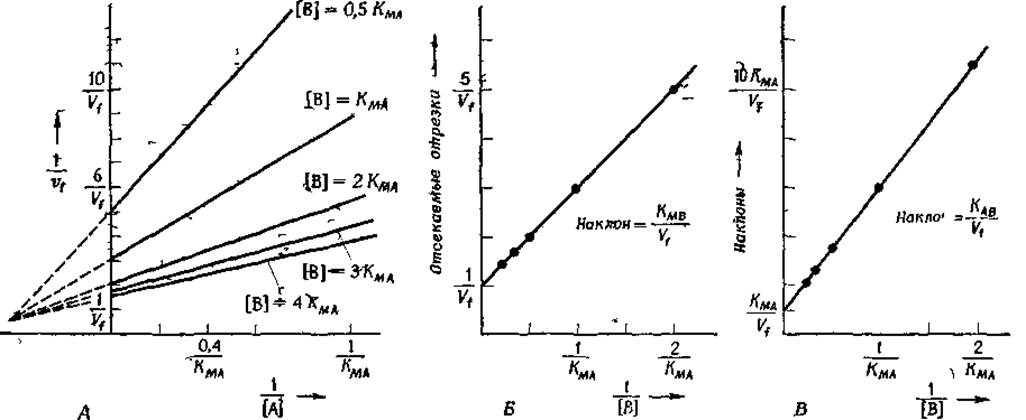
FIG. 6-5 Double-reciprocal plots used for the analysis of The kinetics of two-substrate enzymatic reactions. A A series of plots of 1/vt versus 1/[A] at various fixed concentrations of the second substrate (B). B Secondary plot of the intercept on the ordinate axis of the lines in coordinates {1/vt; 1/[A]} versus 1/[B]. C Secondary plot of the slope of the primary plots presented in Fig. A versus 1/[B]. All dependencies are calculated using equation (6-35a) with the following parameter values: KMA=10-3 M, KMB = 2KMA, KAB = KeqAKMB = KMA/200, [A] = [B] = 1 M. Eadie–Hofstee plots, i.e., plots of vt/[A] versus vt constructed at constant concentrations of substrate B, can also be used as primary plots. The reader can easily transform equation (6-35a) into a linear form of type (6-20).
From these secondary plots, The values of Vt and one of the Michaelis constants can be determined (Fig. 6-5, B and C). Two sets of secondary plots allow all constants of equation (6-35b) to be found (however, the product KeqAKMB is treated here as a single constant KAB). Kinetic parameters can also be determined using numerical Methods, which make it possible to process all data simultaneously and obtain optimal parameter values. The advantage of this approach is that it allows for a reliable estimation of standard deviations for the determined parameter values [1].
Some kinetic parameters have a clear physical meaning. The parameter Vf is the velocity achieved under conditions where both the concentration of substrate A and the concentration of substrate B are infinitely high. Each constant Km corresponds to the Michaelis constant for a simple system in which the concentration of the second substrate is high enough to saturate the enzyme.
For the bimolecular reaction discussed above, the following two Haldane relations hold1):

Of these two relations, usually only the first one is used.
1) The constants included in these relations are defined by the following expressions (see, for example, Segel I. H., Enzyme Kinetics, J. Wiley and Sons, New York, 1975, p. 564).
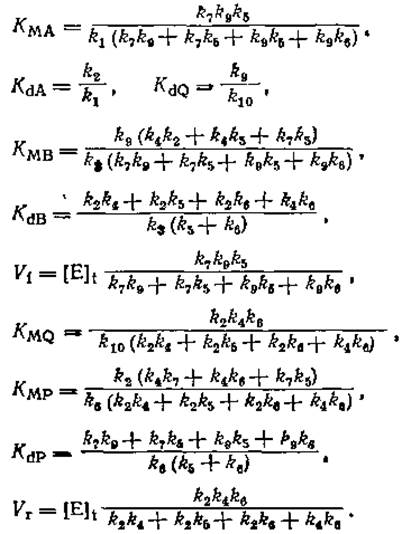
Note also that the constant KdA was previously designated by the author as KeqA — Trans. note.
a. Ping-pong mechanisms
A particularly common mechanism for Enzymatic reactions involving a coenzyme is the so-called ping-pong mechanism; its distinguishing feature is that the enzyme alternates between form E and form E':

The interaction of the enzyme with substrate A leads to the Formation of the E' form via the EA complex. E' is a modified form of the enzyme in which the coenzyme is often chemically modified (for example, in the Transamination reaction; ch. 8, sec. D, 1). Simultaneously, substrate A is converted into product P, which remains bound to the enzyme. The dissociation of product P releases the E' form, which can then interact with the second substrate, B, and complete the second half of the cycle, converting the E' form back into the E form.
The rate equations for the ping-pong mechanism resemble in form the rate equations for a bimolecular reaction with ordered substrate addition (6-35a) and (6-35b), except that each of them contains one term fewer1);
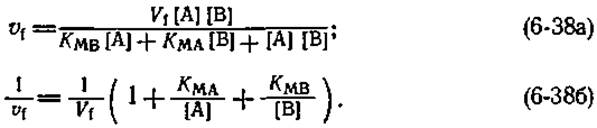
Accordingly, kinetic data in this case yield one kinetic parameter fewer than for reactions with ordered substrate addition. The kinetic scheme (6-37) for an enzymatic reaction proceeding via a ping-pong mechanism contains 12 kinetic constants. This corresponds to the minimum number of steps that must be considered to describe the kinetic properties of an enzyme functioning According to the ping-pong mechanism. Clearly, only a portion of these constants can be determined from steady-state kinetics data; other approaches must be used to evaluate all of them.
An interesting feature of the ping-pong mechanism is that the family of straight lines in double-reciprocal coordinates, obtained by varying the concentration of one substrate at fixed
Note that if the term KeqKMB in equation (6-35b) is negligibly small compared to the other terms, the kinetic Properties of the reaction resemble those of reactions obeying a ping-pong mechanism, even though it proceeds via a sequential mechanism through the formation of an intermediate ternary complex EAB.
concentrations of the second, has a different appearance than the family of lines in Fig. 6-5, A: it is represented by lines parallel to each other (as shown in Fig. 6-8 for noncompetitive inhibition).
b. Nonproductive complexes
A characteristic feature of an enzymatic reaction proceeding via a ping-pong mechanism is that in the steady state, part of the enzyme is in the E form and part is in the E' form. Ideally, the E form exhibits affinity only for A and Q, and the E' form only for B and P. However, in many real situations, P and B also exhibit some affinity for the E form (and A and Q for the E' form). This is easily understood since products and substrates often have a similar Structure. Thus, it is reasonable to assume that all four reactants will possess a certain affinity for both the E and E' forms. Sometimes the ability of enzymes whose kinetics follow a ping-pong mechanism to form nonproductive (so-called abortive) complexes has regulatory significance. Let us modify scheme (6-37) to show that product P typically undergoes a series of further transformations:
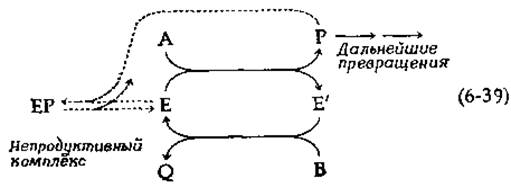
If product P accumulates in sufficiently large quantities, it can interact with the E form to yield a nonproductive EP complex. This phenomenon represents an effective form of product inhibition that is reversed only when the concentration of product P decreases As a result of further transformations. Specific Examples of this type of inhibition and its role in the Regulation of Metabolic processes have been described in the literature.
c. Derivation of the rate equation for complex mechanisms
For simple kinetic mechanisms such as those considered above, deriving the steady-state rate equation is relatively straightforward; the situation is quite different for more complex mechanisms. To solve steady-state and transient kinetics problems, topological graph theory, widely used in the analysis of electrical circuits [23-25], is applied. Let us consider a diagram of the form
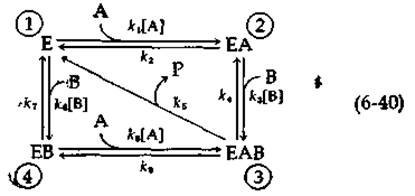
Here, a reaction is shown in which the binding of two substrates (A and B) by the enzyme occurs in a random fashion [scheme (6-34) corresponds, by contrast, to the case of ordered substrate binding]. The resulting EAB complex dissociates into free enzyme and a single product P. Each vertex of graph (6-40), numbered from 1 to 4, corresponds to a specific form of the enzyme, and each arrow is assigned a specific first-order rate constant or apparent first-order rate constant. Following established rules, the steady-state rate equation can be easily derived [1].
The advantages of using simplified schematic methods become especially apparent when considering a more complex mechanism in which the EAB complex dissociates with the random release of two products (P and Q). The denominator of the rate equation for this mechanism contains 672 terms, and it is clear that obtaining the rate equation without introducing A number of simplifying assumptions is extremely difficult. In such complex cases, it is advisable to resort to computers [26].
d. Rapid-equilibrium assumption
Rate equations are often simplified if one step in the mechanism [for example, the catalytic dissociation step of the EAB complex in scheme (6-40)] is the rate-limiting step of the enzymatic process. Assuming that all reaction steps preceding or following the rate-limiting step are at equilibrium, the rate equation for a mechanism with random addition of two substrates and random release of two products simplifies to an equation analogous to the rate equation for the ordered substrate binding mechanism [equation (6-35a)]. Such an assumption indeed often turns out to be valid, but in some cases (especially for enzymes with high catalytic activity) it still does not hold.
e. Reaction kinetics at high enzyme concentrations
In experiments studying the kinetic properties of purified enzymes under laboratory conditions, enzyme concentrations are typically 10-7–10-10 M, whereas in The Cell they are 10-6–10-5 M and, consequently, can be much higher than the concentrations of the corresponding substrates. Therefore, a certain caution must be exercised when interpreting data obtained under laboratory conditions. Methods for analyzing kinetic data when the enzyme concentration exceeds Ki have now been developed [28]; using conventional equations leads to unacceptably large errors.
Last update: 06/08/2026
Editorial and Educational Adaptation: This material has been compiled based on the primary/original source text. The project team performed an editorial review, corrected technical inaccuracies, structured sections, and adapted the content for an educational format.
What was processed:
- elimination of formatting defects (OCR errors, structural breaks, corrupted characters);
- editorial organization of content;
- standardization of terminology in accordance with academic sources;
- verification of factual statements against the original source text.
All mentions of the author, publication year, and origin of the primary text have been preserved in accordance with the source.